
The 151 northbound at ten past five is not a bus. It is a crowd with a motor in it, and the last person on does not get to choose anything about the ride.
She was already standing when I got on at Addison, three rows back from the door, both hands wrapped around the overhead rail with her chin down inside her scarf. I got a seat behind her and had it for two stops. Then Belmont filled the bus the way Belmont does, and the aisle went solid, and I stood up, because there is no reason to keep a seat when forty people are looking at it.
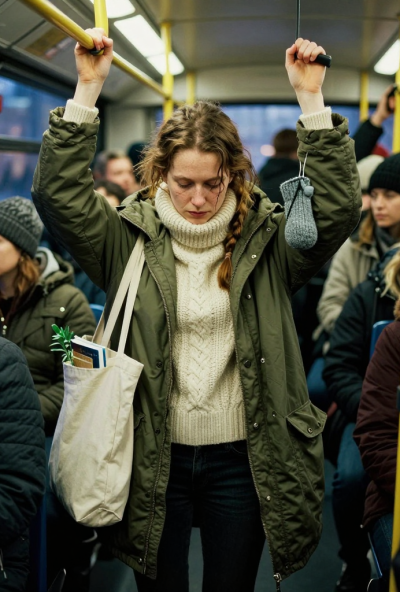
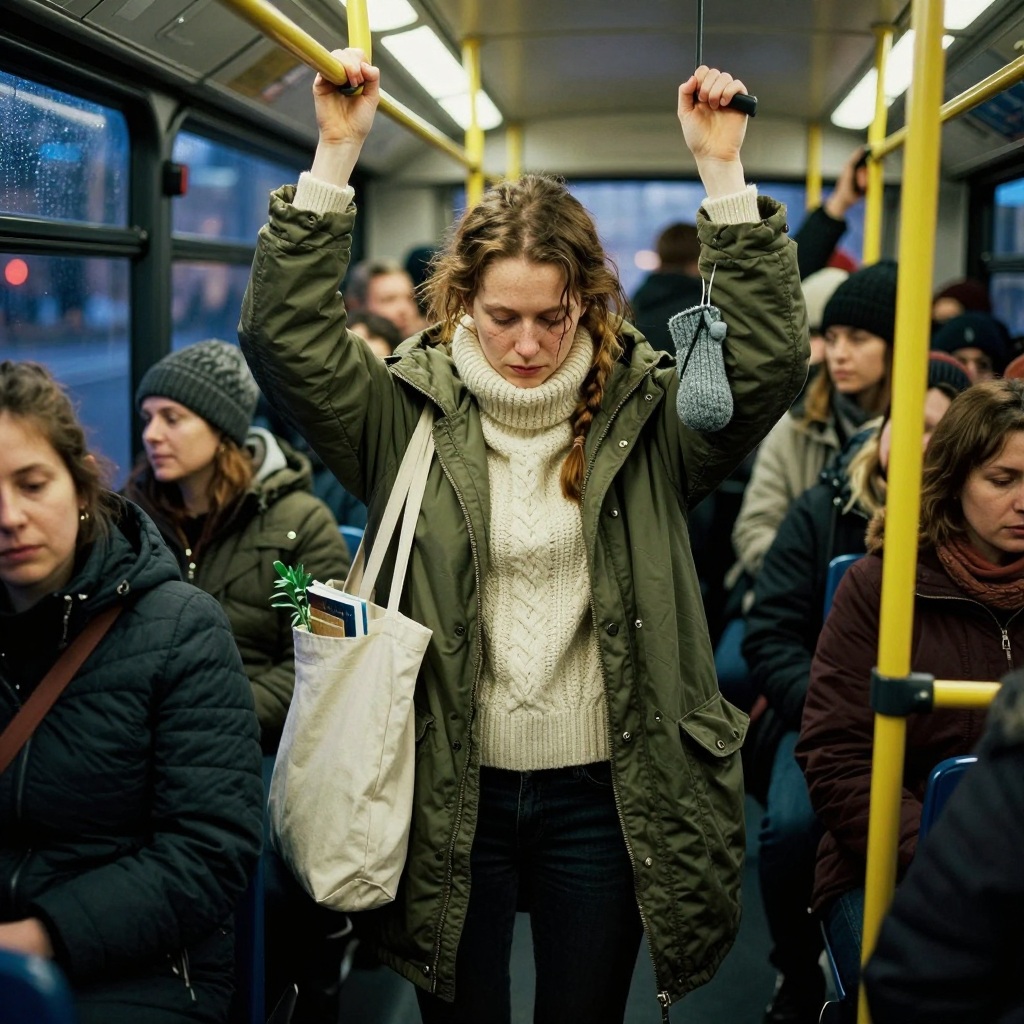
She was small. Not short the way a woman is short when she has made peace with it, but small, the way somebody is small when they have spent their whole life being moved out of the way. Five one in boots with a heel that had been glued back on at least twice. Narrow shoulders inside an olive parka that was two sizes too big for her, with a broken zip pull replaced by a paperclip. Under it, a cream cable knit sweater pulled up to her chin, the kind a grandmother makes and nobody else does. Jeans. Thin wrists coming out of the cuffs, gone red from the cold.
Light brown hair in a braid that had given up somewhere around the middle and was coming apart at her neck, small damp hairs stuck to her cheek. Pale. Freckles across the bridge of her nose. Chapped lips that she kept pressing together and then licking, and a scab on one knuckle from something she had burned or hit. No makeup, no earrings, no glasses. She smelled of cheap vanilla body spray and wet wool and the wet paper towel wrapped around a plant cutting in her tote bag.
Twenty-three, twenty-four. A student, from the tote and the library books and the laptop charger hanging out of the side pocket like a tail. She had mittens on a string through her coat sleeves, grey knitted mittens, and she had not taken them off in a heated bus, and she said sorry to everybody who bumped into her, which by Fullerton was everybody, and she said it to the floor.
At Fullerton it got worse. A man with a folded stroller, four nurses off shift, two boys sharing a speaker, and the driver kept opening the doors anyway. I ended up behind her because there was nowhere else to end up. My chest against her back, my bag between my feet, my hand on the rail over hers. I said sorry. She said sorry. We were both sorry and neither of us could move an inch.
Three stops went by and nothing happened except the bus. That is the thing people do not understand about a crowd like that. Everybody is touching everybody and nobody is touching anybody, and the whole trick of it is to hold your body in a shape that says nothing at all. I held mine. She held hers. The heater was up too high, the windows were running with water, and the man behind me had his elbow in my back the entire time.
Then the bus braked at Diversey and her whole weight came back into me, and she stayed there when it straightened out, and something in my body made a decision that my head had not been consulted about.
It happened slowly. That is the part I remember. It was not a switch. It was heat coming up through me by degrees, the way a radiator comes on in an old building, and there was nothing I could do about it except stand there while it happened and hope the man with the stroller was not looking.
I felt her feel it. Her spine went straight first, all at once, like somebody had run a finger up it. Then her ears went red, the whole shell of them, and she stopped breathing for a second, and her hands on the rail tightened until her knuckles showed through the mittens. She had two inches of floor in front of her. There were two inches. She did not take them.
Neither of us said anything. The bus went up Clark. The doors opened and shut and the crowd rearranged itself and pushed her back against me again, and this time she did not go stiff, she just let it happen, and I could feel her heart going through the back of her coat.
At the next stop everybody surged forward and she came back into me hard, and made a small sound that was not a word, and then she did it again. Deliberately. One slow shift of her hips, the kind of movement a person can tell themselves was the bus.
I put my hand on her hip. Over the coat. That was all. She went still, and then she put her mitten over my hand and pressed it down hard, and left it there, and we went past Wellington and Barry like that, two strangers standing in a crowd holding onto each other for no reason anybody could have named.
“Someone is going to notice,” she said. It was the first thing she had said to me that was not sorry, and she said it into her scarf, at the window, not at me.
“Nobody is going to notice.”
“I am noticing,” she said, and then her ears went redder, because she had heard herself say it.
Her coat was open at the front and I got my hand inside it, flat on her stomach over the sweater, and she put her head back against my shoulder for a second and then snapped it forward again, like she had caught herself leaning on something that was not hers.
I moved my hand down. Over the sweater, over the denim, and then I pressed the heel of it between her legs, and she came up onto her toes. She grabbed my wrist through the coat with both mittened hands and held it there. Not pushing it away. Her breath came out of her in one long shaking line and did not go back in.
“Yes,” she said. Very quiet. “Yes. Please.”
So I did it properly. Slow at first, in time with the rocking of the bus, because a bus is the best alibi in the world if you use it right. She had her forehead against the window by then with her eyes shut and her mouth open against the glass, and the fog from her breath came and went in a circle, and the whole time her hips were moving in tiny circles that she was not admitting to.
Her jeans were thick and it did not matter. She started to shake somewhere around Armitage, a fine tremor all through her, and she took one hand off the rail and put it over her own mouth, and then bit down on the mitten instead, and the wool went dark.
She came at the light at Roscoe, standing up, in a parka, with a stranger’s hand between her legs and seventy people around her. She made no sound. Her whole body folded forward over my hand and her forehead went against the glass and stayed there, and she went through it in waves, one, and then a worse one, and then a third that took her feet out from under her, and I had to get my arm around her ribs to keep her standing.
Nobody looked. The nurses were talking about somebody’s wedding. The boys with the speaker were arguing about a video game. The man with the stroller was asleep on his feet with his chin on his chest.
She wiped the window with her mitten, which was a lost cause, and then she turned her head just enough to look at me for the first time all night, and her eyes were wet and enormous and completely furious.
“I have to get off,” she said. “This is my stop. I have to get off.”
She got off. I got off behind her without deciding to. It was cold enough on Sheridan that the lake wind went through a coat like it was not there, and she stood on the corner with her back to me and her tote against her chest, and she did not walk away. She stood there for a good ten seconds, in the cold, breathing, and then she turned around.
“You do not have to come up,” she said. “I am on the fourteenth floor.”
The elevator had a mirror in it. She looked at me in the mirror the whole way up and did not say a single word, and her hand, when she took mine, was cold and small and hard, like a bird’s foot.
Her flat was one room with a bed in the corner and a radiator that knocked and forty plants, most of them on the windowsill and a few of them dying. A cat got up off the bed, looked at me, and left the room. She put her tote down and took the plant cutting out of it and put it in a glass of water on the counter, and then she stood there with her coat still on.
“That one is a pothos and it hates me,” she said, pointing. “That one is a fern. That one is moss. I am doing my thesis on moss. The moss that grows on buildings downtown. There is more of it than people think.” She stopped. “I am talking about moss because I am nervous. I do this. I talk about moss.”
“I know.”
“You do not know. Nobody knows that about me.” She looked at the floor. “I have never — on a bus. I have never done anything on a bus. I want you to know that I am not — I do not do that.”
“All right.”
“I did it tonight,” she said, to the floor, and then she laughed, one short disbelieving breath, and put her hands over her face.
I got her coat off and dropped it on the chair, and then the sweater, and her arms came up across her chest at once, hard, the way they do on a woman who has been laughed at in a bedroom before. She was thin and pale and her ribs showed, and her tits were small and high with dark nipples already hard from the cold, and there was a mole under her left arm and a bruise on her shin the colour of a storm.
“I look like a boy,” she said.
“You do not look like a boy.”
“I do. I know what I look like.”
I put her arms down at her sides and she allowed it, chin up, eyes fixed on my collarbone, and stood still while I looked at her, and her whole body was shaking, and it was not the cold.
She knelt on the rug by the radiator before I had asked her to, and she was awkward about it, all elbows, and she got my belt open and then stopped with her hands flat on my thighs and said, “Can I ask you something and you do not laugh.”
“Ask.”
“Am I doing it wrong? Because I have done this four times and I think I have been doing it wrong.”
“You are not doing anything yet.”
“That is a fair point,” she said, and then she took me in her mouth and did it carefully, seriously, like a woman studying, and she was not bad at it, and she kept stopping to breathe and look up at me to check, and I told her she was doing fine and kept my hand still against her neck, and she made a small satisfied noise around my cock that I felt everywhere.
I pulled her up onto the bed and got the jeans and the boots off her, and she grabbed the sheet in both fists and said, “Wait. Wait, the light.”
“No.”
“No?”
“I want to see you.”
“That is a terrible thing to say to somebody shy,” she said, and then she stopped arguing.
She was tight and wet and nervous, and I went slowly, and she was so quiet that I stopped to ask her if she was all right, and she said, “Do not stop, I am quiet, I am always quiet, it is not — ” and then I moved and she lost the end of the sentence. After that she was not quiet at all. She put her face in the pillow and then turned it to the side and said, into the mattress, “Oh, that is — oh,” and then, “You are going to make me make noise.”
“Yes.”
“The neighbours,” she said, and then she stopped caring about the neighbours.
I got my hand between us and she came with her hand over her mouth and her heels drumming on the mattress, and the cat came back into the room and sat down and watched us with the flat disapproval of an animal who has seen worse.
Afterwards she lay there with her arm over her eyes and her chest going, and said, “I want to do the end part. I want to finish it.”
“You do not have to.”
“I want to,” she said, and got up on her elbow. “I have never done the end part. I want to know what it is like.”
She was better the second time. She had worked something out, the way she probably worked everything out, and she took her time about it, and when I told her I was close she did not pull off and she did not look away. She stayed exactly where she was and took it, and swallowed, and then sat back on her heels with her hand over her mouth and her eyes streaming and a look on her face like she had just solved something.
“Well,” she said, when she could talk. “Well. That is a lot of pressure, isn’t it.”
“Are you all right?”
“I am excellent,” she said. “I am going to be thinking about that at the wrong times for the rest of my life.”
She made tea in a chipped pot and we drank it sitting on the floor with our backs against the bed, and she told me about the moss. That it grows on the north sides of buildings where the water sits. That some of the patches downtown are older than the buildings they are on, because the buildings were put up around them. That nobody notices, and she has been looking at it for two years, and I had never once looked up.
At the door she said, “Same time Thursday,” and then, immediately, in a rush, “or not, whatever, it does not matter, the 151 runs every eight minutes, so.”
“Thursday,” I said.
“Thursday,” she said, and shut the door, and then opened it again to add, “Wear a coat. It is going to be cold.”
I take the 151 now. She is usually by the middle door with both hands on the rail, and when she sees me her ears go red before the rest of her face has decided anything, and she looks at the floor, and she says sorry to somebody who did not touch her.
The moss on the buildings downtown, she says, is older than the buildings. I have started looking up when I walk.
My Bus Adventures #5: Late Pass
My Bus Adventures #4: Straight Lines
My Bus Adventures #3: The Signal
My Bus Adventures #2: Window Seat
My Bus Adventures #1: The 9:40
Related posts:
 My Bus Adventures #1: The 9:40
 My Bus Adventures #4: Straight Lines
 My Bus Adventures #2: Window Seat
 My Bus Adventures #3: The Signal
 My Bus Adventures #7: Beginner’s Luck
 My Bus Adventures #5: Late Pass
 Solstice Ch. 01-1
A Mother’s Worry – part 07
Colleen – chapter 02 – part-06
A Mother’s Worry – part 22
Colleen – chapter 01 – part-03
Colleen – chapter 03 – part-08
