
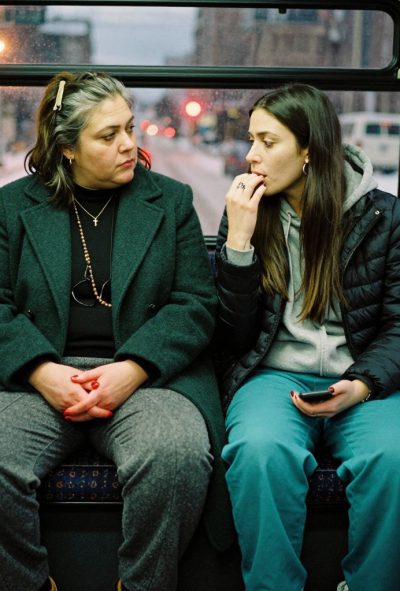
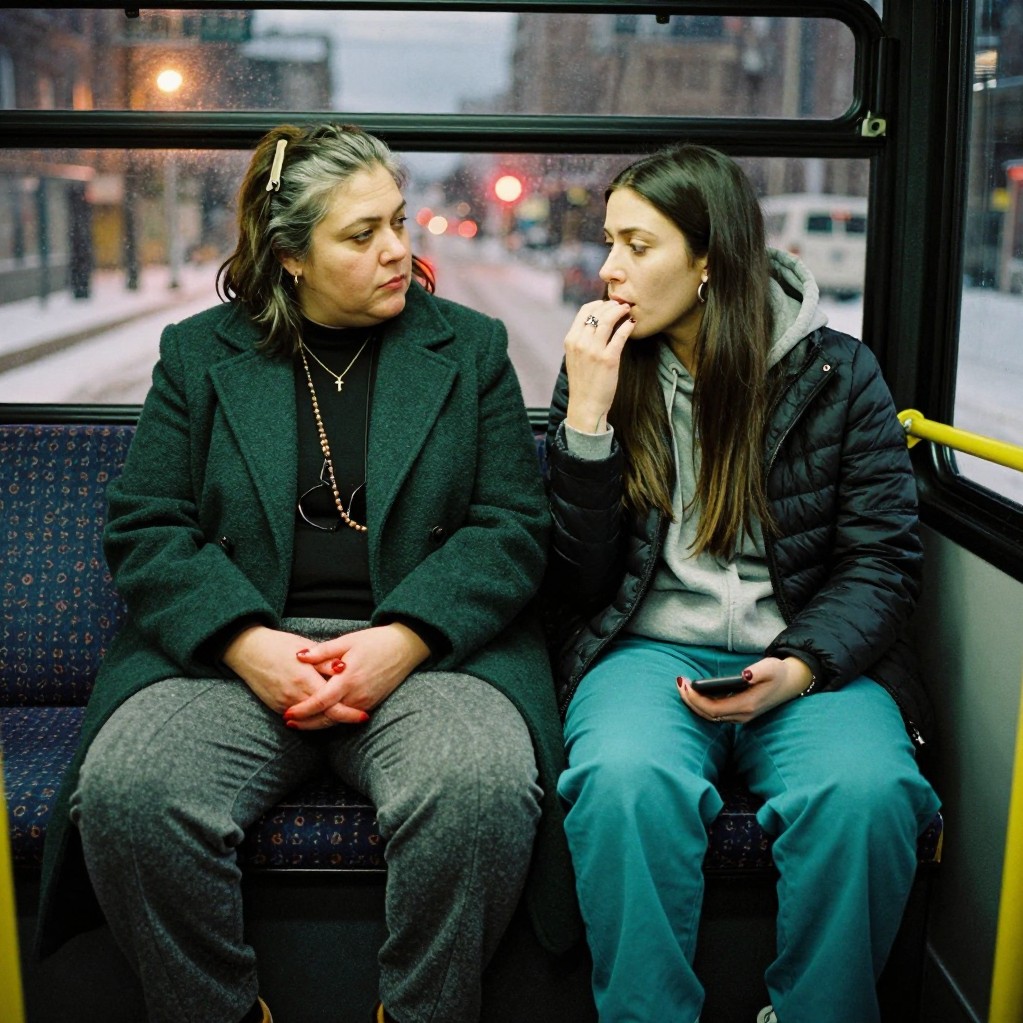
The 62 Archer at twenty to midnight is mostly empty and always smells like the inside of a bakery: flour and yeast and something sweet that has been in the upholstery since the eighties. It runs southwest out of the Loop, past the church on Archer with the floodlights on the saints, and past the funeral home, and past four blocks of Polish delis with the shutters down, and then it turns and goes on into the dark where the streetlights get further apart.
They got on together at Archer and Pulaski, and they took the back row, and the mother took the seat next to me.
I had the aisle. She had the window side of the bench and I had the aisle side and there was a hand’s width between us, and the daughter sat down on the other bench across the back, facing us, with her knees together and her bag on her lap.
The mother was the first thing I saw and she stayed the thing I saw. Forty-six, forty-seven. Five foot four in flat boots, and built the way women of that generation in that neighbourhood are built: full through the chest, full through the hips, a body with weight on it and no apology in it. A dark green wool coat, good wool, ten years old and brushed, open at the front because the bus was too warm. Under it a black turtleneck that had a job to do and was doing it badly, and grey wool trousers with a crease down the front of each leg that somebody had ironed with a proper iron and a damp cloth.
Her hair was that dark brown that goes to rust in the light, cut to the jaw and pinned back on one side with a plastic clip, and there was grey coming in at both temples that she had not coloured, and the whole thing had been set with hairspray at some point in the evening and had held. Round face. Straight nose. Dark eyes with a fold of skin above the lid and lashes that were her own. A mouth that was still full and had a line at each corner from forty years of holding opinions in.
Her hands were in her lap. Chapped, red at the knuckles, a thumbnail with a split down it, a thin gold band on the right hand and nothing at all on the left, just a pale stripe where a ring had been for twenty-three years. A small gold cross at her throat on a chain that had worn a groove in the skin. Cheap gold hoops. Reading glasses on a beaded chain around her neck that she kept picking up and putting down again without putting them on.
She smelled of hairspray and caraway and cold outside air, and under all of it, faintly, of the inside of a house: cooking, laundry, the particular warm dust of a radiator.
The daughter was twenty-five, twenty-six. Taller by four inches, and slimmer, and wearing the same shape with less of it: a black puffer jacket, a grey hoodie under it, scrub trousers in a dark teal that said she had come from work, white sneakers with a scuff across the toe. Her hair was long, dark, straight, and pulled over one shoulder, and she had the mother’s nose and none of the mother’s mouth — a smaller mouth, a thinner upper lip, and a small silver ring through one nostril that the mother kept looking at.
Long oval face. Dark eyes with a lot of white under them, tired, kind. Silver hoops the size of a quarter. A little tattoo on the inside of her wrist, three thin lines. Nails done, almond, a dark red that had grown out two weeks. A phone in her hand with the case peeling at the corner, and a stick of gum she was working steadily, and the flat, unimpressed expression of a woman who had spent the whole evening at her godmother’s name day and had eaten too much and was done being polite.
The bus pulled out and the heater came on and the mother’s thigh settled against mine, warm through the wool, and did not move away when the bus straightened.
I got hard. Not at once. It was the road, and the heater, and the smell of her, and the way she had her coat open and her hands folded like a woman at the end of a long day, and by the time we were past the funeral home it was obvious, and there was no coat over my lap, and there was nowhere to put it.
She noticed at the light at Kedzie. I felt her notice. Her hands stopped moving in her lap, and her chin came up a half inch, and then, without turning her head, her eyes went down and stayed down.
The daughter noticed her mother noticing. That took about ten seconds.
“Mamo,” she said, quiet, from the bench across. “Mamo.”
“Co?” the mother said, still not looking up.
The daughter said something short in Polish and tapped the back of her own hand twice, and I did not understand a word of it and understood all of it.
The mother’s head came up and she said, “Nie.” Then a longer sentence, fast, the way you talk when you are defending yourself, and then another one, quieter, and then she turned her face to the window and her ears went red.
The daughter looked at me. Looked at my lap. Looked back at her mother. And then she did something I did not expect, which was to lean back against the window and fold her arms and smile, just slightly, at the ceiling.
“She says I am embarrassing her,” the daughter said, in English, to me. Her accent was Chicago flat, no trace of the house. “She is not wrong.”
“I did not say anything,” I said.
“You did not have to,” she said. “She has been looking at that since Pulaski. I have been watching her do it for eleven minutes. My mother is a very bad criminal.”
“Marta,” the mother said, warning, in the voice of a woman who has said that name in that tone for twenty-six years.
“What? I am translating. You wanted to talk to him and you cannot, so I am translating.” She popped her gum. “Do you want me to translate or do you want to sit there and die?”
The mother looked at the window for a while. The bus went past a used car lot with the lights still on, and the light came across her face and went away, and then she faced me properly for the first time and said, in careful English, with her chin up:
“I am sorry. I am not — I am not this person. I am a mother. I work. I go to church on Sunday. I do not do this.” She stopped. “But I am looking. I know I am looking. I am sorry.”
“You do not have to be sorry.”
“I do,” she said. “I have a daughter here.”
“She is twenty-six,” the daughter said, to nobody. “She says that like I am in a stroller.”
The mother ignored her. “My husband — my ex-husband — he left three years ago. He is in Arizona now. He has a girlfriend who is thirty. He sends money for the house and he calls at Christmas and he thinks this is — ” she made a gesture, the flick of a hand that means a thing is finished and too small to discuss.
“Three years,” Marta said, and looked at me, and raised her eyebrows, which is a thing people do when they want you to understand the size of something without saying it.
“Three years what?” I said.
“Three years nothing,” Marta said. “Three years of my mother going to bed at nine thirty with the radio on.”
“Marta.”
“It is true.” She turned in her seat and put her elbow on the window and her chin in her hand, and she was not smiling now. “I hear her. The flat is not big. I hear the radio go off and then I hear her not sleeping.” She looked at her mother. “You think I do not know? I am twenty-six and I live in my mother’s flat and I hear everything.”
The mother’s eyes were wet and she was furious about it.
“I am not sad,” she said. “I am not — I have a life. I have the deli. I have — ” she waved at her daughter “ — this one, who is a pain in my — ” she could not finish it and started laughing instead, and wiped her eye with the back of her hand, and the laugh turned into something with a shake in it.
Marta reached across and took her mother’s hand and held it, and they sat like that for a stop, mother and daughter, in the back of a bus, holding hands.
“Okay,” Marta said, and let go. “Okay. So.” She looked at me with her chin up and her eyes direct. “She is not going to say it, so I will say it, and then I am going to look out the window and you two can do what you want.” She took a breath. “My mother has not been touched by a man in three years and she is forty-seven years old and she is not dead. She has been sitting next to you for four stops looking at your — ” she nodded at my lap, once, without any embarrassment at all “ — and she is not going to do anything about it because she is my mother and she thinks she is not allowed.”
“Marta!”
“I am going to look out the window now,” Marta said, and did.
The bus went down Archer. The mother sat with both hands in her lap and her face turned half toward me and her breath going in and out through her nose, and I put my hand on her knee.
She did not move. She did not breathe. Then she put her hand over mine and pressed it down flat, hard, and her fingers were cold and rough and shaking.
“I do not know what to do,” she said, in a whisper. “I have forgotten. You understand? A woman forgets. She thinks she will remember and she does not.”
“You do not have to do anything.”
“I want to do something,” she said, and then, with her eyes shut, she moved my hand up her thigh, over the wool, to the top of her leg, and held it there with her own hand on top of it, and her jaw was tight.
The wool was thin there and warm and I could feel the shape of her through it, and the heat of her through it, and she made a sound low in her throat that she clearly had not meant to make.
Marta, at the window, said, “I am still looking out the window.”
“Good,” her mother said, and turned her face to me and kissed me.
She kissed like a woman who had been rehearsing it for three years. Careful at first, then not careful, one hand on my jaw, her whole body turned into the seat toward me, and she tasted of coffee and of the sweet thing they had eaten at the name day, and she made a small hurt noise against my mouth and did not stop.
When she came off me she was breathing hard and her hair clip had come loose and she said, “Oh. Oh, I have missed that. I have missed that so much.”
Then she looked past me, at her daughter, and something went across her face — shame, and then not shame, and then a kind of recklessness that was worse.
“Marta,” she said. “Look at me.”
Marta turned her head.
“You are not shocked?”
“I am extremely shocked,” Marta said. “I am also thirty and I am not a child and I have been telling you for two years to go out and meet somebody. This is not what I meant. But it is a start.”
The mother laughed, and then she put her hand on my belt, and then she stopped laughing.
She got my belt open and her hand in, and her fingers came around it, and she stopped talking altogether, and then she said, in Polish, something quiet and disbelieving, and then in English, “Is big. Is very — my God. Is big.”
“Mamo,” Marta said, from the window, in a warning voice, and then, after a second, she turned her head and looked.
She looked for a long time. Long enough that her mother noticed her looking, and neither of them said anything, and the bus went through a yellow light and the whole back row lit up orange.
“Okay,” Marta said, finally, and her voice had changed. “Okay. Wow. Okay.” She sat back and pushed her hair off her face. “That is — yes. That is a lot. That is objectively a lot.”
“You see?” her mother said, and there was something in her voice that I had not heard yet: not shame, not apology, but a kind of proud, delighted mischief. “You see what I am looking at?”
“I see,” Marta said. “I am looking at it right now. I am not blind.”
The mother’s hand started to move, slow, and I put my hand over hers to stop her, because the driver had a mirror and there was a man asleep in the third row and it was not the place.
“We get off at the next one,” Marta said, and stood up, and pulled the cord, and looked down at both of us with her hand on the rail and said, “Both of you. Come on. My mother’s flat is two blocks. She has a big bed and a tea kettle and she is going to make tea and then she is going to be brave.”
Their flat was on the second floor of a brick two-flat with a wooden staircase and a hallway that smelled of somebody’s soup and somebody’s cigarettes and, faintly, of the church. The front room had a rug that had been good once, a sofa with a crocheted blanket folded over the back, a glass cabinet with china in it that nobody had used since 1998, and a corner with a statue of the Virgin and a red glass candle that was not lit.
The mother hung up her coat and took off her boots and put them side by side against the wall, and then stood in her stocking feet in her own front room and did not know where to put her hands.
“I will make tea,” she said.
“You will not make tea,” Marta said, and took her by the shoulders and turned her around. “Sit down. He is going to sit down. I am going to sit over there and I am going to be quiet, and if you want me to go to my room, say so, and I will go to my room, and I will not say one word about it ever.” She looked at her mother. “But I am not going to pretend I do not know what is happening in my own flat.”
The mother looked at her daughter for a long moment. Then she said, “Stay.”
“Okay,” Marta said, and sat down in the armchair by the window with her knees up, and took out her phone, and put it face down on the arm of the chair without looking at it.
The mother sat down on the sofa next to me and folded her hands in her lap and said, “I am forty-seven years old.”
“I know.”
“There is a — ” she gestured at her own middle, at the softness there “ — I am not a girl. You understand? Two children. My body is not — ”
I put my hand on her face and turned it toward me and said, “Take your clothes off.”
She did. She stood up and took the turtleneck off over her head and folded it, because she could not help folding it, and put it on the arm of the sofa, and then her trousers, folded the same way, and then she stood there in a black slip and a pair of ordinary cotton underwear and looked at the carpet.
She was magnificent. Full, heavy, soft everywhere a woman is soft at forty-seven, with the white lines of two pregnancies across the low belly and a scar under the fold of it, big breasts gone low and full with wide dark nipples, arms that had carried groceries and children and trays of deli meat for twenty years, and thighs that touched all the way down. A small mole under her right collarbone. A line of pale hair below her navel. She had shaved her legs that week and not since.
“Look at me,” I said, and she did, and her eyes were enormous.
I got the slip off her and the underwear down and she kicked them away and stood with her hands at her sides, and she was not a girl and she was not trying to be, and that was the whole of it.
She was wet. Standing in her own front room with her daughter in the armchair and a stranger’s hands on her, she was so wet that it showed on the inside of her thighs.
“Don’t look at that,” she said.
“I am going to look at it,” I said, and got my hand up between her thighs, and she bent forward over my shoulder and held onto my shirt and said something in Polish into my neck.
“She said thank you,” Marta said, from the armchair, quietly. “She is thanking you. She does that.”
I put her on her back on the sofa with a cushion under her hips and my mouth between her legs, and she came in under two minutes with her heel drumming on the arm of the sofa and one hand over her own mouth and the other in my hair, and she cried out anyway, twice, in a voice that had not been used in that room in three years.
When I came up she was laughing and crying at the same time and saying “no, no, no, wait, wait” and pulling me up by the shirt, and then she got me out of my clothes with hands that were not steady and pushed me down onto the sofa and climbed on top of me.
“I want to,” she said. “I want to do it like this. I want to be — ” she reached down and got me into her hand and guided it, and stopped with the head of it just inside her, and looked at me with her hair falling forward over one eye “ — I want to be the one who does it.”
She came down on it in one slow movement with her mouth open and her hands flat on my chest, and when it was all the way in she sat still and shook her head slowly from side to side like a woman who had been given something she had asked for and could not believe the size of it.
“Oh my God,” she said. “Oh my God. Is — is too — I cannot — ” and then she started to move.
She was clumsy and knew it and did not care at all. She rode me with both palms flat on my chest and her chin up and her eyes shut, and after a minute she found the angle, and after two she found the rhythm, and after three she was making a sound on every stroke and had stopped being careful about the neighbours. Her breasts moved heavily and she had one hand under them, holding them, and I got a fistful of her hip in each hand and hauled her down harder and she said, “Yes. Yes. Like that. Like that.”
Marta was still in the armchair. She had her knees up and her arms around them and her chin on her arms, and she was watching with a flat, absorbed, unreadable face, and when her mother came the second time, with her head thrown back and her hand clawing at my shoulder, Marta closed her eyes and let out a breath through her nose.
The mother slumped forward onto my chest, and then lifted her head, and looked over at her daughter, and said, “Marta.”
“I am fine,” Marta said, without opening her eyes.
“Marta. Come here.”
“Mamo — ”
“Come here,” the mother said. “I am your mother. I know when you are lying.”
Marta opened her eyes. She looked at her mother, and at me, and then she got up out of the chair, slowly, and came across the rug in her socks, and stood in front of the sofa with her arms folded.
“This is insane,” she said.
“Yes,” her mother said.
“This is genuinely insane. I want that on the record.”
“On the record,” her mother agreed, and reached up and took her daughter’s hand and pulled her down onto the sofa.
Marta sat there for a moment with her mother’s hand in hers and her eyes on me, and then she said, “I am going to take my clothes off now, and nobody is allowed to say anything.”
She took them off fast, the way people undress in gyms, and then she was standing there in a grey sports bra and black underwear with her hair coming down out of its band, and she was twenty-six, and she was beautiful in the other way: long, lean, small-breasted, a flat stomach with a line of soft hair down it, a bruise on one shin, the three thin lines tattooed on her wrist, and a small silver ring in her navel that her mother had not known about, judging by the sound she made.
“You have a — ” the mother said.
“I have had it for four years,” Marta said. “You have seen me in a swimsuit.”
“I have not looked!”
“Clearly.”
She got the bra off and her breasts were small and high with dark pink nipples, and her mother, still sitting on my lap with me inside her, reached up and touched her daughter’s hair, once, and then put her hand back down.
Marta knelt on the sofa beside us and kissed me, and she kissed like her mother, which should have been the strangest thing in the room and was not even close.
We got onto the bed eventually, all three of us, in a bedroom with a lace curtain and a wardrobe with a door that did not shut and a framed photograph of two girls in first communion dresses on the wall.
The mother lay on her back and I fucked her slowly while Marta lay beside her with her hand on her mother’s stomach and her mouth at her mother’s ear, saying things in Polish, and the mother held her daughter’s wrist and cried a little and told her to stop, and did not mean it.
Then the mother wanted to watch. She sat up against the headboard with the sheet over her legs and said, “Now her. Do it to her now. She is twenty-six and she thinks I do not know what she does.”
“Mamo!”
“I know everything,” the mother said, and folded her arms, and watched.
Marta was tight and wet and nervous, and she laughed when I first pushed into her, a high surprised laugh, and said, “Oh, that is — okay — okay, that is very — ” and then stopped talking and put her face in the pillow.
She was loud. Louder than her mother, once she got going, and she had a way of pushing back that was not shy at all, and her mother watched the whole thing from six inches away with her hand over her own mouth and her eyes shining.
“Is good?” the mother said, at one point, and Marta said, “Mamo, please,” and the mother said, “I am asking a question,” and Marta said, “Yes. Yes, it is good. It is very good. Please stop talking.”
We went on like that for a long time. The mother’s mouth on me while I was inside her daughter, which is a sentence I have never had occasion to think before; Marta’s hand between her mother’s legs while her mother did it; the two of them side by side on their backs with their hair spread out on the same pillow while I moved from one to the other and neither of them pretended not to watch.
It was the mother who finished it. She pushed Marta gently out of the way and said, “No. Me. I want to.” She got me onto my back and knelt over me and took me in her hand and said, “I have not done this in three years. I am going to be bad at it.”
“You will not be.”
“I will be terrible,” she said, and bent her head, and was not terrible at all.
Marta lay on her side with her head on her mother’s hip and watched, and put her hand on her mother’s back, and said nothing.
When I told them I was close the mother did not stop and did not pull away; she took it in her mouth and her hand and then, at the last second, lifted her head so it went across her chin and her throat and her chest, and she sat back on her heels afterwards with her hand at her mouth and her eyes shut, breathing like a woman who had run somewhere.
“Well,” she said, eventually.
“Well,” Marta said, and started to laugh, and then the mother started to laugh, and then they were both laughing on the bed with their hair everywhere, and the mother had to put her hand over her daughter’s mouth and say “shh, shh, the neighbours.”
We had tea at two in the morning in the kitchen, all three of us, the mother in a dressing gown and Marta in a t-shirt that came down to her thighs, and the mother cut bread and put out the good butter and the cold cuts from the deli and would not be talked out of it.
“You eat,” she said. “You are too thin.”
“I am not thin.”
“You are thin,” she said, and put another slice of ham on my plate, and it was the most maternal and the least maternal thing that had happened all night.
Marta sat with her chin in her hand and watched her mother fuss and said, “She has not been like this in three years.”
“Like what?”
“Awake,” Marta said.
The mother pretended not to hear it and buttered another piece of bread.
I left at three. The mother walked me to the door in her dressing gown with her arms folded and said, “I do not know your name.”
I told her.
“That is a good name,” she said. Then, after a pause, “I am going to be embarrassed tomorrow.”
“Probably.”
“I am going to be embarrassed tomorrow,” she said, “and then I am going to get over it, because I am forty-seven and I have decided.” She opened the door. “We cook on Sunday. Twelve o’clock. There is too much food and it is only the two of us.”
Then she kissed me on the cheek, briskly, the way you kiss a cousin, and shut the door.
I was on the 62 the following Wednesday and the back row was empty and the heater smelled like burnt dust, and I sat there and looked at the seat where she had been sitting and thought about bread and butter and a framed photograph of two girls in white dresses, and got off two stops early to walk.
On Sunday at twelve I rang the bell of the second-floor flat, and Marta opened the door with a dish towel over her shoulder and said, without any expression at all, “She has been cooking since eight. There are three kinds of meat. Do not say you are not hungry.”
From the kitchen her mother’s voice said, “Who is it? Marta, who is it?”
“It is the man from the bus,” Marta called back.
There was a silence. Then the mother said, in a voice that was trying very hard to be normal, “Tell him to wash his hands.”
My Bus Adventures #8: Night Shift
My Bus Adventures #7: Beginner’s Luck
My Bus Adventures #6: Standing Room
My Bus Adventures #5: Late Pass
My Bus Adventures #4: Straight Lines
My Bus Adventures #3: The Signal
My Bus Adventures #2: Window Seat
My Bus Adventures #1: The 9:40
Related posts:
 My Bus Adventures #3: The Signal
 My Bus Adventures #8: Night Shift
 My Bus Adventures #1: The 9:40
 My Bus Adventures #4: Straight Lines
 My Bus Adventures #5: Late Pass
 My Bus Adventures #6: Standing Room
 My Bus Adventures #2: Window Seat
 My Bus Adventures #7: Beginner’s Luck
 Sleepwalking Mom – Chapter.03 – Part.06 – Twins find out. Now it’s three on one
 A Mother’s Worry – part 02
Solstice Ch. 01-2
A Mother’s Worry – part 32
