
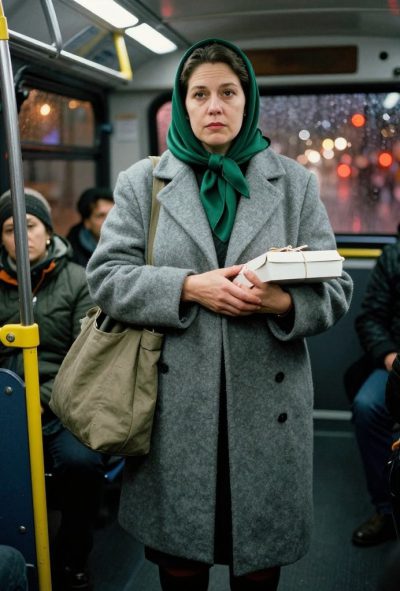
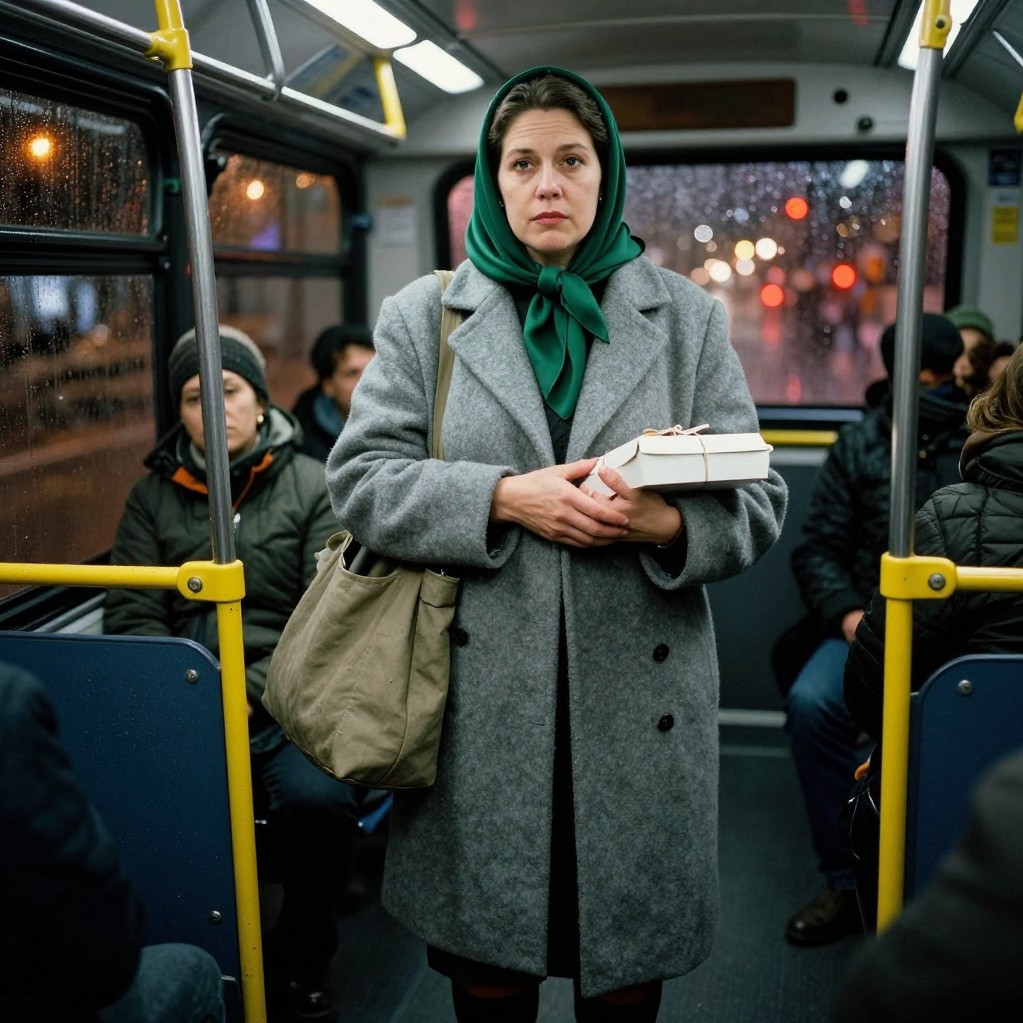
The 81 came eleven minutes late, and by then there were forty people at Kedzie and the bus was already full when the doors opened.
I got on behind a woman with a folded stroller under her arm and stood in the well by the back door with groceries against my leg and my collar up.
Rain on the windows, rain on everybody’s shoulders, that smell a Chicago bus gets in November: wet wool, diesel, somebody’s coffee, hot rubber.
She was three feet away with her hand up on the rail.
Dark green scarf, silk, knotted at the back of her neck, the knot small and exact, and under it a long grey coat buttoned to the throat, a black skirt below the hem, thick tights, low-heeled boots that had been rained on and dried again.
Forty, maybe. A little more. A wide, soft, grown woman’s body, and a coat that did not hide the size of her hips or the weight of her arms — the kind of body that has been somebody’s whole life for years and has not been looked at in a while.
Her face is what I kept coming back to. A straight fine nose, dark eyes with the first lines at the corners, no makeup at all, a mouth she held closed like she was keeping something in it.
And the scarf. The way it framed her. The only skin in the whole picture was a strip of throat, one ear and her hands, and it made the throat and the ear and the hands the most interesting things on the bus.
Her hands were red from the cold, short-nailed, with a pale band on the wrong finger where no ring had ever been and a thin white scar across the back of the left one.
Spaulding. More people. She stepped back to let a man through and her shoulder came against my chest and she said, “Sorry,” and put the r in the middle of the word.
“That’s all right.”
She looked up, one quick look, and away, and I watched the side of her face go red from the jaw down into the scarf.
The second time was ten seconds later, and the second time she did not look at my face at all.
She looked at my hands on the rail, then lower, then at the floor, and the colour went to her ear.
I was half hard from the crowd and the heat and the way she smelled, clean soap and something like cardamom, and there was nowhere on that bus to put it, and she had seen it, and she had looked again.
I moved the grocery bag in front of me, out of decency. She watched me do it. Her mouth came open a quarter of an inch and then shut.
“Here,” I said. “Take the rail. I’ve got the pole.”
“I am fine.”
“Take it.”
She took it. Her fingers went where mine had been, which is a stupid thing for a man to notice, and I noticed it.
“Long day?”
She looked at me like the question had come out of the ceiling. “Yes. Long.”
“You work around here?”
“The bakery. On Lawrence, past Kedzie.” She said it the way people say the name of a place they are tired of. “I do the books. And the counter in the morning, because the girl who is supposed to open does not open.”
“That’s why you smell like bread.”
It was a stupid thing to say. It got me one short breath out through her nose, and it changed her entire face, and I wanted to hear it again.
“I smell like bread and bus,” she said.
The bus braked hard at Western and everybody in it went forward at once.
She had one hand on the rail and her bag in the other and nothing to hold with, so she came into me hip first and stayed there longer than the brakes needed.
Then I felt her understand what she was against. Her body went still — not pulling away, just still, the way a person goes still when they are deciding something — and her hand came up and closed on the front of my coat.
“I am sorry,” she said, into the wool. “I am not—”
“You’re not doing anything.”
She stayed where she was.
At Western half the bus got off and the rest sat down, and there were two seats left, one behind the other, and she took the window and I took the aisle and put the groceries on the floor between my feet.
Up close she was better and worse than she had been from three feet away. Better because her eyes were kind. Worse because she was tired down to the bone and not hiding any of it.
“You can ask,” she said. “Everybody wants to ask. They ask with their eyes and then they are polite about it.”
“Ask what?”
“Why the scarf. Where I am from. Whether my husband beats me.” She said it flatly. “Bosnia. And there is no husband.”
“I wasn’t going to ask any of those.”
“Then what?”
“Your name.”
That got me the short breath through the nose again. “Amra.”
“Amra.”
“It is not a name that works here. At the bakery they call me Amy and I stopped correcting them in 2019.”
“How old are you, Amra?”
“Forty-one.”
“And you still get carded for cigarettes.”
“I do not smoke.” She delivered it seriously, then saw my face and laughed. “That was a joke. My God. I am very bad at this.”
“You’re not bad at it.”
The bus went down Lawrence in the dark, past the laundromat and the taqueria and the place with the neon that has been closing down for two years.
“My mother died in April. Eleven years she was sick. First the stroke, then everything else. I was thirty when it started.”
“Who took care of her?”
“I did.” No weight on it at all. “You cannot leave a woman alone in a bed for a week. Then it is a month. Then it is eleven years, and you are forty, and the bed is empty and the flat is very quiet.”
“And you do the books at a bakery.”
“Twenty-six thousand a year, in a room with no windows, so that the woman in the flat is fed and has her medicine and can still smell bread when she comes home.”
I said nothing, because anything I could have said would have been a small coin dropped down a big hole.
“There was a man. In 2009. He wanted a wife who would come to his mother’s house in Prijedor and cook and not talk. I said no in September, and I was thirty-four, and I thought there would be somebody else.”
“There wasn’t.”
“There was a lot of other things.” She turned her hand over in her lap. “The strange part is that I am not sorry about any of it. I am sorry about the time.”
I looked at her properly while she watched the window. The line of her jaw, the soft underside of it, the grey silk at her hairline, the ear with no earring in it. Her breasts came forward under the coat when she leaned, heavy and held in with a plainness that made them worse to look at than lace would have been. Her hands were clasped over her bag. Her thighs were wide apart in the seat and the skirt was pulled tight across them, and the tights had a run at the left knee that she had stopped, by the look of it, with nail polish.
“You are looking at me,” she said, still at the window.
“I’ve been looking at you since Kedzie.”
“That is not a nice thing to say to a woman in a scarf.”
“It’s not a disrespectful thing either.”
A block went by. Then she said, very evenly, with her eyes on the glass: “You are going to think I am a strange woman.”
“I don’t.”
“I have never been with a man.” She said it to the window. “I mean never. Not one. Not a boy’s hand under a shirt in the back of a car. Nothing.”
The bus stopped at Rockwell, let two people out, took nobody in, and folded its doors shut on us.
“Never,” I said.
“Never.” She turned. The flush was not a shy one now; it was something angrier at herself. “The women at the bakery talk. They think I am deaf. Fatima had a thing with a man from the gym and she told us all of it in the back room and I stood there with a tray and I wanted to put my hands over my ears.”
“Because you didn’t want to hear it?”
“Because I wanted to hear it so much,” she said. “And then I go home to that quiet flat and I lie there and I think: this is the whole life. There is this one part of being alive and I am going to die not knowing it. And in the morning I put the scarf on and I go and count the money from the bread.”
The lights outside went from neon to windows to neon.
“You could have,” I said. “Any night. There are men who would not have asked twice.”
“I know. I am not stupid and I am not blind, I have seen how men look at a woman in a scarf. But the scarf is not a costume, it is not for one day.” She pulled the coat straight over her knee. “For eleven years I could not leave the flat for a night. And before that I was young, and then I was thirty, and then I was nobody’s idea of a wife. Now I am a woman who counts bread money and has never—”
“Has never what?”
“Has never had anything happen to her,” she said, and her voice cracked down the middle of it, and she was furious about that too.
“You’re the most interesting person I’ve talked to all year.”
“Do not be kind to me. I cannot stand kind.”
“I’m not being kind, I’m being honest.” I turned in the seat to face her. “You’re beautiful. Not for your age. Not in a nice way. The kind of beautiful that has been going on in a bakery back room for eleven years and nobody has mentioned once.”
“Beautiful is for young women.”
“Beautiful is for that mouth. And those hands. And the way you looked at my lap on Western and then told yourself you hadn’t.”
She put her hand over her face, then laughed — a real one, helpless, fingers still over her eyes. “You saw that.”
“I saw it. You looked four times.”
“I looked five times,” she said, from behind her hand, and that was the moment I knew I was going to have her.
She took the hand down. Her eyes were bright and her chin was up, and she looked like a woman walking into cold water on purpose.
“I have seen pictures,” she said. “On the telephone. Things that come up when you are looking for something else. So I know the shape of it.”
“But.”
“But I do not know what it is like.” She said the word like it had a bad taste and she was making herself swallow it anyway. “Warm. Heavy. What a person does with their mouth. What it is to have a thing like that inside you — if it hurts, if it is good, how long it—” She stopped. “You see. Strange woman.”
“Amra.”
“What.”
“This is my stop.”
The bus was already slowing for Wolcott and I was already standing with the groceries in my hand, and she was looking up at me with her mouth open and her hands still folded on her bag.
“Come up. I’ll make you tea, and you can look at my lap properly instead of by accident.”
“That is a terrible thing to say.”
“It’s an honest thing to say, which is different.” The doors opened and cold came in. “And if the answer is no, you go home on the next one and I’ll see you on this bus some other night and be polite about it.”
The driver was watching us in his mirror. She sat there for the length of three breaths.
Then she got up and came down the steps in front of me and stood on the wet pavement with her bag against her chest, scarf, coat, chin up.
“One tea,” she said. “And if you are a murderer I am going to be very angry with myself.”
“It’s half a block.”
“It is a long half a block.”
We walked it. Her boots were loud on the wet concrete and the wind came down Wolcott off the lake and pulled at the hem of her coat, and she held the scarf at her throat with one hand. She walked like a woman who had been on her feet since six: hips full and slow under the wool, the run in her tights, the low heel coming down flat. I thought about my hand on the back of that knee and made myself stop.
The stairs were narrow. She went up first with one hand on the rail, and stopped on the landing with her chest going.
“I am forty-one years old,” she said, to the wall. “I am standing on a strange man’s stairs.”
“You can go back down. The 81 comes in nine minutes.”
“I know what time the bus comes,” she said, and came up the rest of the way.
The flat was cold because I had been out all evening. I put the groceries on the counter, the kettle on, the radiator up. She stood there with her bag against her chest like a shield, looking at everything: the dishes, the calendar, the bad chair, the window with the fire escape on it.
“It is clean,” she said, surprised.
“I’m not an animal.”
“All men are animals. Some of them have a sink.” She set the bag down on the table, took off her coat, folded it over the back of a chair, and stood there in a black skirt and a black cardigan over a blouse buttoned at the wrists. Without the coat the shape of her was so much better that I had to look at the kettle.
The kettle boiled. I made the tea. She wrapped both hands around the cup and drank it standing up, and I stood on the other side of the table with mine, and for a while neither of us said a word.
Then she put the cup down.
“Will you do something for me.”
“Depends what it is.”
“Do not be gentle with me about this.” She reached up behind her neck and found the knot. “I have been handled gently by everybody my whole life and it has got me exactly here.”
She pulled. The knot came undone and the green silk came off her head.
Her hair was long — dark, going grey at the temples, pinned up all day under the scarf and coming down now in a bad wave over her shoulders — and she put both hands into it and pushed it back off her face, and that was the moment. Not the coat. Not the cardigan. Not anything under them.
I said something. I don’t remember what it was.
“Now you are looking,” she said.
“I’ve been looking all night. This is different.”
“This is the part they do not see.” She dropped the scarf on the table. “Forty-one years old, and the only people who have seen my hair since I was twenty are my mother and the woman who cuts it.”
I came around the table.
“Wait,” she said.
I waited.
“I will be terrible at this. Frightened, and talking too much, and you are not to laugh.”
“I’m not going to laugh.”
“Then come here.”
I put my hands on her face first, because I wanted her to see it coming, and she closed her eyes and lifted her chin and kissed me like somebody stepping off a ledge.
It was bad for about four seconds. Then it wasn’t. She found the rhythm of it, and her hands came up to my jaw and then into my hair, and she made a small desperate sound against my mouth and pushed herself into me until the table was against her back.
We broke apart and she was breathing like she had run up the stairs again.
“I am shaking,” she said, holding her hand out to look at it. “Nothing has even happened and I am shaking.”
“Something’s happening.”
“Something is happening,” she agreed, and pulled my face back down.
The cardigan came off. The blouse came off, and I did the buttons myself because her hands were not cooperating, and under all of it she was wearing a white cotton bra washed a thousand times and a white vest under that, and her body was nothing like a young woman’s body and everything I wanted.
Full. Heavy. Soft at the belly, wide at the hips, with the marks of a life on it — the scar under the arm, the pale lines low on the stomach, the skin of her breasts white and veined and spilling over the top of the cotton when I got the bra open. Her nipples were dark and already hard, and she made a small horrified noise when I put my mouth on one.
“Oh,” she said. “Nobody tells you about that either.”
“About what?”
“That it goes all the way down.” She had a hand flat on her own belly. “Down to here. Like a string.”
I did it again and she bent over me and held my head there with both hands, and her knees gave, and she laughed at herself for it.
The skirt went. The tights came down with the run in them. She stood in plain white underwear and did not cover herself, and let me look, and her thighs were full and her fingers were curled at her sides.
“Now you,” she said.
I undid my belt and she watched my hands the way she watched the bus driver, and when I got it out she did not say anything for a while.
“It is bigger than the pictures,” she said finally.
“Not much.”
“It is bigger than the pictures.” She came closer. “May I?”
“Go on.”
She touched it with the backs of her fingers first, then her whole hand, and made a small sound of surprise. “It is hot.”
“That’s how it works.”
“I know how it works. I have a book.” She was stroking it slowly, learning it. “It moves. By itself.”
“Not by itself.”
“By itself,” she insisted, and then, in a completely different voice, “Can I put it in my mouth?”
“You don’t have to ask.”
“I am asking because I want to do it properly and I do not know how.” She went down onto the kitchen floor in one movement, which I did not expect from a woman of forty-one, and looked up at me. “Tell me if I do it wrong.”
She took the head into her mouth and stopped there, eyes closed, fingers wrapped around the base of it, breathing through her nose. Then she went further, and further than she could manage, and gagged and came off it coughing, wiping her lips with her thumb.
“Sorry. Sorry.”
“Don’t apologise. Slower.”
“I am going to be good at this,” she said. “Very good at this, and then I am going to be angry that I did not know.”
The second time she was slower. She learned that her tongue on the underside was the thing that made my hand close in her hair. She learned to use her hand where her mouth could not reach. She got spit on her chin and did not care, and when I told her she could stop she shook her head with her mouth full and kept going, and there was something in the way she did it, some forty-one years of not knowing, that made it hard to stand up straight.
I pulled her up by the arm before it was over, and she came up with her lips wet and her hair in her face and a look on it like she had won something.
“Now the other thing,” she said.
“The other thing.”
“I want to know how it feels.” Her hands were on my chest and she was walking me backwards, out of the kitchen, into the room with the bed in it. “And I want it to be you, because you were honest with me on a bus, which is more than most men manage in a marriage.”
She lay down on her back and looked at me and did not close her legs.
“First,” I said, “I’m going to do something to you.”
“What?”
“Something nobody’s told you about.”
I put my mouth there and she came off the mattress like a fish.
“No — that is not — ” Her hands were in my hair, pushing me away and holding me there at the same time. “That is not a thing people do.”
“It’s the only thing people do.”
“Nobody has ever— oh. Oh, my God.” Her heels came down on the bed and her knees went wide and her voice changed completely. “Do that again. That exact thing again.”
She lasted barely two minutes, one palm clapped over her own mouth, her back bent off the bed, her thighs clamping on my ears, and then she lay there with her forearm across her eyes and her chest rising and falling, and said, “What was that. What was that, what did you do to me.”
“You came.”
“That is what that is?” She took the arm away. Her eyes were wet. “That is what that is. All this time. That is what everybody is doing on a Friday night.”
I shoved a folded pillow under her hips and she watched me do it, her eyes going between my face and my hand and what I was holding.
“Tell me the truth,” she said. “Does it hurt?”
“Sometimes. A little. The first time.”
“Good.”
“Good?”
“I do not want it to be nothing. I want to remember all of it, even the bad part.” She reached down and guided me, badly, and then better.
I went in slowly and she went very quiet. Her eyes were fixed on the ceiling, her mouth open, no sound coming out of her at all, her hand gripping my forearm hard enough to hurt, and I stopped when I was halfway.
“Keep going.”
“It’s tight.”
“Keep going.” Her heels came up on the backs of my legs. “I am not made of glass. I have been carrying my mother up a stairs for eleven years.”
I pushed, and she made a sound that was not a good sound, short and sharp, and her nails went into my arm, and I stopped again.
“Wait,” she said. “Do not move.”
I didn’t move. I could feel her whole body adjusting, small settlements, the way a person gets into cold water, and after a while her breathing changed.
“All right. Now.”
I moved and she said “oh” — a completely different oh, one that came up out of her chest — and her hand let go of my arm and went flat on the sheet.
“Oh. That is not what I thought. I thought it would be a pushing. It is not a pushing.”
“What is it?”
“It is— ” She moved her hips experimentally and her whole face changed. “It is like being full. Full of something that is alive.”
She kept moving and I let her, and I watched her learn it in real time, the way her hips worked it out before her brain did, the way she found the angle that stopped her breath and then went back to it again and again.
“This is what everybody is doing,” she said, wondering. “On the bus. In the bakery. All of them. This.”
“All of them.”
“And nobody told me.” She started to laugh and it turned into something else halfway, and she pulled my mouth down to hers. “Move. Please. Move.”
I moved, and she was wet in a way that surprised her more than it surprised me. I could feel it, and she could hear it, and the sound of it in that quiet flat made her put her hand over her own mouth.
“That is me,” she said, muffled. “I did not know my body did that.”
She came the second time with me inside her, which she had not expected at all. Her legs locked around my back, her voice went up and broke, she said something in Bosnian into my shoulder twice, and then she was holding on and shaking, and the shaking went on in waves long after the rest had stopped.
“Amra.”
“Wait.” Her hand was flat on my chest. “It is still happening. It is happening in my legs.”
“That’s normal.”
“Nothing is normal.” She laughed, and there were tears at the corners of her eyes and she did not wipe them. “I am a normal woman and nothing about tonight is normal.”
We did it again later with the light off, slower, and she talked her way through it in a low voice, asking questions — is this right, is this what they do, do you like that, tell me what you like — and before long she stopped asking and started telling me, in two languages, what she wanted, and the words she used in English were not words I would have guessed she knew.
Then she pushed me over onto my back and got on top of me. That took her a while to work out and she laughed at herself the whole time, and then she found it and stopped laughing.
“Oh. This is different. I am doing it. I am doing it myself.”
“You’re doing it.”
“I have been on my back my whole life,” she said, and rode me with her hair stuck to her face and both hands on my chest. “Look at me. Look at me doing this.”
I looked. Her body in the dark, the weight of her coming down, her breasts moving, the sweat on her throat, forty-one years of nothing at all going up and down on me like a woman making up for every one of them.
“I’m close,” I said.
“Good.” She leaned down, hair over her face and off it again, and said it into my mouth: “Inside. I want to know that too.”
“Amra—”
“Inside,” she said. “Forty-one years old, and I want to know everything, and I am starting tonight.”
So I did. She felt it and went still, then her hips moved once, twice, and she said “oh” quietly, and then she put her forehead against mine and stayed there while it went on with her hand on the back of my neck.
“It is warm,” she said, after a while. “It is still there. It is moving.”
“It does that.”
“I can feel it in me.” She sat up slowly, looked down at herself, put her hand between her legs and then looked at her fingers. “Look. All of this.”
“That’s you.”
“That is both of us.” She lay down on me, heavy and hot and completely limp, and said, “I am going to be extremely bad at work tomorrow.”
She woke me at five with her mouth on it.
I came awake with her hair across my stomach and her tongue doing the thing she had learned four hours earlier, and I said her name, and she came up off it just long enough to say, “I want to see how it ends,” and went back down.
“Amra, I’m going to—”
“Good,” she said, and did not stop, and did not turn her head away.
She was not ready for it. She came off it with her hand clapped over her mouth, eyes watering, coughing and laughing at once, and then she sat back on her heels and swallowed and looked absolutely delighted with herself.
“It is salty,” she said. “Nobody tells you anything. It is salty and it is a lot and nobody tells you.”
“Are you all right?”
“I am magnificent.” She got up off the bed, naked, in the kitchen light, with her hair everywhere. “I am forty-one years old and I am magnificent and I have to go and open a bakery.”
She washed at the sink and dressed with her back to me, then stood in the hallway mirror with the green scarf in her hands, tied it — knot at the back, small and exact — and looked at her own face for a long time.
“You look like a woman who has been up all night,” I said.
“I look like it,” she agreed, turning her head one way and the other, and then she grinned at me in the glass, and it was a completely different face from the one that had got on the bus at Kedzie.
At the door she put her palm on my sternum and kissed me, hard, then stepped back.
“Same bus,” she said. “Friday.”
“Friday I’ll cook.”
“Friday you will cook.” She was halfway down the stairs when she turned around. “And do not tell the girl who does not open.”
“I won’t tell the girl who does not open.”
She went out into the cold with her coat buttoned and her bag on her shoulder, and at the corner she did not wave. She checked her scarf instead, both hands, once, the way other women wave, and then she got on the 81 and paid her fare and sat down by the window, and the bus pulled away east with her in it, going to count the money from the bread.
My Bus Adventures #11: Deep Clean
My Bus Adventures #10: Close Quarters
My Bus Adventures #9: The Back Row
My Bus Adventures #8: Night Shift
My Bus Adventures #7: Beginner’s Luck
My Bus Adventures #6: Standing Room
My Bus Adventures #5: Late Pass
My Bus Adventures #4: Straight Lines
My Bus Adventures #3: The Signal
My Bus Adventures #2: Window Seat
My Bus Adventures #1: The 9:40
Related posts:
 My Bus Adventures #3: The Signal
 My Bus Adventures #6: Standing Room
 My Bus Adventures #4: Straight Lines
 My Bus Adventures #1: The 9:40
 My Bus Adventures #9: The Back Row
 My Bus Adventures #5: Late Pass
 My Bus Adventures #8: Night Shift
 My Bus Adventures #2: Window Seat
 My Bus Adventures #10: Close Quarters
 My Bus Adventures #11: Deep Clean
 My Bus Adventures #7: Beginner’s Luck
 Sleepwalking Mom – Chapter.03 – Part.06 – Twins find out. Now it’s three on one
