
The 82 was on time for once, which in this city is a kind of warning, and it came up Kimball with its inside lights on and everybody in it looking straight ahead.
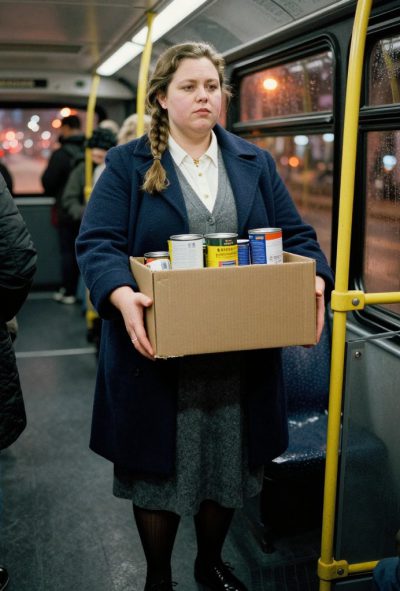
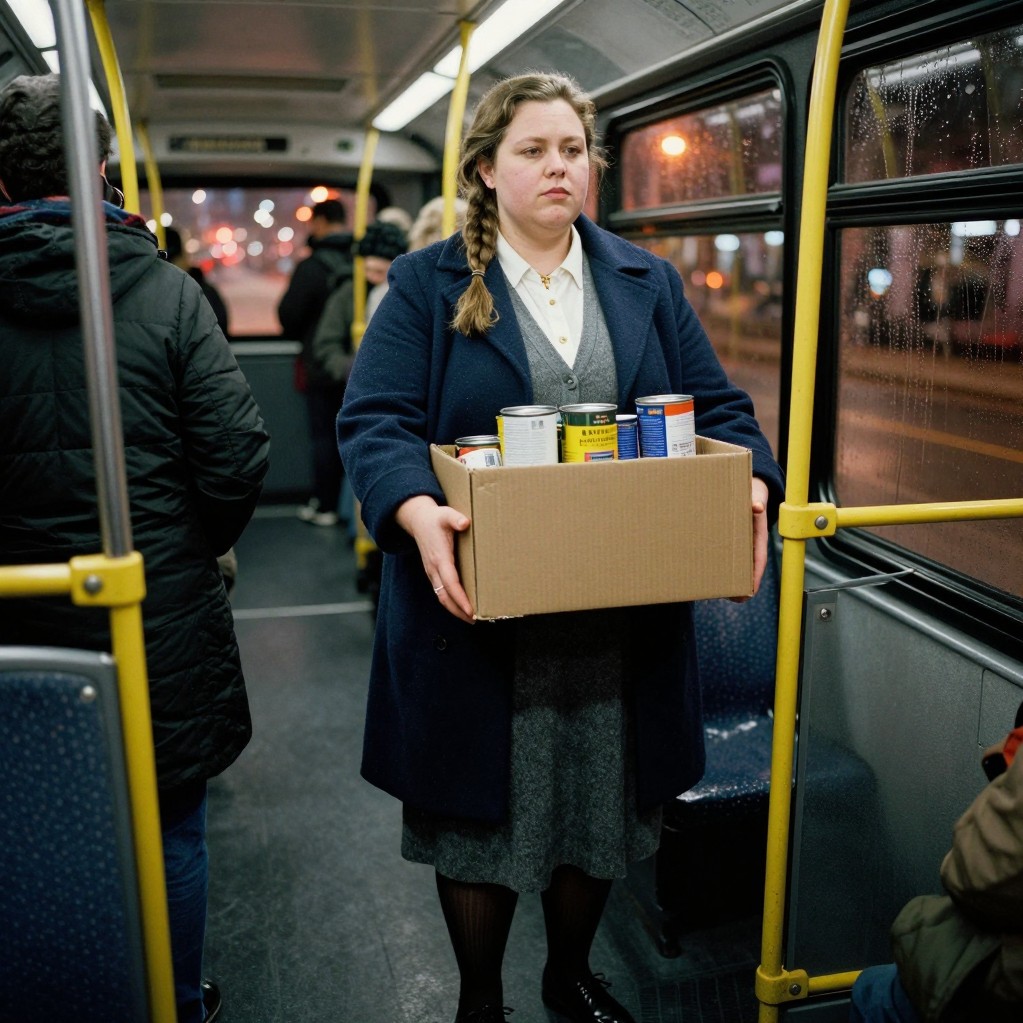
She got on at Lawrence with a cardboard box in her arms.
The box was heavy. I could tell from the way she came up the steps sideways, one hip leading, and the driver waited without saying anything, and the whole bus watched her do it because there was nothing else to watch.
Navy wool coat, a man’s, with the sleeves turned up twice at the cuff and the shoulders hanging past her own. Grey skirt to the middle of the calf. Thick ribbed tights, black, the kind you wear because it is November and not because you want anybody looking. Lace-up shoes, flat, polished, sensible, the kind a nurse wears.
Her hair was in a braid down her back, brown going to grey, and there was no makeup on her face at all, not even the little bit women put on and pretend they didn’t.
A gold cross at her throat, small, on a thin chain, sitting in the hollow.
She set the box down by the wheel well and sat in front of me, and I looked at the back of her neck where the braid started, and the bit of skin there that had gone pink from the cold.
“Ma’am, you can put that up here.” The man across from her moved his bag.
“I’m all right, thank you.”
“It’s going to slide.”
“It has been sliding since Kimball and Lawrence,” she said. “It is the Lord’s canned corn and He can keep it upright.”
The man laughed. She did not, exactly, but her mouth moved, and I saw that she had a good face when it did — round, plain, thirty-five, forty, no trying in it anywhere, with a wide mouth and a strong jaw and eyes the colour of weak tea.
The bus pulled out and her box slid a foot and she caught it with her foot and put it back.
I had a bad week behind me and a cold flat in front of me and I was in no hurry to get to either, so I looked at her.
Not her face.
The coat was a man’s coat, too big in the shoulders, and it made you think about what was under it. The skirt was grey wool, thin at the seat, let out at the waist at some point and badly. The tights were the good thick ones, and under them her calves were heavy — the calves of a woman who carries boxes up stairs.
Her hands were on the box: no rings, but a pale band at the third finger and a red mark where a band had been until recently.
She caught me at it. Not the hands. The hands were nothing.
Her eyes came up and found mine and her whole face went red from the collar of the coat up, in one wave, and she looked at the floor.
“Sorry,” I said.
She said nothing.
“I was looking at the box, is what I’d like to say.”
“You do not have to say anything.” Her voice was low and flat and had a little Chicago in it under whatever else was there. “I know what men look at.”
“I wasn’t looking at that.”
She looked up then, and the redness was still there, but something in her eyes had gone careful. “Then what.”
“Your hands. You’ve got a mark where a ring was.”
The bus stopped at Addison and let four people on and she did not answer me until the doors shut.
“Six years,” she said. “It’s been off six years. It’s still there.”
“That’s a long time for a mark to stay.”
“It’s a long time for a lot of things.”
She said it to the window, and then her mouth started moving.
Not talking. Her lips were going, slow, shaping words with no sound, and her jaw was tight, and her hands had come together on top of the box of canned corn and her fingers were laced.
I had seen people pray on the bus before, old women with beads, a man with his hands over his face. I had never had one pray with her eyes open, at my hands on the rail.
She stopped and wiped her lips with her thumb, and looked at me properly for the first time.
“Are you saved?”
“What?”
“Saved. Born again. Washed in the blood.” She said it like she was reading it off a card. “I have been sitting here four stops asking the Lord to take something out of me and He is not doing it. I would like to know who I am sitting next to.”
I could have lied. I have lied about less.
“No,” I said. “Not lately.”
She nodded slowly, like I had confirmed a diagnosis.
“That’s honest,” she said. “Most of them say yes and then you find out what they mean by it.”
“What do you mean by it?”
“I mean I know what I am and I know what I’m for and I know what the wages of sin are, and I have been standing at that window for six years with my hands folded, and it has not made me one bit less hungry.”
The bus came down to Belmont and the lights of the taquerias went across her face one after another.
“Ruth,” she said. “My name is Ruth.”
“Ruth.”
“Ruth Kessler. I clean Calvary Independent Baptist on Elston and I do the bulletins Thursday nights and I keep the nursery on Sundays, and I am thirty-nine years old and I have a boy in Berwyn who is seventeen and does not call me.”
“That’s a lot to tell a stranger.”
“You asked about my hands.”
The bus lurched at Roscoe and she put her hand out and caught my forearm — hard, all five fingers, the grip of a woman who has caught a lot of falling things — and she did not take it back when the bus straightened out.
Her hand was warm and dry and there was a callus at the base of the fingers.
“I’m sorry,” she said, and did not let go.
“For what?”
“For this.” She looked at her own hand on my arm like it belonged to somebody else. “I’ve been holding on to the rail for four stops and now I’m holding on to you, and I know exactly what I’m doing, and I’m going to keep doing it.”
She had a small gold cross and a plain face and a cardboard box of canned corn, and her thumb had started to move on my sleeve, one slow stroke, up and back, like she was testing whether the cloth was real.
I turned my hand over. She looked at my palm for a second, then put her palm against it, and her fingers closed.
“I get off at Elston,” she said. “The church is a block up. It’s dark and cold and there’s nobody in it but me, and I count the collection and lock the doors and go up the back stairs, every Thursday, by myself.”
“Ask me.”
“I am asking you,” she said, and her voice cracked on the last word, and she was angry about that too, the way she was angry about everything.
Elston was empty and wet, and the wind came up between the buildings and got under her coat.
I carried the box. She let me, which surprised me, and she walked beside me with her hands pushed into her sleeves and her chin down.
“You don’t have to do this,” she said. “I want to say that once, at the start, so that later I know I said it.”
“Do you want me to go home?”
“No.” Very quick. “No. I want you to come in and I want you to be somebody I don’t have to explain myself to, and I know that’s not a thing you can promise.”
The church was brown brick between a tire place and a laundromat, CALVARY cut into the stone over the door, one lit window down in the basement, everything else dark. The sign out front said REVIVAL WEDNESDAY 7 PM and under it GOD IS NOT MOCKED.
She got her keys out. There were nine of them on a ring with a rubber grip.
“It’s cold in here,” she said, unlocking. “It’s cold in here until June.”
Inside it smelled like floor wax and wet coats and old paper. The sanctuary was dark except for the exit sign, and the pews went up both sides, and there was a piano at the front with a scarf over the top of it. She hit four switches and the lights came on in the back half only, so I could see the carpet worn white down the middle aisle and a bulletin on the floor somebody had stepped on.
“Wait here.”
She went down the aisle with her coat still on and came back with a metal bowl and a canvas bag, and set the bowl on the table by the door.
“Wednesday night they put it in the bowl,” she said, sitting down. “Fifty-one dollars and some change, and I count it and I write it in the book and I take it to the bank on Friday, and that is my Thursday.”
She counted it while I stood there. Her lips moved again, not praying this time, just the numbers.
“Why do you do all of this?”
“Because they let me.” She flattened a five with her thumb. “That’s the whole answer. They took everything else away from me, and they let me keep the keys.”
She stacked the bills and put the rubber band on them and did not look up.
“I was twenty when I married him. Dean. He was in the choir and he had a job at the water department and everybody said he was a catch, and I said yes in the fellowship hall with a sheet cake.” She wrote a number in the book. “Nine years. Then he met a woman from the sister church in Oak Lawn and he was gone in a month, and she was pregnant by the spring.”
“What did they do?”
“The elders came to the house. Three of them, in the front room, with their hats in their hands.” She turned a page. “They said the marriage had failed and that failure was in the body of the church, and that I should step back from teaching the girls and from the nursery and from the choir, for a season, while I was restored.”
“For how long?”
“It’s been six years.” She put the pen down. “The season is apparently ongoing. They let me clean. Cleaning is not a calling, so I’m allowed to clean.”
“And you still go.”
“Where would I go?” She looked up. “I have a flat upstairs that comes with the job, a car that doesn’t start, and a boy who lives with his father because his father has a house in Berwyn and I have a room over a church hall. This is my whole life, and it’s on Elston Avenue.”
I sat down in the pew behind the table.
“Does it help?” I said. “The praying. On the bus.”
“It helps about as much as pressing a bruise.” She closed the book. “I was asking Him to make it stop. Not the wanting. The wanting is fine, the wanting is a test. I was asking Him to make me stop looking at men’s laps on the 82.”
She said it the way she said everything, flat, with her chin up, and then she heard herself and put her hand over her mouth.
“Lord,” she said, through her fingers. “I have not said that out loud to another living person.”
“You said it to Him.”
“He already knew.” She stood up and picked up the bowl. “Come on. Before I come to my senses.”
The back stairs were narrow, the rail was loose, and there was a bulb over the landing on a pull chain. She went up first, and I walked behind her and looked, and she knew I was looking and did not hurry.
“Mind the third one,” she said. “It’s soft.”
The flat was two rooms and a kitchen, and it was hot, and it smelled like lemon polish and something baking that had been baking a long time ago.
There was a verse on the wall over the table, cross-stitched, framed in gold: AS FOR ME AND MY HOUSE. A sofa with an afghan folded on the arm, an upright piano with a hymnal open on the stand, a calendar with the church’s whole month on it in a small tight hand.
And through the door in the back, a bed. One bed. Narrow, made, with a white spread and two pillows.
She put the kettle on and stood with her back to me, and her shoulders were up around her ears.
“You can take your coat off,” she said. “I’m going to take mine off, and then we’re going to have a cup of tea, and then I’m going to ask you something, and you can say no.”
She hung her coat on the hook behind the door and turned around, and the cardigan under it was grey and buttoned to the throat, and the blouse under that was white and buttoned too, and the skirt had a safety pin where the button should have been.
The tea was too hot to drink, so we held the cups and looked at the table.
“Ask me,” I said.
She took a breath and put her cup down and folded her hands in front of her like a woman in a meeting.
“I want you to stay.” She said it slowly, one word at a time, and her knuckles were white. “I want you to do what married people do, and I want you to do it to me, and I have been thinking about how to say it for a block and a half.”
“Why me?”
“Because you told the truth on a bus and you carried a box of corn four blocks and you haven’t once looked at me like I’m a joke.” Her chin came up. “And because I am thirty-nine, and being good has started to feel like being dead.”
“Ruth—”
“You can say no.” Her voice was steady and her hands were not. “I’ll make you drink your tea and walk you down and I’ll see you on the 82, and I won’t be strange about it.”
I stood up and came around the table.
She stood up too, too fast, and knocked her cup, and caught it, and said “sorry” to the cup.
“I don’t want to be handled like something that might break,” she said.
“I wasn’t going to.”
“Then do something.”
I put my hand on the side of her neck and her eyes shut and she made a sound, a small one, like a woman setting down something heavy.
I kissed her. She did not know what to do with her mouth at first and then she did, and one hand came up and took hold of the front of my shirt, and the other stayed at her side, clenched.
She broke off and put her forehead against my chin.
“Wait. Wait.” She stepped back. “Not like this. Not with the verse looking at me.”
She went to the window and pulled the shade down and stood there with her hand on it.
“I know what I’m doing,” she said, out loud, to the ceiling, and it was not for me. “I know exactly what I’m doing and I am not going to pretend I don’t. Amen.”
Then she came back and kissed me herself, hard, badly, with her hands in my hair, and walked me backwards until the table edge caught her.
The cardigan went first. She did it herself, quick, like a bandage.
The blouse had eleven little buttons and I got four of them; she did the rest. Underneath was a white cotton bra that was not pretty and was not meant to be — thick, wide-strapped, the kind that costs twenty dollars and does a job — and it was doing the job.
“Don’t look at that yet,” she said.
“I’m looking.”
“I know you’re looking. I can feel you looking.” She reached behind her back and got the hooks and pulled the thing off and stood there with her arms half up, and then she made herself put them down.
She was pale all over, the white of somebody who keeps her clothes on, and built like a woman who works: broad across the shoulders from lifting, soft and full at the breasts, heavy through the hips, with the seam of the skirt still pressed into her skin. Her nipples were wide and dark and had gone hard in the cold room, and there were silvery marks low on her belly and a Caesarean scar, old and pale, under the waistband.
I put my hand flat on her stomach, over the scar.
“That’s the boy,” she said. “That’s David.”
“David.”
“Seventeen. He plays baseball and he doesn’t call.” Her voice was doing something. “Don’t be kind about that either. If you’re kind about that I’ll cry and then I’ll stop and I don’t want to stop.”
The skirt went down with the pin still in it. The tights came off with a struggle and a hop, one hand on my shoulder, and she laughed out of nowhere with them around one ankle, and then she stood in white cotton pants with her hands at her sides.
She was not trimmed or waxed or any of the things women do now. Dark hair, a lot of it, and the tops of her thighs full and pale and the muscle in them hard as a rope from a lifetime of stairs.
“Your turn,” she said.
I got my belt undone. She watched my hands and then she watched the rest of it and her mouth came open and stayed open.
“That’s — ” She stopped.
“What.”
“That’s not what I — ” She covered her mouth with her fingers and let them drop. “I’ve seen my husband. I was married nine years. I know what one looks like.”
“And?”
“And that is a great deal more than one looks like,” she said, and her voice had gone up at the end, and she was blushing down her chest.
I took her hand and put it there. She held it like a woman holding a bird, and then not like that at all, and her thumb moved and she made a noise in her throat.
“Lie down,” I said.
“On the bed?”
“On the bed.”
She walked into the back room ahead of me. The bed was as narrow as it looked, the spread was white, and there was a Bible on the nightstand with a ribbon in it and a clock radio with the time wrong.
She lay down on her back with her knees together and her hands folded on her chest, and she was shaking. “I’m cold,” she said. “I’m not cold. I’m not a virgin, for goodness’ sake — I did this every week for nine years with a man who read the sports page afterwards.”
“Terrified,” she said, when I asked her what she was. “He never — it was quick. It was always quick and it was always dark and then he was asleep, and I used to lie there and think, is this it, is this the whole thing, and then get up and make his lunch.”
I moved my hand up her thigh and she stopped talking.
Her legs came apart an inch at a time, and she was already wet before I got there, and when I put my fingers on her she grabbed my wrist and held it still.
“Don’t move yet,” she said. “Just — leave it there.”
I left it there. Her hips came up off the bed a half inch, then down, and she made a sound through her nose.
“All right,” she said. “Move.”
I moved, and she came in under a minute, which she had not expected at all, and it was not quiet. Her hand got the headboard, her heels dug in, she said “oh” four or five times going up each time, and then “stop, stop,” and I stopped, and she lay still, breathing like she had been running.
The room smelled like her. It had not smelled like anything before.
“That’s never happened,” she said, from under her arm.
“Never?”
“Nine years.” The arm came down. Her eyes were wet and furious. “Nine years of Wednesday and Sunday and he never once — and I thought it was me. I thought there was something wrong with me, that I was made wrong.” She put both hands over her face. “Oh, I’m so angry. I’m lying here naked and I’m so angry I could spit.”
“Be angry later.”
“That’s not very Christian of you.”
“I’m not the Christian here.”
She laughed, and it turned into something else, and she pulled me down by the shoulders.
The bed was too narrow for two people, which we found out when I got between her legs and my knee went off the edge. She hooked one foot around my calf and said, into my ear, “Don’t be careful.”
I was careful anyway for the first inch, and she reached down and put her hand around me and guided me, and pushed.
“Oh,” she said. “Oh — that’s — you’re all the way in.”
“Not all the way.”
“Don’t you dare say a thing like that to me.” Her voice had gone high and thin. “Move. Slowly. I want to feel all of it.”
I moved and she held my face in both hands and watched me the whole time, which almost undid me, and the headboard knocked the wall and she said, “the neighbours,” and then, “I don’t care about the neighbours.”
She came again with her teeth in my shoulder, and then she was saying things that were half prayer and half not — “please, please, oh Lord, please” — and I don’t think she knew which one she meant.
“Ruth—”
“Not yet.” Her hand flat on my chest. “Not yet. I want — ” She pushed me onto my back and got up over me, all knees and laughing, and then she found the angle and came down on it and stopped laughing.
“Lord,” she said. “Lord, that’s deep.” She rocked once and her whole body shuddered, and then she was riding me with the cross swinging on her collarbone, hard and graceless and certain, and I said her name and she said, “now, now,” and got off me.
She finished it with her hand, hard and unpracticed and completely certain, and it went over her belly and her fingers and a little of it on her thigh.
“That’s an awful lot,” she said, in the same voice she used for the collection, and she had not let go of it.
“It’s been six years for me.”
She sat there with it in her hand and looked at what was on her stomach like a word she was sounding out, and then said, “I’m not sorry,” and wiped her hand on the sheet.
“I’m going to wash,” she said. “And then I’m going to do something else.”
“What else?”
“I’ll tell you when I’m doing it.”
She was gone a minute. I heard the tap and the towel, and then she came back with the sheet wrapped around her and her face washed and her hair down in a mess around her shoulders, and she looked a decade younger and a hundred times less frightened.
She knelt down on the floor at the foot of the bed, which was not what I had expected, and put her hands on my knees.
“Show me,” she said. “Not with your mouth. With your hand on my head — show me what to do and I’ll do it.”
“You don’t have to.”
“I want to.” She looked up. “Every part of it. And then I want to be able to say I did it, to myself, in that church on Sunday when they hand me the tray.”
“Ruth.”
“Show me,” she said, and opened her mouth.
I put my palm on the crown of her head and she went down on it and came off coughing and went down again. She was not good at it at first. She used her teeth by accident and I said so and she said “sorry” with her mouth full, which is a strange thing to hear from a woman on her knees.
Then she got it: her hand and her mouth together, wet and slow and deliberate, learning as she went, and she made a small satisfied noise every time my hand tightened in her hair.
“Ruth, I’m going to—”
She came off just long enough to say, “I know,” and then, “Go on, then,” and went back down.
I finished in her mouth and she stayed there for it, and then she knelt up straight with her hand at her lips and swallowed and coughed once and wiped her eyes with her knuckles.
“Well,” she said.
“Are you all right?”
“I’ll be thinking about that one for a while.” She looked at the towel, at the bed, at me. “It’s a person. It’s a whole person you’re doing that with, and nobody tells you that either.”
She got up off the floor and got onto the bed and put her head on my chest, and her hair smelled like the church, and she said, “Don’t go home. There’s the sofa. It’s terrible but it’s a sofa.”
I woke up on the sofa at six with the afghan over me and the radiator knocking and eggs frying.
She was at the stove in a robe and a pair of slippers, with her hair down and her face puffy from sleep, and she had made too many eggs.
“Sit,” she said. “It’s Thursday and I’ve got the bank and the bulletins and I don’t have time to be shy about this, so I’m going to be practical, and then I’m going to be shy about it later when I’m alone.”
I sat. She put the plate down in front of me and then sat down opposite and folded her hands and bowed her head, and I did not know what to do with mine, so I bowed it too.
“Lord, thank you for this food,” she said. “Thank you for the man who carried the corn and stayed, whatever he is and whatever I am, and thank you that I am still able to be surprised. Amen.”
“Amen,” I said.
She looked up and her mouth was doing something it had not done all night.
“Don’t you dare say amen to that.”
“You said it.”
“I said it to Him.” She pointed her fork at me. “You are not in the conversation.”
“There’s a thing I have to say.” She put her fork down. “If anybody saw you leave — if Mrs. Kovacs next door saw, or the deacons hear — I lose this flat. It comes with the job, and the job comes with the flat.”
“Then I’ll go out the back.”
“The back goes past the tire place and the tire place opens at seven.” She thought about it. “Seven is fine. It’s the men coming in for their winter tires. Nobody looks up.”
“Ruth.”
“I’m not ashamed of it.” Her chin came up. “I want that said out loud, first, because I will be ashamed at some point today, in the middle of the bulletins. I am not ashamed. I am scared, which is different.”
She cleared the plates and washed them and put them on the rack, and then she went into the back room and got dressed with the door open.
The thick tights. The grey skirt with the pin in it. The white blouse, the grey cardigan, all eleven buttons. The bra with the wide straps that flattened her down to nothing, and I watched her put it on and it was like paint over a window.
She did her hair at the mirror in the front room, one long braid, quick, practiced, and put the little gold cross straight.
“How do I look?”
“Like a woman who cleans a church.”
“Good.” She smiled at herself in the glass. “That’s the whole trick. It has been the whole trick for six years.”
At the door she handed me my coat and did not open the door.
“Sunday,” she said. “Eleven o’clock. There’s a service and there’s a Sunday school before it and I’ll be in the nursery with the babies until quarter of.”
“I’m not coming to church, Ruth.”
“You’re not coming to church, you’re coming to look at me.” She said it plainly. “Sit in the third row from the back, on the aisle, and don’t you dare come down to the front, and don’t you dare sing. You don’t know the hymns and you’ll make a show of yourself.”
“Third from the back.”
“On the aisle.” She opened the door. The stairs smelled like cold brick. “And mind the third step, it’s soft.”
I went down past the tire place at seven with my collar up and the taste of her still in my mouth, and got the 82 southbound at Elston with the windows fogged, and sat by the wheel well where she had put down a box of the Lord’s canned corn.
The whole way home the bus smelled like lemon polish.
My Bus Adventures #12: Unopened
My Bus Adventures #11: Deep Clean
My Bus Adventures #10: Close Quarters
My Bus Adventures #9: The Back Row
My Bus Adventures #8: Night Shift
My Bus Adventures #7: Beginner’s Luck
My Bus Adventures #6: Standing Room
My Bus Adventures #5: Late Pass
My Bus Adventures #4: Straight Lines
My Bus Adventures #3: The Signal
My Bus Adventures #2: Window Seat
My Bus Adventures #1: The 9:40
Related posts:
 My Bus Adventures #12: Unopened
 My Bus Adventures #5: Late Pass
 My Bus Adventures #3: The Signal
 My Bus Adventures #8: Night Shift
 My Bus Adventures #4: Straight Lines
 My Bus Adventures #9: The Back Row
 My Bus Adventures #6: Standing Room
 My Bus Adventures #2: Window Seat
 My Bus Adventures #10: Close Quarters
 My Bus Adventures #7: Beginner’s Luck
 My Bus Adventures #11: Deep Clean
 My Bus Adventures #1: The 9:40