

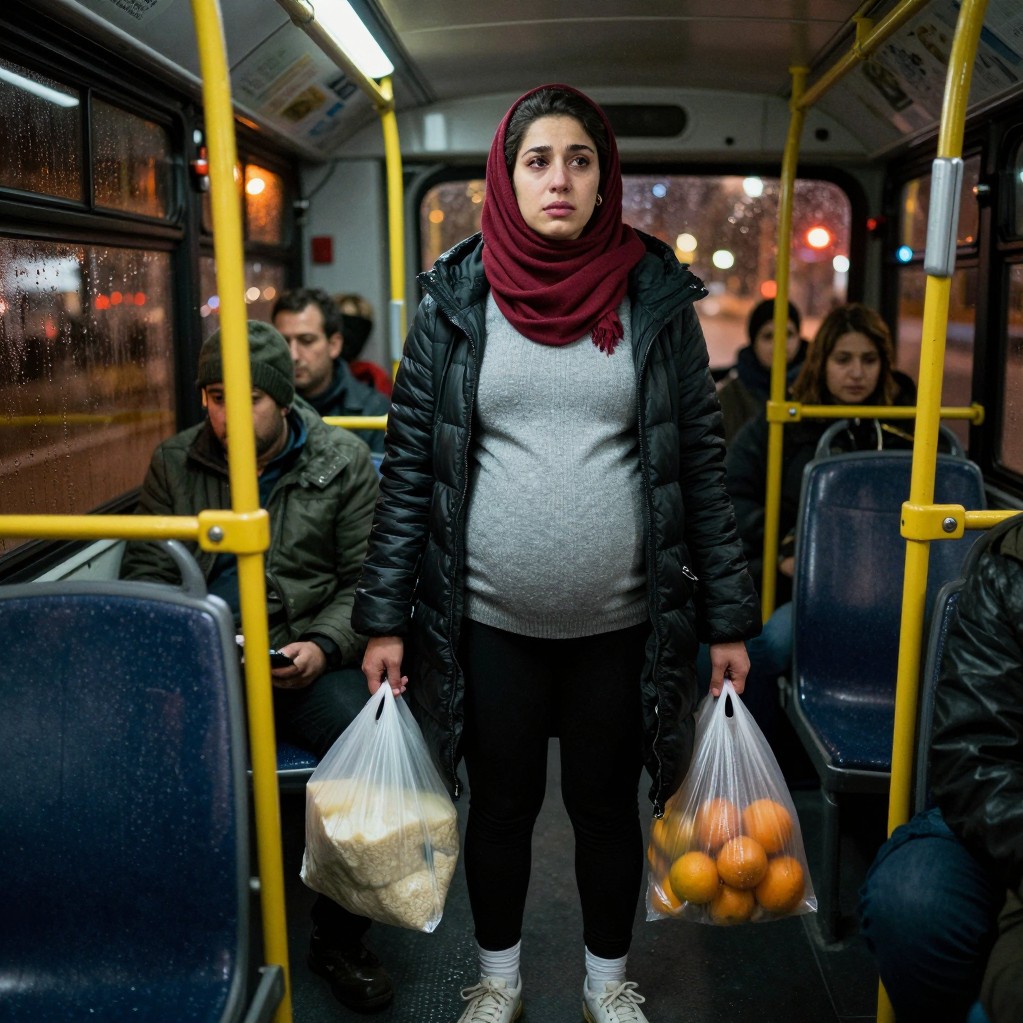
The 151 came up Sheridan at ten past eight with the heat too high and every window running, and she got on at Loyola with two plastic bags and a purse she had to hold with her teeth.
Nobody got up. There were seats in the back and she looked at them the way a person looks at a hill.
She was young. That was the first thing and it was not the thing I kept looking at. Twenty-three, maybe twenty-four, with a face that had not gone hard yet, round and brown and tired, and lashes so long they looked drawn on.
The scarf was the second thing. Dark red, jersey, wrapped close around her head and pinned at the side, the ends tucked in, not a single hair showing, and a gold hoop in one ear that the scarf had been arranged around on purpose.
Then the coat, open, because it would not close. Black puffer, cheap, the zip broken at the bottom. Under it a grey sweater stretched over a belly seven months along, black leggings, men’s white socks in sneakers that had been rained on and dried until they cracked.
Her hips were the thing I could not stop looking at. Wide, heavy, womanly in a way that made the rest of her look smaller — the hips of a woman built for exactly what she was doing, carrying a child in front of her like a sack of flour.
She got the bags down the aisle and sat sideways in the seat across from me because she could not sit straight, and put one bag between her feet and the other on her knees.
“Excuse me,” she said, to nobody, in English with a heavy roll in it, and then something in Arabic under her breath.
The bus pulled out and she started going through the first bag with both hands, checking, the way you check when you have counted the money four times already and you are going to count it a fifth.
Bread. Rice. A bag of lentils with the top torn open and taped. Four eggs in a plastic bag inside the bag. A jar of something red.
The second bag had milk and oranges and a pack of the cheap diapers, size one, which is what you buy when the baby is not here yet and they are on sale and you cannot believe it is coming.
She caught me looking at the diapers and her face did something.
“You have children?” she said.
“No.”
“How old are you?”
“Forty-four.”
She nodded, and looked at the window, and then back at me, and made a decision about something.
“Excuse me. Is this going to Devon?”
“Past it. It turns at Devon.”
“Good.” She put her hand on the bag of rice. “I am going to Devon. There is a man there who sells the good bread and he gives me the bread from yesterday for one dollar. But tonight he is closed, because it is Tuesday, and I forgot it is Tuesday.”
“That’s a lot of groceries to carry from Loyola.”
“The Jewel is cheaper there.” She said it like a fact she had fought for. “Two dollars and sixty cents cheaper. I know, because I wrote it.”
The bus stopped at Granville and a man in a hood got on and stood over her, and she moved the bag of oranges off the seat without being asked, and he sat down and put his music on loud enough for three rows.
She looked at me again, over the rice.
“You are looking at me,” she said. Not angry. Just saying it, the way you would say the bus is late.
“I know.”
“Why?”
“Because you’re the most interesting thing on this bus and I’ve been on it since Addison.”
She thought about that for a while. Her hand went to the pin at her jaw and checked it, once, a small automatic movement.
“I am not interesting,” she said. “I am a woman with two bags.”
“You’re pregnant and carrying forty pounds of groceries up Sheridan at eight o’clock at night. That’s interesting.”
“It is not interesting. It is Tuesday.” She looked at the window. “Every day is Tuesday.”
At Devon she stood up too fast and the bag of oranges went over and rolled down the aisle, and I got three of them and a man in a Bears hat got the rest, and she stood there saying “sorry, sorry, thank you, sorry” in two languages with her hand flat on her belly.
The doors opened at Devon and she got down with the bags and I got down behind her, because I was going that way anyway and because she was going to drop something on the steps.
“You do not have to help me.”
“I’m not helping. I’m walking.”
“It is the same thing,” she said, and let me take the rice.
Devon at night is a street of lit shop signs in four alphabets and men outside the groceries talking, wind coming off the lake four blocks east. She walked with her chin down and her scarf ends flapping and her belly going before her like a lantern.
“I am Rania,” she said.
“Rania.”
“Rania. Like the song.” She said it flatly, like she had said it a thousand times to people who did not know the song. “And you?”
I told her. She repeated it badly and then correctly, and nodded, and did not say anything else for half a block.
“My husband is called Bassel,” she said, at the corner. “He is not dead. I want to say that first, because people are always sorry for me in the wrong way.”
“Where is he?”
“Detroit.” She shifted the bag on her hip. “He has a cousin there with a shop. He went in August to look at it, came back for his clothes and the money, and went again, and now there is a woman there, a Libyan woman with a car.”
The light changed. We crossed.
“And the baby?”
“The baby is mine,” she said. “That is the only thing he did not take.”
Her room was behind a laundromat on Pratt, down a set of concrete steps with a handrail that had rusted through in one place, and the door had a number on it in marker: 2B.
“Two minutes,” she said. “I have to put the milk in the cold.”
I stood at the bottom of the steps with the rice. There was a window at street level with a sheet pinned over it, and a light behind the sheet, and a smell of cooking oil and someone else’s cigarettes.
She came back out without the bags and with a jacket on over the sweater, and she stood in the doorway with her arms folded under her belly, holding it up the way pregnant women do without knowing they are doing it.
“Now,” she said. “You said the flat needs cleaning.”
“I said I’d pay you to clean it. Not tonight.”
“Tomorrow I have to give her three hundred dollars.” She said it like a weather report. “I have thirty-seven. My cousin can give me one hundred on Friday but Friday is too late. She wants it Thursday, she is not a bad woman, she has a mortgage, so I do not blame her and I do not have the money.”
“Rania—”
“The salon was paying me forty a day to sweep hair and wash towels. Then I got too big to bend over the sink and the woman said come back in February.” She put her hand flat on the doorframe. “Two years and four months I have been here. A case number, a lawyer who does not call me back, a county card that buys the milk. I am not asking for anything. These are the numbers.”
“I’ll give you the money.”
“No.” Very fast. “No. I clean your flat and you pay me for the cleaning. That is a job. I have done jobs since I was fourteen.”
“It’s ten o’clock at night.”
“I am awake at two in the morning and at four,” she said. “The baby is on my bladder and my head is full of numbers. I would rather scrub a floor.”
So we went.
It was eleven blocks and we walked them slowly because of the ice on the corners, and she talked the whole way, in that flat reporting voice, and I learned the whole architecture of her life before we got to Lawrence.
Homs until she was nineteen. A building with a courtyard and a fig tree. Two brothers, one in Germany now, one she does not talk about. A father who died in 2016 of something ordinary, in a country where hearts were not what killed you. A mother in Irbid, waiting for papers.
“I was going to study,” she said. “Pharmacy. I had the marks. I had the marks for the university in Damascus and then there was no university in Damascus.”
“And Bassel?”
“Bassel was in the queue at the aid office.” She stepped around a puddle. “He had a good jacket, and he was polite, and my mother said he is from a good family, and we were married in eleven days. I thought that was what a life was: you got in the car and somebody drove you.”
The light at Lawrence took forever. She stood with her hand on her belly and her eyes on the red hand.
“He was not a bad man at first,” she said. “I want to say that too. He carried the boxes up three flights. He put his hand here.” She touched the side of her belly. “Every night he put his hand here and said, this one will be a doctor.”
“And then?”
“And then we came here, and there was no work for him, and a man at the mosque found him a kitchen job and he did that for a year and a half and he was tired, and I was tired, and we were in one room with one window, and he started to say it was my fault. Then he stopped saying it and just went.”
The building is a three-flat on Kenmore with a buzzer that does not work and a hallway that smells like the Indian place downstairs. She stopped at the bottom and looked up them.
“Which floor?”
“Third.”
“Of course it is third,” she said, and started up.
I have never seen anybody clean a flat like that.
She took her jacket off and dropped it on a chair, and put her scarf straight with two hands, and then went through my kitchen like a health inspector: the dishes, the inside of the fridge, the drawer with the takeout menus in it. She found the rubber gloves under the sink and put them on and they were too big and she did not care.
“You have no bleach,” she said.
“I have bleach.”
“You have a bottle with a little bleach in the bottom of it. This is not bleach, this is a memory of bleach.”
She scrubbed the stove for twenty minutes, then the cabinet fronts, then the floor on her hands and knees, which I told her not to do twice, and she said, “I am not an invalid, I am pregnant,” and kept going.
At midnight she was standing on a chair with a cloth, doing the top of the cupboard where I keep the things I never use. I said, “That’s enough, come down,” and she said, “One minute,” and then she stopped with her hand on the cupboard door and did not come down.
“I am dizzy,” she said, in a completely different voice.
I got her down and into the chair and put a glass of water in her hand and she drank it and put her head back and shut her eyes and said, “I am sorry. I have not eaten since eleven.”
“Jesus, Rania.”
“Don’t.” Her eyes were still shut. “Do not do the voice. Everybody does the voice.”
I made her eat. Eggs and the end of a loaf and a glass of milk, and she sat at the table with the gloves still on and cried while she ate, which is a thing I had never seen anybody do.
“I am not crying because I am sad,” she said, with her mouth full. “I am crying because I am tired and the eggs are hot.”
“Eat.”
“You are a strange man.” She wiped her face with the back of the glove, which did not work, then took the glove off and used her wrist. “You give a woman a job at ten o’clock and then cook for her.”
“In my country it’s not either.”
She laughed — a real one, surprised out of her — and then put her fork down and looked at the clean kitchen: the shine on the stove, the floor, the front of the cabinets.
“One hundred and twenty,” I said, and put it on the table.
She looked at the money for a long time and did not touch it.
“Fifty,” she said.
“One twenty.”
“The job is fifty. I did four hours. That is fifty and maybe sixty because of the cupboard, but one hundred and twenty is not a number for cleaning.”
“It’s the number for cleaning at midnight on a Tuesday.”
“That is not a thing.” Her chin came up. “You are doing the thing that people do. You are giving me money and calling it work so that I do not have to be a woman who is given money.”
“Yes.”
“Then say it.”
“I’d rather give you money than watch you carry rice up Sheridan in the dark.”
“Say it properly.”
I sat down across from her.
“I have three hundred dollars in a drawer that I don’t need this month,” I said. “You need it on Thursday or you and that baby are out in January. I would like to give it to you, and I would like you to take it, and I would like to stop pretending it’s about a stove.”
She put her fingers over her mouth and stared at the ceiling for a while.
“Okay,” she said, finally. “But I am going to clean this flat every Thursday until the baby comes, and after the baby comes, and you are going to pay me fifty. The rest is a loan and I will pay it back when I have the permit, and I am going to write it in my book.”
“Fine.”
“Not fine. Written.” She got a notebook the size of a hand out of her purse, with a pen clipped to it, and wrote in Arabic and then in numbers, and turned it around: 300, and under it, THURSDAY, and under that, RANIA.
“Now it is real,” she said.
She sat back and drank the last of the milk and held my eyes over the glass, and something in her face had changed and I could not tell what it was.
“You are not going to ask me anything,” she said.
“About what?”
“About how I am going to pay the rest.” She set the glass down. “I have been in this country two years and I know how this works. A man helps a woman like me and then one night he is standing too close in the kitchen and he is waiting to see if she says something. So I am going to say something first, and then we will both know.”
“Rania—”
“Wait.” Her hand came up. “I am not a fool and I am not a child. I know what I look like now. I look like a woman with a belly and no husband and no money, and there are men who like that because they think it is cheap.” She looked at me. “You are not one of those. You have not once looked at me the way they look. That is why I am telling you the truth.”
“Which is what?”
“Which is that I have been dead for three months.” Her voice was low and steady. “I get up and I buy the milk and I count the money and I see the lawyer and I lie on that bed listening to the laundromat and I am dead. And tonight I scrubbed a floor and a man cooked me eggs and I felt something in my chest that was not fear.”
She stood up. The chair scraped.
“I am not asking you for money,” she said. “I have the money. I am asking you for one night where I am not a woman with two bags.”
“Your baby.”
“My baby is asleep and my baby is fine and I am not going to do anything stupid.” She put her hand flat on the belly, low. “I asked the doctor in September, at the clinic on Devon, because I am not an idiot. She said it is fine if it is fine. And it is fine, and I am the one who decides.”
I stood up. She did not step back, and she did not come forward either. She just stood there with her chin up and her hand on her belly and her scarf pinned neat at her jaw, and waited.
I put my hand on her waist, on the wide part above the hip, and she let out a breath like she had been holding it since Devon.
“Okay,” she said. “Okay.”
The sweater came off over her head and the undershirt under it, and she stood in a nursing bra that she had already bought, and black leggings, and her belly was enormous and low and brown and shining, with a dark line down the middle of it and the skin pulled tight.
“Don’t look at it like that,” she said.
“Like what?”
“I’m looking at it because it’s the best thing I’ve seen all year.”
She made a sound that was not quite a laugh. Her breasts were full and heavy over the top of the bra and the nipples were wide and dark and she was embarrassed by them, which she said out loud, in English, and then in Arabic.
The leggings went down with the pants and she stepped out, her hand going straight to the dark hair between her legs.
“I cannot see it,” she said. “I cannot see anything down there since the sixth month. I am shaving like a blind woman.”
“I don’t care.”
“You say that now.”
“I’ll say it in the morning too.”
She held my eyes for a second, then reached up and took the pin out of the scarf.
“You don’t have to,” I said.
“Only my husband has seen this.” She unwound it, and the hair came down, dark and long and heavy, going to her waist, and she ran both hands through it. “And my mother. And now a man who cooks eggs.”
She kissed like somebody who had not been kissed in a year, which she had not, and she did it with her whole face, and her hands stayed on my chest at first and then went everywhere.
“Slow,” she said, against my mouth. “I am not glass but slow.”
We got to the bed eventually. She sat down on the edge of it and pulled me by the belt and undid it herself, and when it was out she looked at it, then at my face, and said, “Okay,” in a completely different tone than she had been using, and put her hand around it.
“That is — ” She stopped. “That is big.”
“It’s all right.”
“I did not say it was not all right.” She was stroking it slowly, learning it, and her eyes had gone from tired to something else. “In my head I am still a woman who has one husband and one bed. And now I am in Chicago in a strange flat and it is big and I am not frightened.”
“You don’t have to do anything.”
“I know I don’t have to.” She looked up. “That is the whole point. I have not been able to do anything I did not have to for three months.”
She lay back on the bed, and I put a pillow under her hip and she watched me, and said, “The doctor said that. On the side.”
“Then on the side.”
She turned over. Her back was broad and smooth and her hips went out wide and the belly hung under her, and she reached back and found my hand and pulled it around her, onto the belly, and held it there.
“Careful,” she said. “Not because of the baby. Because of me. I am very — ” She laughed into the pillow. “Everything is close. Everything is near the surface. Since the sixth month I am like a radio with the volume broken.”
I went in slowly and she went quiet, and then her whole back moved, one long shudder from the base of her spine up, and she said something in Arabic into the pillow and then, in English, “again. That. Again.”
“Like that?”
“Like that. God. Like that.” Her hand came back and grabbed my hip. “Do not stop to ask me things. I will tell you if it is wrong.”
I did not stop to ask her things.
She was wet in a way that made it easy and loud, and after a while she put her own hand over her mouth because the window was at street level and the sheet over it was thin, and then she took it away and stopped caring, and the bed made a noise like an old door and she said, “the bed, the bed,” and laughed.
“Wait,” she said. “Wait. I want to see you.”
She turned over, which took a while, and got a pillow under her hip on the other side, and put her knees up, and looked at me and pulled me down by the neck.
“I want to see a man’s face,” she said. “It has been a long time since I saw a man’s face while he was inside me.”
It was different on her back. She could not close her legs and she did not want to, and her hands were on my shoulders and then in my hair and then flat on my chest, pushing, not to get away.
“Talk to me,” she said.
“What do you want me to say?”
“Anything. Say my name.”
“Rania.”
“Again.”
“Rania.”
She came with her teeth in my shoulder and her hand over her own mouth, and it went on longer than I expected, three waves of it, and in the middle she said “oh no, oh no” like something had gone wrong, and then she was holding my head against her neck.
The bed was wet. So was my hand. She looked down at herself and then at me and her face did something complicated.
“That has not happened,” she said. “Not since — I do not know. Not like that. Not ever like that.”
“Not ever?”
“I am twenty-three and I have been married two years and four months.” She wiped her forehead. “He used to do it in the dark with the television on, and I used to lie there thinking about the laundry. And now I am in Chicago with my belly out and a man’s hand still wet and I am — ” She laughed and her eyes filled. “I am so angry at him. That is all.”
“Be angry at him.”
“He is in Detroit.” She wiped her eyes. “It is a four-hour drive and I do not have a car.”
She looked down at me, at what was still hard against her thigh, and her hand came down and found it and held it.
“Now you,” she said. “But not inside.”
“Rania—”
“Not inside.” She said it clearly, without shame. “I have one thing in my life that cannot be explained and it is this belly. I am not going to spend tomorrow at the clinic on Devon explaining a thing I cannot explain. So. Not inside.”
She sat up and got her legs off the bed and pulled me to stand in front of her, and then she thought better of it and made me sit down on the edge, and knelt on the floor between my knees with her hair down over her shoulders and her belly against my shin.
“You are going to watch,” she said.
“I’m watching.”
“Good. Because I want to know what a man looks like when it is me doing it.”
Her hand was small and sure and she did it the way she did everything, methodically, watching my face, adjusting, learning, saying things in Arabic and then in English — “like this? yes? like this?” — and when I told her she was close she slowed down, and it was worse and better.
“Rania.”
“Not yet.” She tightened her hand. “I want to see it. I have not seen it in a long time and I want to see it.”
She got it. It went over her fingers and her wrist and a little on the inside of her forearm, and she did not flinch, she watched it happen with her mouth slightly open, and then she knelt up straight and looked at her hand.
“Okay,” she said.
“Are you all right?”
“I am extremely all right.” She wiped her hand on the sheet and then thought about it and wiped it again. “In my country there is a word for a woman who does this and it is not a nice word. I am going to say it to myself in the morning and I am not going to care.”
She got shy afterwards, which I had not expected. She went into the bathroom and washed and came out with her hair braided back and her scarf in her hands, and she stood in the doorway of the bedroom with it and did not come in.
“Now you are going to say something,” she said.
“Like what?”
“Something about how I am not that kind of woman.” Her chin was up. “The men in the mosque say it about women who live alone. I know what I am and I am not going to be told by a man who has never been hungry.”
“Come to bed, Rania.”
She came to bed and lay down on her side facing me and put the scarf on the pillow between us, folded, neat, and I turned the light off.
“I am not that kind of woman,” she said, in the dark.
“I know.”
“I am a woman who scrubbed a stove for four hours and then had the best night of her life, and in the morning I am going to pay the rent and be normal.”
“Okay.”
“Okay,” she said, and then, after a while, “put your hand here.”
I put my hand on her belly, on the side of it, the way her husband used to, and the baby moved under my palm, a slow roll like something turning over in its sleep, and she made a small sound.
“He does that when he hears a voice,” she said. “He likes low voices. He is going to be a big man and he is going to carry the boxes and I am going to sit down.”
She fell asleep in about four minutes. I lay there with my hand on her belly and the radiator knocking and the laundromat sign going on and off through the sheet at the window, and at some point I slept too.
At six she was dressed and standing at the door with her coat zipped to the chin and the scarf wrapped and pinned, and the three hundred dollars in an envelope in her purse, and a list in her notebook.
“Thursday,” she said. “I come at seven and I do the bathroom and the windows and then I go, because Thursday is when the laundromat is quiet and I can sleep in the afternoon.”
“Thursday.”
“You are going to pay me fifty.”
“I’m going to pay you fifty.”
“And the rest is a loan.” She pointed at me with the pen. “You are not a good man for this. Do not think I think you are a good man. You are a man with a drawer of money and I am a woman who needed it, and that is the whole of it, and I am not going to make it into a story.”
“Rania.”
“What.”
“You’re going to be all right.”
She stood there with her hand on the door and her mouth working.
“I know,” she said. “I know I am going to be all right. I have known that since the fourth month, when I understood that he was not coming back and that the baby was still coming.” She opened the door. “It is only that I did not know when.”
She went up the concrete steps with her coat on and her purse under her arm, and at the top she turned around, and I thought she was going to say something. She put her hand up and touched the pin at her jaw, once, and then she went around the corner toward Devon and the bread man who sells yesterday’s for a dollar.
I got the 151 south an hour later and sat where she had sat, and the window had been wiped clean by somebody’s hand and there was a smell of oranges in the seat.
The whole way downtown I kept thinking about the notebook, and the number three hundred, and the word she had written under it in Arabic, which she had not translated, and which I did not need translated to understand.
My Bus Adventures #13: The Discipline
My Bus Adventures #12: Unopened
My Bus Adventures #11: Deep Clean
My Bus Adventures #10: Close Quarters
My Bus Adventures #9: The Back Row
My Bus Adventures #8: Night Shift
My Bus Adventures #7: Beginner’s Luck
My Bus Adventures #6: Standing Room
My Bus Adventures #5: Late Pass
My Bus Adventures #4: Straight Lines
My Bus Adventures #3: The Signal
My Bus Adventures #2: Window Seat
My Bus Adventures #1: The 9:40
Related posts:
 My Bus Adventures #3: The Signal
 My Bus Adventures #12: Unopened
 My Bus Adventures #8: Night Shift
 My Bus Adventures #4: Straight Lines
 My Bus Adventures #6: Standing Room
 My Bus Adventures #13: The Discipline
 My Bus Adventures #1: The 9:40
 My Bus Adventures #9: The Back Row
 My Bus Adventures #11: Deep Clean
 My Bus Adventures #5: Late Pass
 My Bus Adventures #2: Window Seat
 My Bus Adventures #7: Beginner’s Luck