
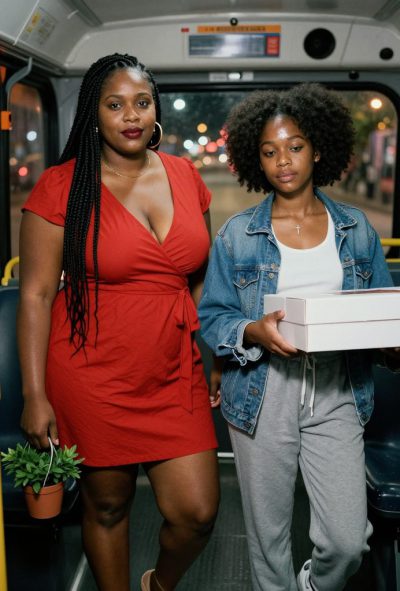
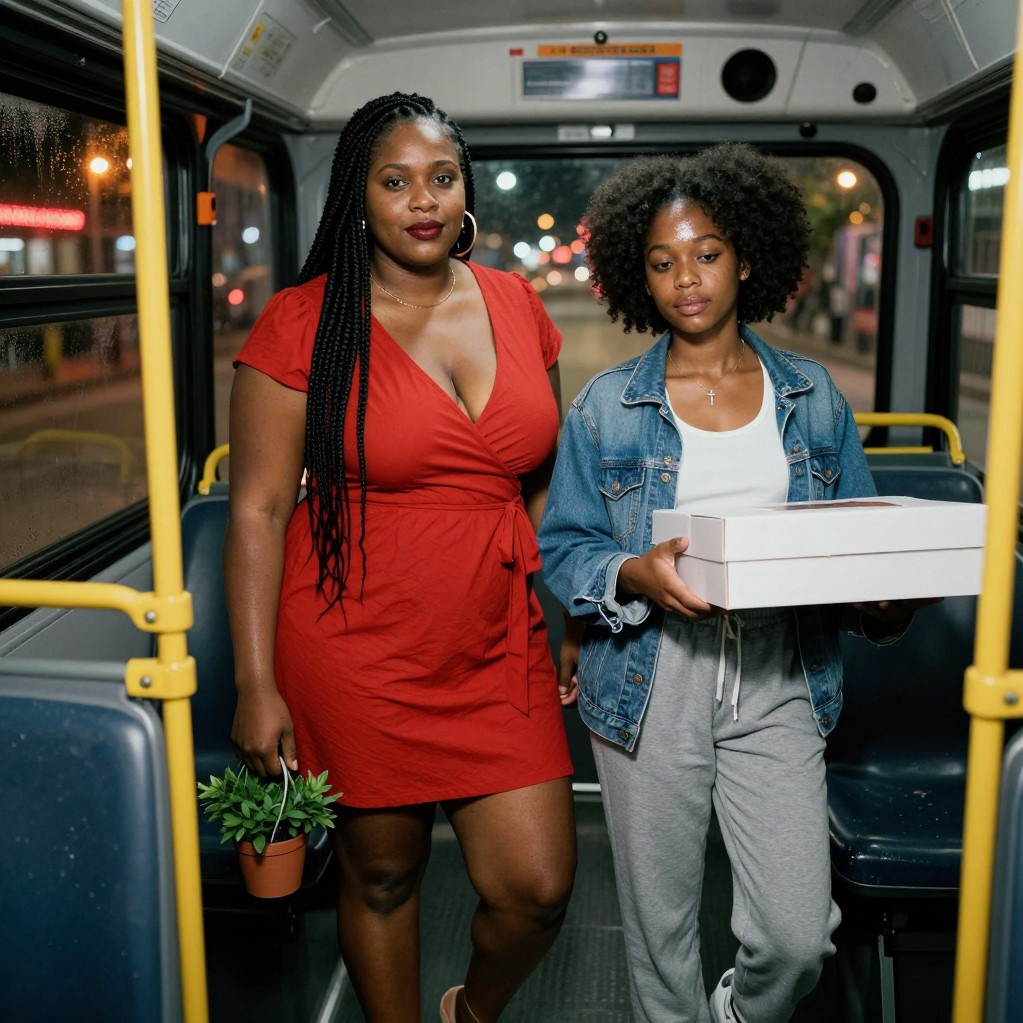
The 79 came east along Seventy-Ninth at five past midnight with the windows down because the heat did not work, and two women got on at Essex with a cake between them and a potted plant, and the whole bus turned around to look.
Not because of the cake. Because of them.
The older one was in front, carrying the plant, and she came down the aisle like the bus belonged to her — tall, five eight or nine, in a wrap dress the colour of a ripe tomato, cut low enough at the front that you could see the top of her breasts and the thin gold chain lying in the hollow between them, and nude heels she had no business walking in on a Chicago sidewalk. Black hair in long box braids down past her shoulders with gold rings on four of them. Big gold hoops. A mouth she had painted dark red and had then eaten a meal through, so it was only red in the middle now.
Her hips were wide and her arms were soft and strong, and she had the walk of a woman who has been looked at since she was fourteen and has made her peace with it.
Behind her, the younger one.
Smaller. Five two, maybe. Slim, not skinny — a little belly under a white ribbed tank top, a denim jacket over it hanging open, grey sweatpants that had been nice once, and white sneakers with a scuff on the toe. No makeup. Skin the colour of a pecan shell, smooth, with a shine to it on the forehead and the collarbones because it was August-hot in that bus. Short natural hair, the kind that is a perfect round shape and looks like it took work and looks like it took none. A silver cross at her throat.
She had the cake. A sheet cake in a box the size of a suitcase, held out in front of her with both arms, and she was walking like a person carrying something that must not tip.
“Fabienne,” the older one said, over her shoulder. “Men aj sou sa.”
“I am watching.”
“You are not watching. You are looking at your feet.”
The little one — Fabienne — set her jaw and looked up, and looked straight at me, three rows back on the left, and did not look away in time, and went red under the brown of her face, which is a thing you can see happen on some people and it is worth seeing.
The bus pulled out. The older one put the plant down on the seat and sat, and Fabienne put the cake on the seat beside her and sat across from her, and then the bus went over a bad patch of asphalt at Paxton and the cake box slid, and I put my hand out and caught it against my knee.
Both of them looked at me.
“Thank you,” Fabienne said. Small voice. American, flat midwestern vowels. “It’s for a christening. If it falls over my aunt will kill me and then bring me back to kill me again.”
“Put it on the floor,” I said. “Between your feet. It can’t slide downhill there.”
She looked at her sister for permission, which was interesting, and her sister lifted one shoulder, and Fabienne put the cake on the floor between her sneakers and held it there with her knees.
“See,” the older one said. “A man with sense.” She turned to me properly, one arm along the back of the seat, and looked me up and down the way a contractor looks at a wall. “You are going where?”
“Nowhere in particular. I got on at Stony.”
“Nobody goes nowhere in particular on Seventy-Ninth at midnight.” Her name, it turned out, was Yveline. She told me that in the first four minutes, along with the fact that she had a shop on Seventy-Ninth two doors from the takeout where her sister worked, that she had been in this country six years, that her husband drove a truck out of Memphis and was home eleven days a month if she was lucky, and that the christening was for her cousin’s baby and the cake had cost eighty-five dollars.
“That’s a lot of cake,” I said.
“That is a Haitian cake. It has rum in it.” She said it with contempt for anyone who did not know this. “You want a piece? Come to the party. There will be forty people and my aunt will feed you until you cannot walk.”
“He doesn’t want to come to a christening,” Fabienne said, without looking up.
“How do you know what he wants?” Yveline said. “You don’t even know what you want.”
Then she turned to her sister and said something in Kreyòl, fast, and Fabienne said “Yveline” in a warning voice, and Yveline laughed and said something else, and Fabienne looked at the window and pressed her lips together and the tops of her ears went dark.
“What did she say?” I asked.
“Nothing,” said Fabienne.
“She said you look at me like a man who has been on a bus too long,” said Yveline.
“That is not what I said.”
“That is the short version.”
The bus stopped at Jeffery and the doors opened and nobody got on, and the air that came in was hot and smelled like the lake and like somebody frying something four blocks away. Yveline fanned herself with the church programme. Fabienne sat with her knees together holding the cake box and her hands flat on top of it, and her arms were bare and smooth and her shoulders were bare and there was a small dark mole on her left shoulder, high up, the size of a peppercorn.
She caught me looking at it. She did not look away this time. She breathed out through her nose, looked at the window instead, and a muscle jumped in her jaw.
“Fabienne,” Yveline said, in English now, clearly for my benefit, “the man is looking at your shoulder.”
“Yveline.”
“He is looking at your shoulder and you are letting him. I am not blind.”
“Mèsi, Yveline. I know.” And then, to me, with a terrible dignity: “She thinks because she is twenty-eight she can say everything out loud.”
“I think because I am twenty-eight I have already heard everything,” Yveline said. “And because I have been married five years and my husband is in Tennessee, and because I am sitting on a bus at midnight with a plant on my lap.” She looked at me. “You. Are you married?”
“No.”
“Good. Are you stupid?”
“I don’t think so.”
“He doesn’t think so,” Yveline said to her sister, in Kreyòl, and then in English: “That is what they all say.”
Then the bus hit the light at Clyde and she leaned forward and said, low, in Kreyòl, one sentence, and this time she did not translate, and Fabienne’s hand came off the cake box and went to her own mouth, and her eyes were bright.
“What did she say?” I asked again.
“Ask her,” Fabienne said. “She is the one who talks.”
Yveline sat back and crossed her legs and the tomato dress slid up her thigh, and she watched me with her chin down.
“I said,” she said, “that if my sister wants to put her hand on your leg she should put her hand on your leg, and stop looking at your hands like they are a bus timetable.”
The bus was empty enough that nobody heard it. Fabienne made a noise like she had been struck in the stomach.
“Yveline.”
“I am not going to say it for you. Do it or don’t do it.”
Then, for about nine seconds, nothing happened. The bus went east. The light over the door buzzed. Fabienne looked at the floor and her throat moved, and I could see her deciding, and the deciding was the best part.
She took her right hand off the cake box and put it on my knee.
She left it there. The whole rest of the ride, her hand on my knee, not moving, warm through the denim, with her little finger just touching the seam, and she stared at the cake box like a woman doing arithmetic.
Yveline did not say one word about it. She watched the two of us in the dark window and smiled with her mouth closed and fanned herself with the programme, and once she said, in Kreyòl, “Bèl,” which needs no translation.
At Cregier they got up. Fabienne picked up the cake with both arms and Yveline took the plant and her heels, and I carried the cake down the steps and stood on the corner with it while Yveline got her keys out.
“Where are you going now?” she said.
“Home.”
“Where is home?”
“Kenmore. Off Sheridan.”
“That is forty minutes.”
“Thirty-five at this hour.”
“Mm.” She unlocked the door of the shop — the sign above it said YVE’S BRAIDS, WALK-INS WELCOME, and the window was full of photographs of hair — and pushed it open, and the smell of coconut oil and lavender came out into the street like something being let out of a box. “Fabienne. Bring him up.”
“Yveline—”
“Bring him up,” Yveline said, without turning around. “Or don’t. But if you stand on this corner for one more minute with that cake I am going to eat it.”
Upstairs was one long room over the shop with a kitchen at one end and two beds at the other, a folding screen between them, a barber chair in the corner under a lamp, a mirror on the wall with a crack across one corner, and a radio on the windowsill playing something with a lot of guitar in it.
“It’s not much,” Fabienne said.
“It’s a home.”
“It’s a home with a chair in it.” She put the cake on the counter, and then stood with her hands at her sides like a person who had finished a task and did not know what the next one was.
Yveline kicked her heels off, one and then the other, and dropped onto the edge of the bed and sighed the sigh of a woman who has been on her feet since six in the morning.
“Fabienne,” she said. “Come here.”
The little one went and stood in front of her sister, and Yveline took her hands and held them, and looked up at her.
“You are eighteen years old,” Yveline said. “You are a woman. But you are my sister and I am not going to let you do something and then cry in the bathroom because you didn’t mean it. So.” She squeezed her hands. “Do you want this?”
Fabienne’s chin was up. “Yes.”
“Say it in a sentence.”
“I want him.” Her voice cracked and she said it again, steady. “I want him. And I don’t want you to leave.”
“I wasn’t going to leave.” Yveline stood up, and she was so much bigger than her sister — a head taller and twice the width at the hip — and she put her hands on Fabienne’s shoulders and kissed her on the top of the head. Then she looked at me over it. “You. If she says stop, you stop.”
“I know.”
“I am not asking if you know. I am telling you.” Then she smiled, and it changed her whole face, and she said, “Okay. Now take off your jacket, Fabienne, before you die of the heat.”
Fabienne took the denim jacket off and dropped it on the bed and stood in the white tank top with the shine of sweat on her chest and her arms, and she was not wearing a bra, and her small breasts were right there under the thin white cotton with the shape of her nipples showing through, dark and hard, and the cross lying in the middle of it.
“See,” Yveline said, behind her. “Look at her. She thinks she is nothing.”
“She doesn’t look like nothing.”
“She thinks she is the small one.” Yveline came around behind her and put her hands flat on her sister’s stomach, over the tank top, and Fabienne’s head went back against her collarbone and her eyes closed. “She has been the small one since she was six years old. I am the one who is big. I am the one they look at in the street and say, ah, that one, she is a lot. And her, they look at and say, oh, the little one, that’s the baby.” Her hands went up, slowly, under the tank top. “She is not a little girl.”
Fabienne said something in Kreyòl that I did not understand and that did not need translating.
Yveline pulled the tank top up and over her head and then her sister was standing there in her grey sweatpants with her hair a mess from the shirt and her arms half-raised and her small brown breasts bare in the lamplight, and she did not cover them.
“There,” Yveline said. “Now he can see you.”
Fabienne looked at me. Her hands were shaking and she was breathing through her mouth.
“I’m not—” she started. “I haven’t. Not a lot. Twice. That’s all.”
“That’s fine.”
“Don’t be nice about it,” she said, and it was the same thing she had said about the cake, the family habit of it.
“I’m not being nice. I’m being interested.”
“You’re going to have to be interested for a while,” Yveline said, and sat down on the bed and pulled her braids over one shoulder. “Because I am going to take my dress off and I am going to do it slowly, and you are going to watch her while I do it, and nobody is going to touch anybody for a minute.”
She took her time. She reached back and undid the zip and the tomato dress came off her shoulders and down over the wide softness of her hips, and underneath it she was in black underwear that was not much, and her body was the body of a woman who has had a child and carried other people’s children and eaten well — heavy breasts with the mark of a strap across them, a soft belly, the small silver lines low on it, thighs that touched all the way down.
She lay back on the bed on her elbows and said, “Well?”
And Fabienne, who had been standing there with her arms at her sides, said, “You’re beautiful,” in a small flat voice, and Yveline said, “I know,” and laughed, and then Fabienne laughed too and it broke the whole room open.
I put my hand on Fabienne’s waist and she came apart like a knot. Not slowly. She turned into me and put her mouth on mine and her hands went into my shirt and her nails were short and her palms were hot and she kissed like somebody who had read about it.
“Okay,” Yveline said from the bed. “Okay. Slow down, Fabienne. You have all night.”
“I don’t want to slow down.”
“You’ll want to in ten minutes when you’ve finished and you’re embarrassed.” Yveline got up and came over, and she was in her underwear in her own kitchen at half past midnight, and she did not care, and she took her sister by the shoulders, spun her around. “Sit in the chair.”
“The chair?”
“Sit in the chair.” She pushed her down into the barber chair and turned it so the cracked mirror had her in it. “Now. Look at yourself.”
Fabienne looked. Her own bare breasts in the mirror, and her sister standing behind her in black underwear with her hands on the back of the chair, and me coming around the side.
“There,” Yveline said. “That is what we look like. You are not a little girl in a bus. You are a woman in a chair with a man looking at her. Say it.”
“I’m a woman in a chair.”
“Say it like you mean it.”
“I’m a woman in a chair,” Fabienne said, louder, and then laughed at herself, and then stopped laughing when I put my hand on her knee.
I went down in front of her. Her sweatpants came off over her sneakers, which stayed on, and under them she had plain white cotton underwear with a small tear at the waistband, and she lifted her hips to help me and then put her hand over her eyes.
“Don’t hide,” Yveline said.
“I’m not hiding, I’m—”
“You’re hiding.”
So she took her hand down and gripped the arm of the chair and held on.
She was wet through the cotton, a dark patch the size of a coin, and when I got the underwear off her and put my mouth on her she made a noise like a door and her whole body slid down the vinyl.
“Oh,” she said. “Oh — wait — okay — okay, don’t stop, don’t stop.”
Yveline stood behind the chair with her hands on her sister’s shoulders and watched us in the mirror, and she said, quietly, “Bèl bagay,” and then, in English, “Look at her. Look at her face.”
I looked up. Fabienne’s head was tipped back against the headrest and her mouth was open and her eyes were open and she was watching the two of us in the cracked mirror, and she said, “I can see — I can see everything, I can see your head between my—” and then she stopped being able to talk.
She came fast, the first time, with her thighs clamping on my ears and her heel kicking the base of the chair, and it was loud enough that Yveline laughed and put a hand over her sister’s mouth, and Fabienne bit her palm.
“Neighbors,” Yveline said.
“Let them,” Fabienne said, with her eyes shut, and then, “No, don’t let them, oh my god, I said that out loud.”
“You said it out loud.” Yveline crouched down and kissed her sister on the mouth, properly, one hand in her short hair, and Fabienne’s hand came up and held her wrist. It went on a while. I stayed where I was, with my cheek on Fabienne’s thigh, and watched two sisters kiss above me with the radio going and the fan turning and the smell of coconut oil everywhere.
Then Yveline stood up and said, “Now get up out of that chair, because I want a turn.”
She turned it around so the back of the chair faced the mirror, and she knelt on the seat with her knees apart and her forearms on the top of the backrest, and her black underwear came down over her hips and she looked over her shoulder at me.
“You have been patient,” she said. “Now be patient in a different way.”
She was deeper and heavier and slower than her sister and she made no noise at all for the first minute, just breathed, and then she said, “Yes,” once, and after that she said it every time, in a low flat voice, like a woman agreeing with somebody.
Fabienne sat on the bed with her knees up and watched. Then she got up and came over and stood beside the chair and put her hand on her sister’s back, between the shoulder blades, and left it there.
“Is it good?” Fabienne said.
“It’s good.”
“Is it—” Fabienne’s voice went small. “Is it good for him?”
Yveline laughed into the vinyl. “Fabienne. Ask him.”
“Is it good for you?”
“Yes.”
“Good,” she said, and then, because she was eighteen and could not help it: “I’ve never watched before. I didn’t know it looked like that.”
“It looks like that.”
Yveline came with her forehead down on her arms and her hand reaching back and grabbing my hip, and she said something in Kreyòl into the vinyl, muffled, and then lifted her head and said, in English, “Okay. Okay. Enough of that, my knees are forty years old.” She got down and turned around and sat on the edge of the chair with her braids in front of her and her chest going, and looked at us both.
“Now,” she said. “Both of us. And you are going to be quiet and let us do it.”
They put me on the bed on my back and they did it together, and it was clear that they had talked about it at some point in their lives, or that one of them had, and the other had listened.
Yveline knelt on my left and Fabienne on my right and they worked in a rhythm that was not quite the same — the older one slow and certain with her whole hand, the younger one fast and too tight and then correcting herself — and they talked over me the whole time in Kreyòl, and then in English when they wanted me to hear.
“He is close,” Yveline said.
“He’s not close, he’s —” Fabienne looked at my face. “He is close.”
“See? You can tell.”
“I can tell.”
“Then slow down or he will finish and you will be sad.”
Fabienne slowed down. She put her cheek on my stomach and her hand kept going, lazy now, and Yveline leaned over and put her mouth on my throat and then on my mouth, and her braids fell across my face and smelled like oil and like the shop.
“I want to be on top,” Fabienne said, suddenly, into my stomach. “I’ve never — I want to try.”
“Then get up there,” Yveline said. “And mind your knee.”
She got up there. She was small and light and she had no idea what to do with her hips, and she sat down on me all at once and then gasped and stopped and said, “Oh, no, that’s — that’s too much, that’s —” and Yveline, behind her, put her hands on her sister’s hips and said, “Breathe. Down. All the way down. There. Now rock. Not up and down. Rock.”
She rocked. It took her a minute and then it took, and her head went back and she put her hands on my chest and her mouth opened and she said, “Oh. Oh, this is — Yveline, this is —”
“I know.”
“Why did nobody tell me—”
“Everybody tells you. You don’t listen.”
She came like that, on top, with her sister’s hands on her hips moving her, and she cried a little bit at the end of it, two tears, and wiped them with her wrist and said, “I’m not sad.”
“I know you’re not sad,” Yveline said.
Then Yveline took her place, and Yveline on top was a different thing altogether — she knew what she was doing, she knew what she looked like doing it, and she put her hands in her own braids and lifted them off her neck and let her breasts move, and she watched me watch her.
“You like that.”
“Yes.”
“Say it.”
“I like it.”
“Good.” She leaned down with her palms flat on the mattress either side of my head and her braids falling around both our faces. “Now. My sister has not finished a man in her life, because she has been with boys in cars. But she is going to finish one tonight, and you are going to let her, and I am going to watch.”
They changed over. Yveline lay down on her side with her head propped on her hand, and Fabienne came and knelt between my legs and looked at it, then up at me, and said, “I’m going to be bad at this.”
“You said that already tonight.”
“I know. I’m going to say it and then be good at it.” She put her hand around it and her mouth on it and she was bad at it for about ten seconds and then she stopped trying to be careful, and after that she got good at it.
“That’s it,” Yveline said. “Not so much with the teeth. Use your hand with it. There.”
Fabienne came off it to say, “Stop coaching me,” and went back to it, and Yveline laughed and put her hand on the back of her sister’s neck and left it there.
I told them I was close. Yveline said, “Don’t you dare finish in her mouth, she’ll choke and then I’ll have to hear about it for a year,” and Fabienne said, “I won’t choke,” and Yveline said, “You choked on a grape in June,” and Fabienne said, “Yveline, I swear to God—”
She finished me with her hand, both hands, with her forehead on my hip and her breath going, and Yveline reached over and put her hand over her sister’s hand and made it slower, and I came across my own stomach and Fabienne’s fingers and a little on her cheek, and she came up off her heels and looked down at herself and started to laugh.
“That’s so much,” she said. “Why is it so much.”
“It’s a compliment,” Yveline said.
“It’s on my face.”
“It’s a compliment on your face.” Yveline got up and came back with a roll of paper towels from the kitchen and tore off a piece and wiped her sister’s cheek herself, carefully, the way you would do it for a child, and Fabienne let her.
Then the three of us lay on that bed in the heat with the fan turning and the radio still going and the cake on the counter, and nobody said anything for a while.
“Thursday,” Yveline said, at last, to the ceiling.
“What’s Thursday?”
“The shop is closed Thursdays.” She turned her head. “The christening is tomorrow and on Thursday there is nothing. So come on Thursday. Fabienne cooks on Thursdays.”
“I do not cook.”
“You cook the rice.”
“I cook the rice,” Fabienne agreed, and put her hand on my chest, and left it there.
I woke up in the barber chair at nine in the morning with a blanket over me that had not been there when I fell asleep, and the shop below already open — I could hear women’s voices through the floor and the water running — and Fabienne standing behind the chair with a comb in her hand.
“Don’t move,” she said. “I’m practising.”
“On me?”
“On you. You have good hair for it.” She parted a section with the tail of the comb and her fingers were quick and certain in a way they had not been all night. “Yveline says I have to do forty heads before she lets me touch a client.”
“She’s right.”
“She’s always right. It’s the worst thing about her.” She leaned around and looked at me upside down, and her face was bare and her hair crushed flat on one side from sleeping and she was in a tank top again with her cross on and she was beautiful. “Thursday,” she said, and went back to parting.
Related posts:
 My Bus Adventures #17: The Ramp
 My Bus Adventures #15: Four Eleven
 My Bus Adventures #9: The Back Row
 My Bus Adventures #4: Straight Lines
 My Bus Adventures #3: The Signal
 My Bus Adventures #1: The 9:40
 My Bus Adventures #12: Unopened
 My Bus Adventures #14: The Debt
 My Bus Adventures #13: The Discipline
 My Bus Adventures #6: Standing Room
 My Bus Adventures #8: Night Shift
 My Bus Adventures #5: Late Pass
