
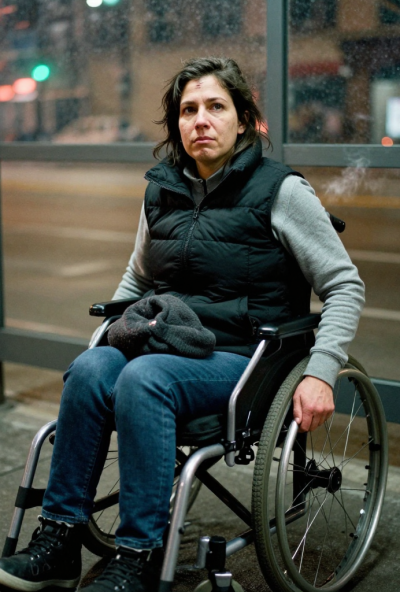
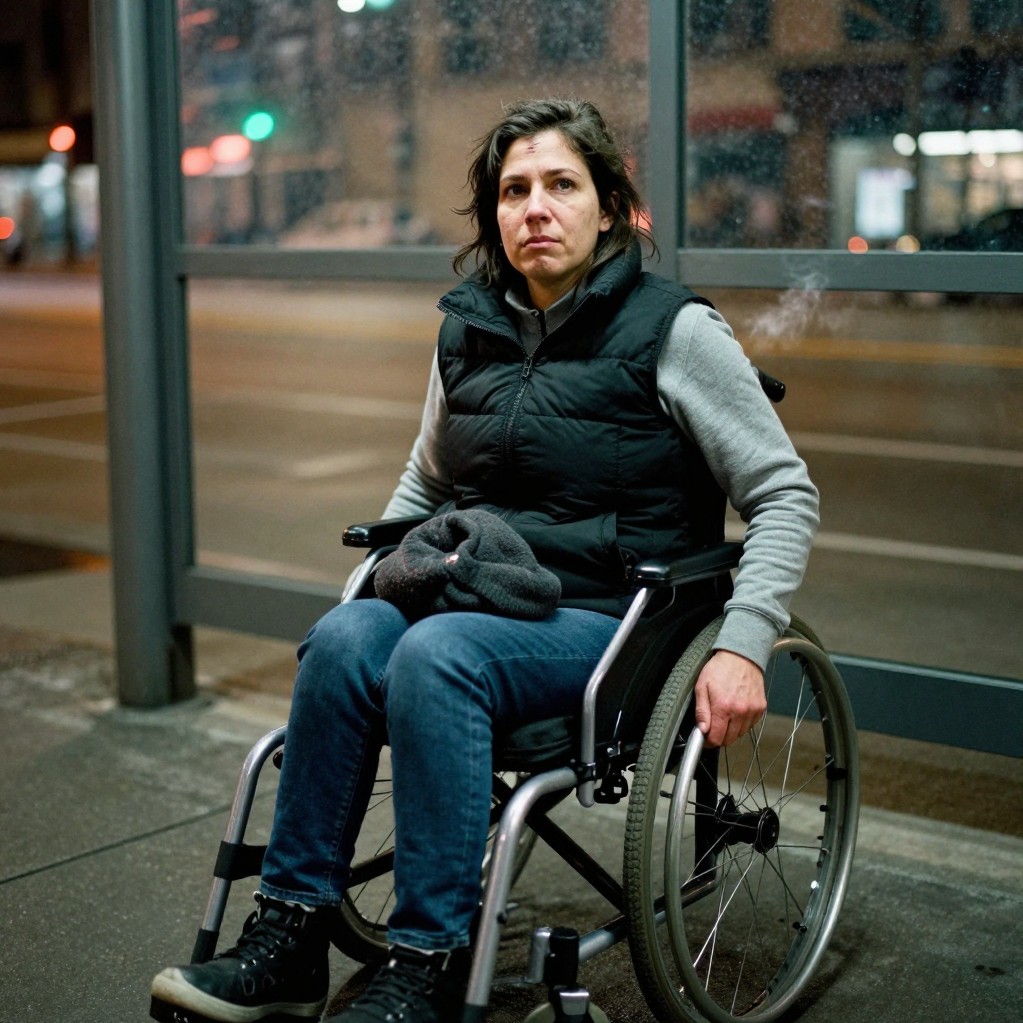
The 56 came down Milwaukee at twenty past one with one man asleep in the back and a driver who had already decided that tonight was not going to be his problem, and there was a woman at the stop in a wheelchair with her hand out.
The bus stopped. The doors opened. The driver looked at her in the mirror and said, “Ramp’s out.”
“I can see the ramp’s out,” she said. “I can hear the ramp’s out.”
“Next bus is twenty minutes.”
“I know when the next bus is. I’ve been standing here for eleven.” She had a glove on her right hand with the fingers cut out and she was gripping the pushrim. “It’s one in the morning and it’s thirty-four degrees. You’re going to sit there and tell me about the next bus.”
“I can’t lift you.”
“Nobody asked you to lift me.”
I got up. I had been three rows back with a bag of nothing much and no particular reason to be anywhere, and I came down and stood in the doorway and looked at the gap between the curb and the step, which was maybe four inches of bad concrete and a puddle.
“Hi,” I said.
“Hi.” She looked me up and down, fast and professional, the way a woman checks a doorway before she goes through it. “You’re not going to say something brave, are you?”
“No.”
“Good. Because the last guy who helped me called me ‘honey’ and then told his friend about it on the phone while I was still holding the door.” She nodded at the step. “Tip me back. Put your foot on the frame there, not the wheel. Back, then up, then forward, and don’t say sorry if it bumps.”
I did what she said. The chair went back on two wheels and she did not make a sound, and her hand stayed on the rim, and we got her up the step and into the bus and turned around in the aisle in one movement that she clearly had done four thousand times.
“Thank you,” she said. “Now sit down before he pulls out and you break your neck.”
I sat down across from her. The bus pulled out.
She was twenty-seven, she told me later, and her name was Corinne, and she was an architect, and the chair was eleven pounds of titanium that had cost more than my first car. She had on a black puffer vest over a grey long-sleeve, jeans with the hems taken up, one boot and one sneaker because the left foot swelled, and a wool hat with the brim pulled down and her hair — dark brown, cut short and pushed back — coming out of it in a mess.
Her face was long and plain and good: strong nose, wide mouth, a small scar through one eyebrow, no makeup at one in the morning. Her arms were the thing you noticed after the chair. Big shoulders, hard triceps, forearms roped with muscle, the hands callused in a line across the palm. The gloves had holes worn through the fingers.
“Go ahead,” she said.
“Go ahead what?”
“Ask.”
“I wasn’t going to ask.”
“Everybody asks. They ask what happened, or they ask if I can feel it, or they ask if I can have —” She stopped. “They ask a lot of things.”
“What do you want me to ask?”
She looked at me a moment, and then laughed, and it was a good laugh, low and surprised, and she took her hat off and put it on her knee.
“Nothing,” she said. “Ask me nothing. That’s the first time in about nine years.”
The bus went north past a bar with the door open and music coming out, past a laundromat, past a taqueria with the chairs up on the tables. She watched it all go by with her chin on her hand.
“Car accident,” she said, after a while. “I was sixteen. I was in the back seat with no belt on and my friend’s brother was driving like an idiot on 94. T-12, incomplete. Which means I’ve got a lot of it and I don’t have all of it, and it’s different every day, and if you ask me what I can feel I’ll give you a different answer on Tuesday than I give you tonight.” She turned her head. “That’s the whole speech. You get it once.”
“Okay.”
“Okay.” She rocked the chair an inch. “Now you talk, because I’ve been talking for four blocks and that’s my limit.”
I told her about my week. She interrupted twice. When I said something stupid she said “that’s stupid” and when I said something true she said “hm” and looked out the window.
At California she said, “You’re getting off at Logan, aren’t you.”
“I was going to ride to the end.”
“Nobody rides to the end of the 56 at one in the morning.” She pulled her glove off one finger at a time. “I’m at Avondale. Two stops past you. You can see me to the door and come up, or see me to the door and head home, and either one is fine, but don’t stand on the sidewalk doing math.”
“What’s up there?”
“Wine, and a bed I made this morning, and a drawing I’ve been fighting with since Thursday.” She put the glove in her lap. “And a rule that I say what happens. All of it. Every bit. Not because I’m fragile. Because I’ve spent nine years having people decide things about my body while I was sitting right there.”
“All right.”
“‘All right’ is easy to say.”
“I mean it.”
“I know you mean it.” She looked at me. “Everybody means it at first.”
She lived on the ground floor of a brick three-flat on Washtenaw with a concrete ramp poured along the side of the building, and a strip of reflective tape on the doorframe at the height of her head.
“I put that there,” she said, unlocking the door. “After I hit the frame at two in the morning and woke up the whole building.”
Inside it was one big room with a drafting table under a lamp, a wall of drawings taped up and overlapping, a low platform bed, a kitchen along one wall with the cabinets at two heights, and a handcycle in the corner with a towel over the seat.
“Bathroom’s through there. Grab bars, wide door, shower chair — it’s all obvious, you’ll see it.” She rolled in and turned the chair around with two pushes. “Take your coat off and pour the wine. Bottle’s on the counter, opener’s in the drawer with the knives.”
The wine was cheap and cold and there was half a lemon and a jar of olives and one of those long thin candles, and she told me to light it, and I did, and the room went from a working room to a room at one in the morning.
“Now sit on the floor,” she said.
On the floor.
“Because I want to look at you from up here, and because I’m not going to start this sitting across a room from a man like a job interview.” She drank her wine. “And because I’m going to take my boots off and I don’t want an audience for the parts of that which are ugly.”
I sat on the rug with my back against the bed. She got the boot off with a shoehorn and a lot of swearing, and the swollen foot came out of it and she turned it over and looked at the ankle for a second, and then put both feet on the footrests and wheeled herself over to me.
Her knees came either side of my shoulder. She smelled like cold air and wool and wine.
“Rule one,” she said. “If I say stop, you stop, and you don’t ask why, and you don’t look wounded, and you don’t make it a thing tomorrow.”
“Understood.”
“Rule two. If I say ‘help’ it means help, and if I say ‘I’ve got it’ it means I’ve got it. Rule three. If you do the face — the sad face, the brave face, the ‘isn’t she amazing’ face — I will put you out on the ramp and you can walk home to Kenmore.”
“How do you know I’m on Kenmore?”
“Because you said ‘Sheridan and Kenmore’ to the driver like a man who wants somebody to know where he lives.” She drank. “Rule four. Don’t tell me about your ex, and don’t ask about mine.”
“Fine.”
“Rule five.” She leaned down with her elbows on her knees, and her face was close. “I’m going to tell you what to do with your hands, and it’s going to be specific, and you’re going to feel like a piece of equipment for about ten minutes, and then you’ll stop feeling like that.”
“I’ve been a piece of equipment before.”
“That’s a strange thing to say.” She smiled with one side of her mouth. “I like it.”
She put her glass down on the floor and took my face in both hands, and her palms were hard and warm and she smelled of the gloves, and she kissed me. Her mouth was wide and she kissed slow, and her hand went to the back of my head and stayed there, holding me exactly where she wanted me, and she made a small sound into my mouth like a person settling into a chair.
“Okay,” she said, and sat back. “That’s good. Now stand up and take your shirt off, and then get back down here.”
I did it. She looked at me without saying anything for about five seconds, which was worse than a comment.
“Turn around.”
I turned around. She put her hand flat in the middle of my back and left it there.
“Now,” she said. “I’m going to get out of this chair, and you’re not going to jump.”
She put the brakes on, swung her feet off the footrests and onto the floor, put one hand on the seat and one on the bed, and lifted her whole body up and across in a movement that was fast and controlled and looked like nothing, and she was on the edge of the bed with her knees together and her hands on her thighs.
“See?”
“See.”
“It’s not magic and it’s not sad, it’s a Tuesday thing I’ve done nine thousand times.” She pulled her long-sleeve over her head and dropped it. “Now come here and get my jeans off, and mind the left foot.”
Her body was not the body of a woman who sat down. Her shoulders and arms were hard and the muscle ran up into her neck, and her stomach was soft over the waistband and her hips were wide and there was a pale line across them from the chair, and her legs were thinner than her arms and did what they did, which was not what she told them.
Her jeans came down over the swelling ankle and she pulled her own foot out of the cuff and swore at it and then laughed.
“Sometimes it’s a comedy,” she said. “You have to be able to laugh at the comedy.”
She was in dark grey underwear and a black bra, and she reached behind and undid it herself and took it off and sat there with her hands on the bed on either side of her, not covering anything, watching me.
“Now you can look,” she said. “Just don’t do the face.”
Her breasts were small, low, soft. Her nipples had pulled into dark points from the cold, and there was a thin white scar under the left one and a tattoo on her ribs in a language I did not know.
“I got that at nineteen,” she said. “To prove something. To who, I don’t remember.”
I put my hand on her knee and she stopped me.
“Not the knee. The knee’s a rumour.” She took my wrist and moved it up, to her thigh, high, on the inside. “Here’s loud. Here’s where you start.”
She was wet before I got her underwear off, and she was not embarrassed about it, and she was not quiet about it either — she said “there” and “not there” and “slower, not that slow, don’t be a coward” in a flat bossy voice that made me laugh into her thigh.
“Don’t laugh at me.”
“I’m not laughing at you.”
“You are. I can feel it.” She put her hand in my hair and pulled, not gently. “That’s better. Now down. All the way down and stay there until I say.”
She propped herself up on one elbow to watch. Her other hand stayed in my hair and steered me, and she narrated it like a person doing a difficult job, and then she stopped narrating.
“Okay,” she said, after a minute. “Okay. That’s — the top of it’s loud, the rest of it’s like hearing a party through a wall, and I need you to not go hunting. Stay where I put you.”
I stayed.
“Good. Good.” Her hand tightened. “Now use your fingers. Two. Curl them up toward yourself, not — yes. Yes, that. Don’t stop that. Don’t stop that even if I swear at you.”
She swore at me. She swore at the ceiling. She came, or she came as close as her body would take her that night, and it took a long time and it was not a small thing and her heels were sliding on the floor and her hand was a fist in my hair, and when it went through her her whole right leg kicked out straight and she laughed and said, “that’s the spasm, ignore it, that’s the — okay. Okay. God.”
She lay back on the bed with her arm over her eyes.
“Right,” she said. “Now get up here and let me do you, because I have been thinking about it since Diversey and I’m not patient.”
I sat on the edge of the bed and she got herself around and put a pillow under her hip and lay on her side, and her hand found it and her fingers closed and she said, “Oh, hello,” which was funny and then was not funny at all.
She was good at it. She was better than good at it — she used her hand and then her mouth, and she had the confidence of a woman who has had to become an expert at everything she does with her upper body, and she took it deep and came off and said, “I’m going to be honest. My jaw’s going to give out before you do,” and went back to it.
“That’s fine.”
“It’s not fine, it’s a challenge.” She looked up. “Don’t warn me. I hate the warning. If it’s going to happen, let it happen.”
She got me close twice and then slowed down both times, on purpose, and laughed at me when I made a noise about it.
“You’re a menace.”
“I’m an architect. I like to know where the load is going.” She put her mouth back on it.
Then she stopped, and sat up, and wiped her mouth on her wrist, and said, “Now I want to be on top, and I want to do it in the chair, and I need you to not have an opinion about that.”
“I don’t have an opinion.”
“Everybody has an opinion.” She swung herself back into the chair and put the brakes on hard and turned it so the back was to the bed. “Come here. Sit on the bed. Legs apart. Good. Now I’m going to come over and you’re going to hold the chair, not me. The chair. If you hold me I’ll feel like I’m falling and then I’ll get angry.”
She braced both palms on the mattress, lifted herself across into my lap, and settled with her knees outside my hips and her arms around my neck, and she was warm and her thighs were hard where they were hard and soft where they were soft, and she reached down between us with one hand and put me inside her herself, in one go, and said, “There,” and closed her eyes.
“All right?”
“I’m not answering that question anymore tonight.” She opened her eyes. “Put your hands on my back. Not my hips, not my ass. My back. I’ll do the rest.”
She did the rest. She was strong as hell and she used her arms on the chair’s pushrims to lift herself and drop, and it was slow and deliberate and she watched my face the entire time, her mouth open, breathing hard and she said, “Yes,” and “That’s right,” and “Don’t you dare come yet.”
“I’m trying.”
“Don’t try. Wait.” She leaned in and put her forehead against mine. “Wait. I want to be up here a while. Nobody’s ever —” She stopped, and her jaw worked. “Nobody’s ever let me be up here this long.”
So I waited, and she took her time, and after a while she was not saying anything at all, and her arms were shaking, and she said, “Okay. Now. Now I want to be face down on the bed with my feet on the floor, and I want you behind me, and I want you to hold me up by the hips, because my hips work and my legs don’t and I’ll be fine.”
She got there herself. She lay face down across the mattress with her legs hanging off the side and her feet flat on the floor, and her arms folded under her head, and looked back over her shoulder at me and said, “Well?”
“Is that comfortable?”
“I don’t know, ask my hips. They’re the ones doing the work.” She laughed into the pillow. “Come on. Come on, before I think about it too much.”
She was deep that way and she liked it, and she said so, out loud, in a register she had not used with me before, and she kept saying it, and her hand came back and took my hand and pulled it around onto her stomach, and she held it there.
“Harder.”
“Yes?”
“Harder. I’m not going to break. That’s the whole —” She gasped. “That’s the whole point. I’m not going to break.”
She came again like that, face down, with her cheek on her folded arms and her hand gripping mine on her stomach, and it was quieter than the first time and went on longer, and at the end she made a sound like a person setting down something heavy.
“Okay,” she said, into her arms. “Okay. Get out, I need to lie down properly.”
I got out. She rolled onto her side and pulled her legs up onto the bed with her hands, one and then the other, and lay there breathing.
“Water,” she said. “Kitchen. Tap’s fine. And bring the chair over here, I’m going to want it in a minute.”
I brought the water and the chair and she drank half of it sitting up and poured the rest on the back of her neck, which was new to me and which she did like a ritual.
“Now,” she said. “Come here. I want to finish you, and I want to do it sitting in the chair, and I want you standing up, and I want you to actually look at me while it happens.”
“All right.”
“Not ‘all right.’ Say something true.”
“I’ve been looking at you all night.”
“That’s true.” She got into the chair, put the brakes on, and rolled it back from the bed so there was room. “Come on, then. Stand there. Put your hand on the back of the chair if you need it.”
She took it in her hand and then in her mouth, and she was serious about it, and she had one hand on my hip and one around it, and the lamp was on and the drawings were on the wall behind her and the wine was on the floor going warm.
“Look at me,” she said, around it, and then stopped and lifted her head to say it clearly, the way she said everything properly. “I told you. Look at me. Not over my head, not at the chair. At me.”
I looked at her. Her hair was crushed flat on the right and her mouth was wet and there was a red mark on her chin from the bedframe, and she had her chin up like a woman who had won an argument.
“Nearly?”
“Yes.”
“Right.” She held my eye. “Then don’t be polite about it. I want it on me. Not in my mouth, I’ll choke and then we’ll both be embarrassed. On my chest. And then you can go and get a towel like a gentleman.”
I came on her chest and her throat, and she kept her hand moving through it and watched my face the whole time with her lips parted, and when it was done she looked down at herself and said, “Well. That’s a lot of paperwork,” and started laughing, and I had to hold the chair because she was laughing too hard to keep it still.
“I’ll get the towel.”
“You will.” She wiped her fingers on the sheet. “And then you’ll get back in this bed, because it’s two in the morning and I’m not calling you a cab at two in the morning like a person who’s ashamed.”
She sent me to the bathroom first and came in behind me with a towel over her shoulder, and the bathroom was the size of a closet with a fold-down bench in the shower and a bar on every wall.
“Sit on the bench,” she said. “I’m not getting on the floor tonight, my shoulders are done.”
The water came out hard and hot and she sat on the bench with her head back and let it run over her face, and the water ran down her chest and over her stomach and between her legs, and she opened her eyes and looked at me standing there dripping.
“You’re staring.”
“Yes.”
“Good.” She pulled me in by the wrist. “Get in front of me. I want to do something I’ve been thinking about since the bus.”
She took me in her soapy hand under the water and worked it slowly, and her other arm went around my hip and held me in place, and she watched her own hand do it with real interest, like a person checking a joint detail on a drawing.
“You’re going to be sore tomorrow,” she said.
“Probably.”
“Not from that.” She laughed. “From standing up all night. You people do it all the time and you don’t even notice.”
She turned me around with a hand on my hip and got me to stand with my hands on the wall and the water coming down between us, and then she put her mouth on the small of my back, and then lower, and then her hand came around and she said, “Now. I want to do it from here. I want to see if it works.”
“Does it?”
“We’re about to find out.” She pulled me back by the hips until I was standing over the bench with my knees bent and her hand guiding, and she took me from behind sitting down, and it did work, and she said, “Oh,” in a surprised voice, and then, “well, that’s going in the drawing.”
“Are you —”
“I’m fine. My legs are on the floor, I’ve got the bar, I’m not going anywhere.” Her hand slapped my hip. “Move. Gently. It’s a small room and I don’t want to hit my head on the taps.”
It was slow and awkward and we both laughed twice, and the water went cold in the middle of it and she said, “Don’t you dare stop, I’ll fix it in a minute,” and did not fix it, and when it was over she sat back against the tiles with her chest going and her hair flat to her head and said, “Right. That’s the whole tour. Bathroom, bed, kitchen, chair.”
“That’s the whole flat.”
“That’s the whole flat.” She held out her hand to be helped up, which she had not done once all night. “And you’re the first person who’s had the tour and not said ‘you’re so brave’ at the end of it.”
I woke up at nine with her side of the bed empty and the smell of coffee and the sound of her chair going across the floor.
She was at the drafting table in a T-shirt and nothing else, with her hair standing up and a pencil behind her ear, and the drawing in front of her was a building — a low building with a ramp that came around it in a curve, wide and long and lined with planters.
“Morning,” she said, without turning around.
“Morning.”
“There’s coffee. Mug’s by the sink. Don’t put milk in it, the milk’s gone off and I keep forgetting to throw it out.”
I got the coffee and stood by the table and looked at the drawing.
“What is it?”
“An apartment building for people who don’t walk.” She rubbed out a line with her thumb. “Which is a stupid thing to say, because apartments for people who don’t walk are just apartments with wider doors and lower counters and a ramp that doesn’t look like the service entrance.” She sat back. “I’ve been fighting with this ramp since Thursday. It’s the curve. The curve is wrong and I can’t see why.”
“It looks right to me.”
“That’s because you don’t use it.” She took the pencil out of her ear and pointed it at me. “That’s not an insult. It’s the whole problem. Every building in this city was drawn by somebody who was going to walk into it.”
She rolled back from the table and turned the chair to face me.
“Right. Two things.” She counted them off on her fingers. “One. You didn’t do the face. Not once, not even when I fell over getting my jeans off, and I was watching for it. That’s rarer than you think.”
“And two?”
“Two.” She pushed herself over to the window and looked down at the ramp. “I’m going to be difficult about this. Not tonight, not because of anything you did. I’m going to have a bad week and I’m going to decide you’re only here because it’s interesting, and I’m going to say something cruel to you about it in about a month.”
“Okay.”
“So if you’re going to go, go now, and I’ll be fine, and I won’t be angry.” She turned the chair around. “And if you’re not going to go, then come back on Thursday, because Thursday is the day I stop hating this ramp, and I make a very good dinner on Thursdays.”
“Thursday.”
“Thursday.” She picked up the pencil and put it back behind her ear, and then said, without looking up, “There’s a curb cut at the corner now. They put it in in April. Two years I wrote letters about that curb cut. Nobody ever asked me what it was for.”
Related posts:
 My Bus Adventures #1: The 9:40
 My Bus Adventures #16: Two Ways Home
 My Bus Adventures #15: Four Eleven
 My Bus Adventures #4: Straight Lines
 My Bus Adventures #2: Window Seat
 My Bus Adventures #14: The Debt
 My Bus Adventures #12: Unopened
 My Bus Adventures #6: Standing Room
 My Bus Adventures #3: The Signal
 My Bus Adventures #9: The Back Row
 My Bus Adventures #8: Night Shift
 My Bus Adventures #7: Beginner’s Luck
