
It happened fast and it happened stupidly, the way it always does: two of them, one asking for a cigarette, the other one already reaching, and I had my phone out and then I did not have my phone out, and the smaller one’s ring opened the side of my hand when I put it up.
They ran west on Diversey. I stood at the stop with my hand dripping on the concrete and the 76 coming up the street with its lights on.
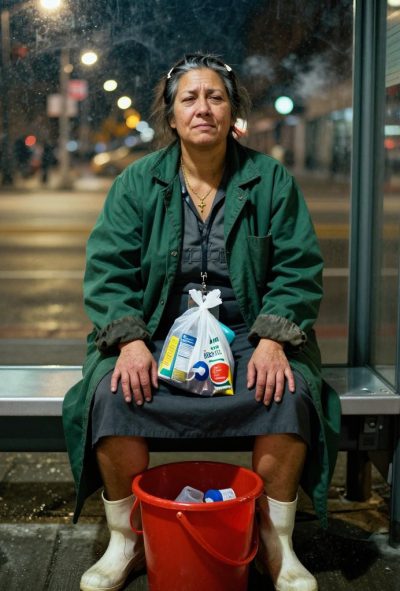
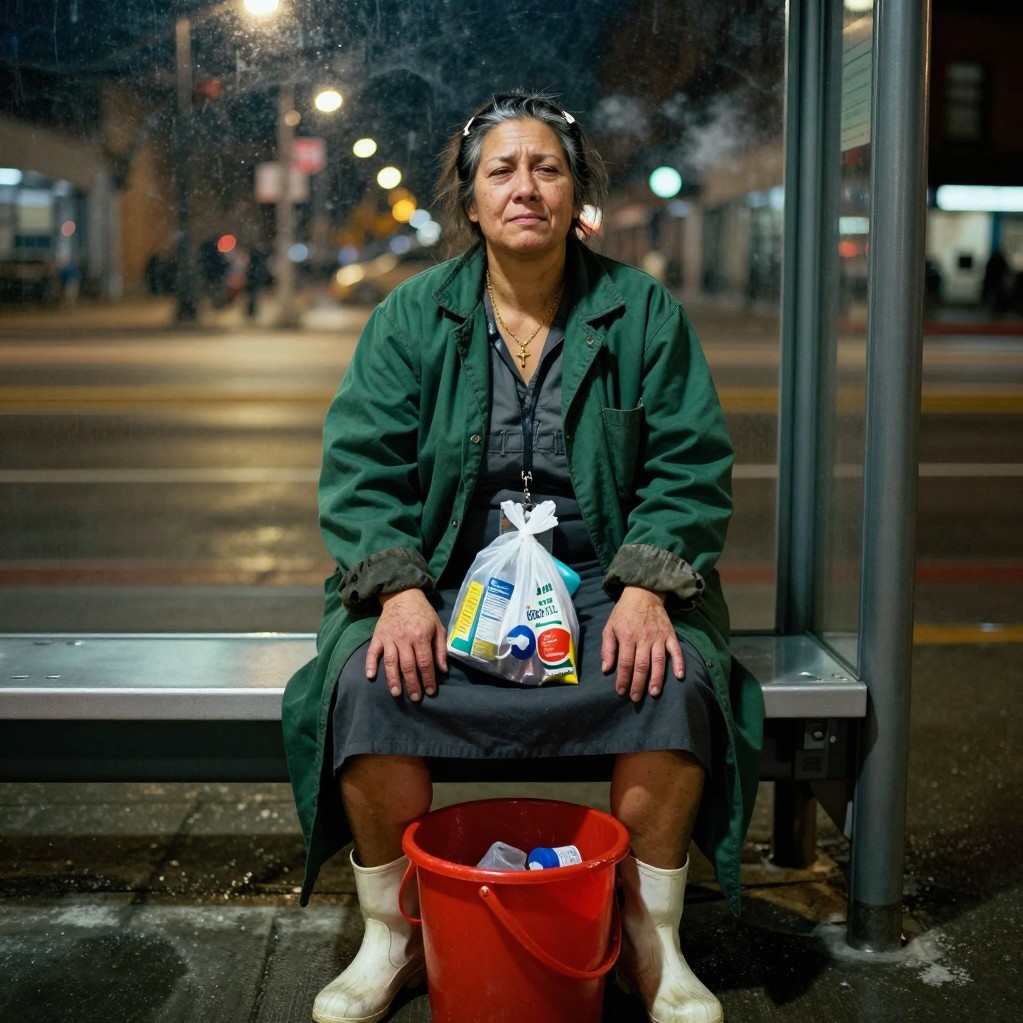
There was a woman already at the stop, ten feet away, sitting on the bench with a mop bucket between her feet and a plastic bag of cleaning things on her lap. She had watched the whole thing without moving, the way people do, and I did not blame her.
Then the bus pulled in and opened its doors and she stood up and said, “No.”
The driver looked at her.
“No,” she said again, to me this time, and put her hand out flat. “You are not getting on that bus and bleeding on everybody. Come here.”
“I’m fine.”
“You are not fine. You are white.” She took my wrist — not gently, both hands, like a nurse taking a pulse — and turned my hand over under the streetlight and made a sound through her teeth. “That is deep. That needs a wash and it needs closing and it needs a man who is not going to faint on a bus.”
“It’ll stop.”
“It will stop when somebody puts a towel on it.” She let go of my wrist and picked up her bucket. “I live one block. You are coming for one block, and I am going to put a towel on it, and then you can do whatever stupid thing you were going to do.”
I went. I do not know why I went, except that she had the voice of a woman who had already decided, and my hand was beginning to hurt in a way that made decisions difficult.
She was forty-one, she told me on the walk. Her name was Erzsébet and everybody called her Erzsi. She cleaned at the hospital on Wellington, nights, four to midnight, and she had been doing it for eleven years, and her bucket had a wheel that squeaked.
“I am sorry I said ‘no’ like that,” she said. “It is my work voice. I use it on doctors.”
“It worked.”
“It always works. That is the trouble with it.” She shifted the bucket to her other hand. “You are not going to be sick, are you? Because if you are going to be sick, do it in the bushes and not on my stairs.”
The flat was a basement on Albany with a door at the bottom of a concrete well and a window that looked out at the level of the sidewalk, so you could see people’s shoes go by. Inside it was warm and it smelled like bleach and like paprika and like something that had been cooking for a long time.
“Take your coat off,” she said. “Shoes off. Sit.”
It was a kitchen with a table in it, a tablecloth with a plastic cover over it, a small television playing Hungarian news with the sound off, a pressure cooker on the stove, and a photograph of a man in a suit on the shelf with a candle in front of it.
“Sink,” she said.
She stood me at the sink and turned the water on and tested it with her wrist — the way you test it for a child — and then put my hand under it and held it there while it stung.
“Ow.”
“I know.”
“Ow.”
“I know. It is supposed to hurt. That means it is clean.” She had her sleeves pushed up and her forearms were pale and mottled and there was a red burn scar the size of a thumb on one of them. Her hands were the hands of a woman who had spent eleven years in rubber gloves: red at the knuckles, dry, the nails cut short and no polish on them, the skin split at the tips.
She washed my hand for a long time. She flipped it and studied the cut and muttered something in Hungarian, then pressed a folded towel onto it and held it there with both of hers.
“Five minutes,” she said.
We stood at the sink with her holding my hand through a towel and the pressure cooker clicking and the television silent. I could smell her — bleach and hand cream and something underneath that was just warm skin.
“You live alone?” she said.
“Yes.”
“Of course you do.” She looked up. “Everybody lives alone now. My son is in Denver and he lives alone and he is twenty-two and he eats from a box.”
“Where’s your husband?”
She nodded at the shelf with the photograph, without turning her head.
“Four years,” she said. “Béla. His heart. He was fifty-one and he was very strong and it did not matter at all.” She took the towel off my hand and looked at the cut. “You are going to have a scar there and it is going to be a boring story.”
“I’ll make one up.”
“Don’t. Nobody believes the good stories.” She pressed the towel back down. “Now. Sit at the table. I am going to give you something to eat and you are going to eat it, and then I am going to put a proper bandage on that and you are going to sleep in the chair, because you are not walking home at one in the morning with one working hand.”
The soup was a pörkölt that had been on the stove since before her shift, thick and red with paprika and full of meat that came apart under the spoon, and bread, and a small glass of something clear that she poured without asking.
“Pálinka,” she said. “My brother sends it from Szeged. It is not good but it is strong.”
It was not good and it was very strong. It went down and sat in my chest like a coal and my hand stopped being the loudest thing in my body.
“Eat,” she said.
She sat across from me with her own bowl and ate with her elbows on the table, watching me the way a woman watches a person eat who has not eaten properly in a while. The plastic tablecloth had a pattern of grapes on it. The candle in front of the photograph had burned down to the tin.
“Better?”
“Better.”
“Good.” She tore bread and put it on my plate without asking. “You have not got a woman.”
“That’s a leap.”
“It is not a leap. Your coat has a button missing and it has been missing a long time, and you did not know where you were going when the bus came.” She dipped bread in her soup. “That is a man with no woman.”
“My button’s been missing since March.”
“Yes,” she said. “That is what I said.”
She got up and took the bowls and washed them, and then she came back with a first-aid box and sat down close and pulled her chair around so her knees were against mine.
“Give me your hand.”
She cleaned the cut again with something that made me grip the edge of the table, and then she put the strips on it one at a time, pressing each one down with her thumb, and her head was bent over my hand and her hair — dark, going grey at the temple, pinned up with a clip — was right there.
“There,” she said. “Now it will not open when you make a fist.” She held my hand in both of hers and turned the palm up and read it, and then, without any warning at all, she put her palm flat on my chest, over my shirt, over my heart.
“Your heart is very fast,” she said.
“It’s been a night.”
“It has been a night.” She did not take her hand away. “When I was young, in Szeged, I worked in a clinic for one year before we came. I took blood pressures. I was very good at it. I could tell you a person’s whole life from their pulse.” Her thumb moved, once. “You have a fast heart and a cold hand and nobody at home.”
“That’s three things.”
“That is enough.” She looked up at me. Her face was close and there were lines at the corners of her eyes and her mouth was bare, no lipstick, and she had eaten and the paprika had made her lips red anyway.
“You’re going to tell me to sleep in the chair,” I said.
“I am not going to tell you that.”
She kissed me. She did it the way she did all things, without hurrying and without asking, one hand still flat on my chest and the other one coming up to the back of my neck, and she tasted of pálinka and paprika and bread.
Then she sat back.
“Now,” she said. “You are going to say something. Say the true thing, not the polite thing.”
“I’ve been looking at your hands all night.”
She looked down at her own hands, at the split tips and the red knuckles, and then she laughed — one short breath through her nose.
“My hands are ruined.”
“They’re the best thing in this room.”
“You are a strange man.” She put her hands on my face, both of them, and held it, and looked at me with her eyebrows up. “I am forty-one. I clean a hospital at night and I come home and I eat alone and I talk to a photograph. Do you understand what I am telling you?”
“Yes.”
“Say it back.”
“You’re telling me the polite part of the evening is over.”
She smiled then, properly, and it made her look ten years younger and a little dangerous.
“Good,” she said. “Now come and sit in the other room, because that chair is a good chair and I am not going to do this on a kitchen chair with a plastic cover on it.”
The other room had a couch with a throw over it and a big armchair with a footstool, and a rug, and a radiator that was too hot, and she turned the lamp down and then turned it back up again.
“No,” she said. “I want to see.”
She stood in the middle of the rug and took her cardigan off and folded it and laid it over the arm of the couch, and then she stood there in a grey blouse and a dark skirt and her work shoes, with her hair coming down out of the clip.
“Now you,” she said. “Sit down.”
I sat in the armchair. She came over and stood in front of me and put one knee on the footstool and then the other, and then she climbed into the chair with me, which was not elegant and which she did not try to make elegant, and ended up straddling my lap with her skirt pushed up around her thighs and her hands on my shoulders.
“Ah,” she said. “This is a good chair.”
“It is.”
“Eleven years I have had this chair and I have never —” She stopped. “Never mind.”
“Say it.”
“No.” She put her forehead against mine. “I am not going to say that out loud, it is too sad, and I am not sad tonight.”
She kissed me again, and this time it went on until neither of us was breathing properly, and her hips started moving without her deciding to, small circles, and she made a low sound into my mouth and then pulled back and said, “Wait. Wait, wait.”
“What?”
“Nothing. I am forty-one and I have not done this in four years and I am behaving like a girl.” She sat up straight. “I do not like behaving like a girl.”
“Then don’t.”
“Then don’t,” she repeated, and took her blouse off over her head without unbuttoning it, and threw it on the floor.
Under it she had a plain white bra that had been washed a thousand times and a body that had done eleven years of nights: soft, heavy, the breasts low and full, the stomach soft with the marks of a child on it, the skin pale and slightly mottled where the rubber gloves ended at her wrists. There was a small gold cross on a chain that she did not take off.
“Now,” she said. “You are going to be honest. Is this a body you want, or is this a body you are being kind to?”
I took her by the waist and pulled her in and put my mouth on her throat, and she let her head go back and said, “Ah,” in a completely different voice — lower, and much less in control.
“That’s not an answer,” she said.
“It’s an answer.”
“It is a rude answer.” She was smiling with her eyes shut. “Do it again.”
I did it again, and then her hand came down and took mine and moved it up under the bra, and her breast was heavy and warm and the nipple was already hard, and she pushed my hand flat against it and held it there.
“Here,” she said. “This is not sore. Everything else is sore. My back is sore, my feet are sore, my hands are sore. This is not sore.”
The bra came off. The cross hung down between her breasts and swung when she breathed.
Then she got off my lap and stood up and looked at me, and undid her skirt and let it drop, and stepped out of it, and she was in plain white underwear with a small wet patch already showing through it, and she stood there in her work shoes with her hands at her sides.
“Look at me,” she said. “Take your time. I am not embarrassed. I have been looked at by doctors and by my husband and by a man in a hospital corridor who was dying, and none of them looked at me like that.”
“Like what?”
“Like you are hungry and I am the food.” She put one knee on the footstool. “That is what I have been missing. Not the — not the other thing. That.”
Then she knelt down in front of the chair, on the rug, in her underwear, with her hands on my knees.
“I am going to do something,” she said, “and you are not going to say ‘you don’t have to.'”
“I wasn’t going to.”
“Good.” She undid my belt. “Because I want to, and because I have thought about it for one hour, which is a very long time for me.”
She took it in her hand and looked at it and said something in Hungarian, and then she put her mouth on it and did not look up for a long time.
She was not shy about it and she was not in a hurry. She used her hand and her mouth together and she made small sounds of her own, and once she came off it and rested her cheek against my thigh and said, “It has been four years. Four years. Do you know what that is? It is a hundred and forty-six weeks,” and then she laughed at herself and went back to it.
I put my hand on her hair and she reached up and took it and put it back in my lap.
“No,” she said. “Not my head. Not tonight. Tonight I am doing this and you are going to sit there and let me.”
She worked at it until my leg was shaking, and then she stopped, and sat back on her heels with her mouth red and her chest going.
“Not yet,” she said. “Now I want the other thing. Now I want to be up there.”
She got up and got the underwear off and climbed back into the chair, and this time she did not talk at all. She reached down and put me inside her herself, all the way, and sat down on it with her hands on my shoulders and her eyes shut and her mouth open, and stayed still for a moment.
“Ah,” she said, finally. “There it is.”
She moved slowly at first, with her forehead against mine, and then she found the angle she wanted and she was not slow anymore, and the chair took it and the radiator ticked and her breasts moved against my chest and she held the back of my neck with one hand.
“Talk to me,” she said.
“You feel—”
“No. Not that.” She pushed down hard, once, to shut me up. “Tell me something true. Something about me.”
“You’ve got a burn on your right forearm and split skin on both thumbs and you’ve been holding other people’s hands for eleven years.”
Her eyes opened. She stopped moving.
“Say that again.”
“Eleven years of other people’s hands. Nobody’s held yours.”
“Ah,” she said, and her voice cracked in the middle of it. “You—” She kissed me hard and then buried her face against my throat and started to move again, and after a minute she said, muffled, “That is a very unfair thing to say to a woman on top of you.”
“Is it true?”
“Yes. It is true.” She sat up and pushed her hair back with both hands. “Now I want to be face down across that table. The kitchen table. I want to be on the table with the plastic cover and I want you behind me.”
“Your back.”
“My back is fine. I will tell you if my back is not fine.” She got off my lap and picked up her underwear and then dropped it again, and walked into the kitchen ahead of me with nothing on, and the sight of her from behind — heavy hips, soft waist, the crease of her spine, her work shoes still on — was the best thing that had happened to me in a year.
She cleared the table with one sweep of her arm. The candle tin and the salt and the bread board went on the floor.
“Up,” she said.
She got up on the table on her hands and knees and then lay down on it with her cheek on the plastic her arms folded beneath her head, and her legs hanging off the edge, feet on a chair she had kicked into place.
“Like this,” she said. “Come on. I am not going to lie here all night.”
I got behind her and put a hand on her hip and she said, “Yes,” before I was even in, and then “yes” again when I was, and then a long breath out.
“Harder than that.”
“Are you—”
“Harder than that. I am not made of glass, I am made of paprika and cleaning fluid.” She laughed into the tablecloth, and then stopped laughing. “Oh. Oh, that. Do that.”
I did that. The table moved an inch across the floor and the plastic cover squeaked under her and she put her hand out and braced it against the wall and said, “The neighbours. The neighbours.” Then, a moment later, “I do not care about the neighbours.”
She came like that with her hand flat on the wall and her forehead on the table, and it was not a small one; she went stiff from the hips up and then shook, and then went completely limp with her legs sliding off the chair, and said, “Wait. Wait, wait, wait,” and I stopped.
“Too much?”
“Nothing is too much. I need to be on my back.” She turned over on the table, which took a while and involved both of us, and lay there looking up at me, hair everywhere, her chest going and her cross hanging off to one side. “Now. Come here.”
She pulled me in by the hips and put her hand around it and guided it back in, and then she put her feet up on my chest and crossed her ankles behind my neck, and said, “Now be quick, and be heavy, and don’t be polite.”
It did not take long. She watched my face the whole while, lips parted and her hand moving on her own stomach, and when I said I was close she said, “Yes. Wherever. Not on the floor,” and then, “Stop — wait,” and pushed me back and slid off the table onto her knees on the floor.
“Here,” she said. “In my mouth. I want to find out what it tastes like now.”
She took him in her mouth and her hand kept working and she did not pull off, and I came and she stayed, and then she coughed and clapped a hand over her mouth and laughed at the same time, which is not a thing that is easy to do.
“Ah,” she said, wiping her mouth with the back of her hand, sitting back on her heels on her own kitchen floor at two in the morning with nothing on and her shoes still on. “There. Now I know.”
“Surviving?”
“I’m excellent.” She held out her hand. “Help me up. My knees are eleven years older than the rest of me.”
We went to bed at three. She slept in a cotton nightgown with her hair in a braid and her back to me and one hand behind her holding my arm, and she snored, lightly, and the window that sat at pavement height had a pair of shoes going past at four in the morning.
At four in the morning she woke me up by putting her cold hand flat on my stomach.
“Are you awake?”
“I am now.”
“Good.” She was propped up on one elbow in the dark, and the streetlight was coming through the window at the level of the sidewalk and making a stripe across the ceiling. “I have been lying here for one hour thinking about something and I am going to say it now before I go back to being a sensible woman.”
“What is it?”
“I want you to do it properly.” She said it flatly, like a woman reading a lab result. “All night you have been careful with me. You have been careful because I am forty-one and because I have a bad back and because I am a widow and because I cried in the kitchen. I am done with careful.”
“You didn’t cry.”
“I nearly cried. That counts.” She sat up. “I have not been — properly, the way you want it, the way it is in your head — since before Béla was sick. Do you understand? Two years of being careful with a sick man and then four years of nothing. Six years. I am not going to be careful again tonight.”
She pulled the nightgown off over her head and dropped it on the floor.
“Now,” she said. “Be heavy with me. And I am going to say things I will be embarrassed about in the morning, and you are not going to repeat them.”
She got onto her hands and knees and then down onto her elbows with her cheek on the pillow, and looked back over one shoulder in the dark.
“Like this. And put your hand on the back of my neck. Not hard enough to hurt. Just so I know you are there.”
I laid my hand on the back of her neck. She exhaled something close to a laugh.
“Yes,” she said. “That. Now.”
It was not slow. She asked for it with her face in the pillow and her hand twisted in the sheet and she said things in Hungarian and then in English and then in Hungarian again, and once she said, “Don’t stop, don’t stop, if you stop I will kill you,” and once, much later, muffled, “I am going to be so sore tomorrow.”
“Should I—”
“No.” Her hand came back and grabbed my wrist. “Sore is the point. Sore is a thing that happened.”
She came with her face down and her hand slapping once, flat, on the mattress, and then she went quiet and still and said, “Wait,” and I waited, and she said, “No. Don’t wait. Keep going. I want the other thing.”
“The other thing?”
“The thing where you stop being polite.” She turned her head. In the dark I could see one eye and the stripe of light across her cheekbone. “I want to be used. Is that a terrible thing to say?”
“No.”
“Say it back to me.”
“You want to be used.”
“Ah,” she said, and put her face back down in the pillow. “Yes. That. Do that.”
So I did. She took it with her hands over her head and her fingers in the headboard and she made a sound on every push that was not quite a word, and at the end she was shaking and saying “yes, yes, yes” in a flat exhausted voice, and then she said, “Now. Now finish, and finish on my back, and then leave me alone for ten minutes.”
I finished on her back. She lay with one cheek on the pillow and her eyes shut and did not move while I got the towel, and when I came back she said, without opening her eyes, “Do not say anything kind. Not for ten minutes.”
I did not say anything. I wiped her back and put the sheet over her, and she reached out and found my hand and held it against her shoulder and went to sleep like that, with the streetlight stripe moving slowly across the ceiling and somebody’s shoes going past the window at five in the morning.
In the morning she was already up. There was coffee and there was bread and there was a shirt of mine on the back of a chair with the missing button sewn back on, done in dark thread that did not quite match.
“Give me your hand,” she said, at the table, and changed the bandage herself, and looked at the cut, and pressed it with her thumb.
“It’s fine.”
“It is fine.” She held my hand a moment longer than the bandaging required. “Friday,” she said. “I finish at twelve on Fridays. Come at one and I will make you something that takes longer than soup.”
“What if I can’t come on Friday?”
“Then come on Saturday and I will be angry for ten minutes and then I will make you something anyway.” She let go of my hand and picked up her coffee. “But come. All these buttons.” She nodded at the shirt. “I cannot be sewing buttons for a man who does not come back.”
Related posts:
 My Bus Adventures #3: The Signal
 My Bus Adventures #17: The Ramp
 My Bus Adventures #12: Unopened
 My Bus Adventures #16: Two Ways Home
 My Bus Adventures #15: Four Eleven
 My Bus Adventures #14: The Debt
 My Bus Adventures #13: The Discipline
 My Bus Adventures #9: The Back Row
 My Bus Adventures #4: Straight Lines
 My Bus Adventures #2: Window Seat
 My Bus Adventures #6: Standing Room
 My Bus Adventures #8: Night Shift
