
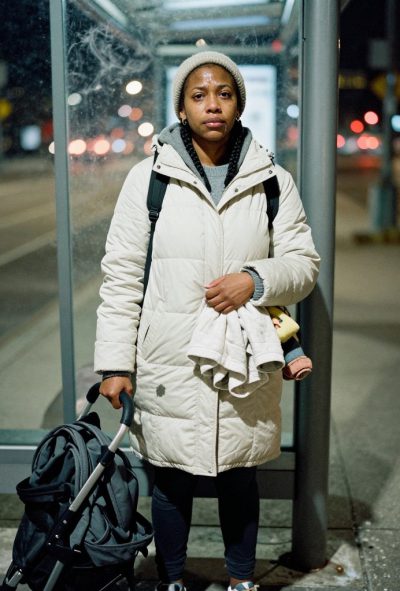
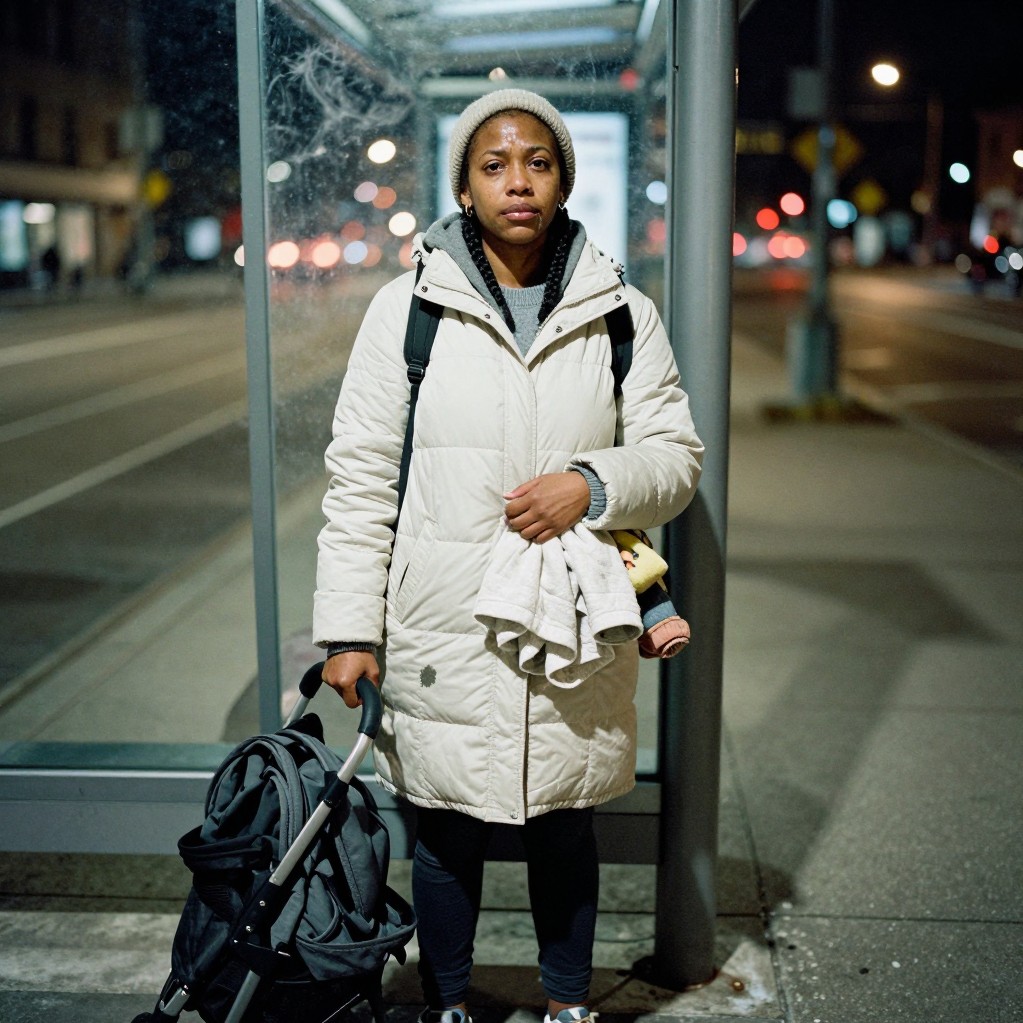
The 20 came west on Madison at eleven at night with six people on it and a woman standing in the aisle holding a baby and a folded stroller at once, which isn’t a thing a person can do, and she was doing it anyway.
She had the stroller up under one arm and the baby against her shoulder and a diaper bag hanging off the crook of her elbow, and the bus lurched at Halsted and she went sideways into the fare box and caught herself on it with her hip.
“Ma’am,” the driver said. “You want to put that down before you fall.”
“I know. I know.” She got the stroller folded down against the seats and propped the bag on it and stood there breathing. “Sorry. Sorry.”
I got up. I had a seat by the window and nothing to do with it.
“Take it.”
She looked at me the way tired women look at men who offer them things — quick, flat, checking for the catch — and then she sat down, all at once, like a bag of laundry, and the baby started to cry.
Not a small cry. A real one, a rising one, the kind that has a shape to it and gets worse.
“Okay,” she said. “Okay, okay, okay.” She got the coat open and the sweater up and the baby turned into her chest and the crying stopped in about four seconds.
She fed him right there with her chin down and her hand cupped under his head and the bus going west and the lights going over her face one at a time. Nobody on that bus said one word about it. The man in the hoodie across the aisle turned his head to the window, carefully, and stayed that way.
She was maybe thirty-one. Brown skin, a little shine on the forehead, hair in two braids under a knit hat, gold hoops, a puffy coat that had been white once. Her face was puffy with tiredness around the eyes and she had a small sore at the corner of her mouth and no makeup on at all. Under the coat she had a grey sweater and maternity leggings still, and she had the body of a woman four months out: the belly still soft and round, the breasts heavy and full, one of them out and doing its job, the other one already showing a wet patch through the sweater.
The baby was small — three, four months — in a yellow sleep suit with feet in it, and one hand came up out of the blanket and rested on her chest, and then went limp.
“First one?” I said.
She looked up. “That obvious?”
“The stroller fight.”
“Yeah.” She laughed, quietly, so as not to move him. “Four months. His name’s August. He’s got a cold and he won’t sleep unless he’s on me and my mother says I’m making a rod for my own back and my mother has been right about exactly one thing in her life.”
“What was the one thing?”
“That I should marry a man with a job.” She said it without heat. “Turns out. Anyway.”
She fed him for ten minutes. When he came off he was asleep with his mouth open and milk on his chin, and she wiped it with her thumb and put him up on her shoulder and patted his back, and he burped, and she said, “There he is,” in a voice that was nothing like the voice she had been using on the bus.
“Can I hold the bag?”
“What?”
“Give me the bag. And the stroller. You’ve got a baby on your shoulder.”
She hesitated. Then she handed me the diaper bag and let me take the stroller, and something in her shoulders came down about an inch.
“Thank you,” she said. “God. Thank you.”
“Where are you going?”
“Kedzie. Two more.” She leaned her head back against the window and shut her eyes. “I was at my mother’s since Tuesday because the heat went out in my building. She lives in South Shore and she talks from the minute you walk in the door until the minute you leave, and she thinks August should be on a schedule, and she thinks I’m —” She stopped herself. “I’m doing it. I’m talking like her now.”
“Like who?”
“Like a woman who explains herself to strangers.” She opened one eye. “No offence.”
“None taken.”
The bus went past Ashland and Damen and the street got quieter. Her head tipped over, slowly, until it was against my shoulder, and she said, “I’m not sleeping,” and then she was.
I sat still. The baby was on her shoulder making small sounds. Her braids smelled like coconut and like a baby’s head, and she was breathing the way people breathe when they have not slept properly in four months, and one of her hands was curled on her knee with the nails bitten down.
At Kedzie I said, “Hey,” and she came up out of it like a woman surfacing.
“I’m sorry. I’m sorry — did I drool on you?”
“No.”
“I did. I can feel it.” She wiped her face on her sleeve. “This is my life now. I fall asleep on strangers on the bus and I wake up with my whole front wet.”
She had leaked through the sweater. Both sides now, two dark circles, and she looked down at herself and made a face and then laughed, tired.
“Right,” she said. “Well. That’s the glamour.”
Her building was a two-flat on Kedzie with eleven steps up to the door and no light in the hall, and no elevator, and she stood at the bottom of it with the stroller and looked up at the stairs like a woman looking at a mountain.
“I can take the stroller up,” I said.
“It’s forty pounds.”
“Then I’ll take it up twice.”
She carried the baby and I carried the stroller and the bag, and at the top she unlocked the door and put the light on with her elbow and said, “Welcome to the smallest apartment in Chicago.”
It was two rooms and a kitchen, hot as an oven because the radiator did not have a thermostat, and it smelled like milk and laundry and the inside of a diaper pail. There was a crib in the front corner, with a mobile over it and a rocking chair beside it and a yoga ball in the middle of the floor, and a TV on the wall with the sound off, and a laundry rack with six baby sleepers drying on it, and a Christmas tree in a box in the corner that had not been put up or put away.
“Sit,” she said. “Don’t move anything. Just sit.”
She changed the baby on the floor on a mat with the efficiency of a nurse, and he woke up and complained and then settled, and she walked him around the room for six minutes with her cheek on his head and put him in the crib and turned on a white-noise machine that sounded like rain on a car roof.
Then she stood on the rug with her arms hanging.
“Okay,” she said. “He’ll be out for two hours if I’m lucky. Maybe forty minutes if I’m not.” She looked at me. “I’m going to have a shower. It’s been three days. Would you —” She stopped, and started again. “Would you stay in the room? Not, like, in the bathroom. In here. With the monitor. If he wakes up and I’m in the shower I have to get out with soap in my eyes and it’s — I’ve done it. It’s horrible.”
“Go.”
“You don’t have to.”
“I’m sitting right here.”
She looked at me for a second too long, and something moved behind her face that was not about the shower, and then she nodded and went into the bathroom and shut the door.
The monitor hissed. The radiator ticked. I sat on the couch with August’s breathing coming out of a plastic box at my elbow and a laundry rack dripping on my shoulder and the whole flat smelling of her.
The water ran for a long time. Then it stopped, and there was a silence, and she said through the door, “Are you still there?”
“Still here.”
“Okay.” A pause. “Can you talk? Just — talk. About anything. I haven’t had an adult conversation in a room in about a week.”
So I talked through the door about my week, and she said “uh huh” and “no way” and once, “wait, say that again,” and when she came out she had a towel around her head and a big T-shirt on and her legs bare and she was a different woman entirely.
“That’s better,” she said. “That’s a hundred percent better. Do you want a beer? I’ve got one beer. I’ve had one beer in this fridge since July because I’m breastfeeding and I keep not drinking it.”
“Half of it.”
“Half of it,” she agreed, and poured it into two glasses like a woman doing something ceremonial.
She sat down on the other end of the couch with her feet up on the arm and the towel coming loose and her hair wet down her neck.
“Simone,” she said.
“What?”
“My name. Simone.” She drank. “You’ve been in my house for forty minutes and I never told you my name.”
I told her mine. She said it back twice, testing it.
“Okay,” she said. “Now. I’m going to say something and I want you to not be weird.” She turned her glass in her hands. “I haven’t been touched by a man since I was five months pregnant. Not — nothing. He left in April. He didn’t leave because of the baby, he left because he was who he was, and I’ve made my peace with that, and I’m not going to cry about it on a couch with a stranger tonight.”
“Okay.”
“I’m telling you so you understand something.” She looked up. “I am a mother all day. All day. And all night. My body is a schedule and a machine and a pair of arms and a place to put a baby. And I woke up on your shoulder on the bus tonight with my whole front wet and I thought — oh.” She stopped. “I thought, oh, there’s a man under me, and it was the first time in a year I’d thought that.”
The radiator ticked.
“That’s what I thought,” she said, “and now I’ve said it out loud, and you can take it however you like.”
She set her glass on the floor and came across the couch on her knees, and the towel came off her head and her hair fell down wet and she did not fix it.
“Two things,” she said. “One. If he wakes up, everything stops, and I don’t care where we are or what I said, and you don’t get to be disappointed about it.”
“Understood.”
“Two.” She looked at me steadily. “I don’t know what my body does anymore. It’s not the body I had. There’s a scar and there’s a lot of — everything is different, and it does things I don’t tell it to. So if something happens that’s strange, you don’t make a face, and you don’t stop, and you don’t ask me if I’m all right in that voice.”
“What voice?”
“The voice from the bus. The poor-you voice.” She took my face in her hands. “I’m not a poor-you. I’m a woman in an apartment with a baby asleep in the corner and one beer in her.”
She kissed me and it was not gentle.
Her mouth was soft and she kissed like she was starving, one hand in my hair and the other flat on my chest to feel what she was doing to me, and she made a small hungry sound that turned into a laugh against my mouth.
“Okay,” she said. “Okay. I’m going to be bad at this. It’s been a year.”
“Nobody’s timing you.”
“Everybody’s timing me. There’s a baby.” She pulled the T-shirt off over her head and dropped it behind the couch, and she was naked on the couch in the yellow light of one lamp, with her braids wet and her body four months out of a birth.
I did not make a face. I want that on the record.
Her breasts were full and heavy and low and the areolas were wide and dark and the veins showed blue through the skin, and there was a reddish line where the strap of the bag had rubbed, and one side was leaking, a slow bead at the nipple.
“See,” she said, watching me. “That’s the thing nobody tells you. They just — do that. All day. When he cries. When the shower’s hot. When somebody touches me.” She took my hand and put it on the leaking one and her breath went out of her. “Ah. Okay. That’s — that’s a lot, actually.”
“Too much?”
“No.” Her hand stayed over mine. “No. It’s just — nobody’s touched them since March except a baby and a pump. And the pump is not romantic.”
I put my mouth where her hand had been and she said, “Oh,” and then, “careful,” and then, “no, not that careful.”
Milk. Not much, and not the way it is in a story — a taste, thin and sweet, and she said, “Sorry,” and I said, “Don’t,” and she said, “It’s going to happen, it’s just going to happen,” and laid a hand at the back of my head and stopped apologising.
She came the first time with her heel braced on the arm of the couch her palm clamped over her mouth and her braids on the cushion, and it took a while and it was quiet and at the end she was saying “okay, okay, okay” very fast and then she went quiet altogether.
“Wait,” she said, afterward. “Wait, give me a minute. Everything’s — everything’s very —”
“Take the minute.”
“Don’t be nice. Nice is going to make me cry.” She put her forearm over her eyes. “You know what’s stupid? I almost forgot it was like that. A year. A year and I actually almost forgot.”
She got up and went and looked into the crib, and stood there for a moment with her hand on the rail, and came back and said, “He’s out. He’s completely out. The white noise is a miracle.”
“Come here.”
“Say please.”
“Please.”
“Wrong. You’re supposed to say ‘come here.'” She laughed and came anyway, and got on my lap and put her arms around my neck. “Now,” she said, into my ear. “Here’s the second thing I want to say, and then I’m going to stop talking, because I have been talking for an hour.”
“Say it.”
“For a year everybody has touched me like a mother. The nurses. My mother. My aunt. Everybody’s hands on me like I’m a piece of equipment that has to keep working.” Her mouth was at my jaw. “I want to be touched like something somebody wants. Not carefully. I don’t want careful tonight. If I say stop I’ll say stop.”
“You’ll say stop.”
“I’ll say stop.” She sat back and looked at me. “Now put me on that counter and do it like you mean it.”
The counter was small and the kitchen was hot and she cleared it with the flat of her arm — a bowl, a bottle brush, a tin of formula she did not use anymore — and got up on it herself with her hands on my shoulders.
“Cold,” she said. “God. Okay. Cold.”
“Want a towel?”
“I want you to stop asking me things.” She pulled me in by the hips. “Come on. Before I think.”
She was wet and her thighs were hot and she put her head back against the cabinet when I was in and said something that was not a word, and then her hand came up and took a fistful of my hair and pulled.
“Harder,” she said. “I said what I said.”
I gave it to her harder, and the cabinet doors knocked, and she said, “Yes,” and then “the neighbours,” and then, “sod the neighbours, they’ve heard worse since April.”
She wanted her hair pulled and she wanted to be told what she was doing, and she wanted, at one point, to be turned around, and she got down off the counter and put her hands flat on it and gave me a look over her shoulder with her braids hanging down and her eyes wet.
“Like this,” she said. “And don’t be gentle, and don’t look at me like I’m going to break, because I have pushed a person out of my body and I am not going to break.”
It went on long enough that her legs started to go, and I said so, and she said, “Then hold me up,” and I got an arm around her middle and held her and she said, “There. There. That’s the thing. That’s the — oh.” And she stopped talking again.
She came standing up, with her forehead on the counter and my arm around her and her whole body going tight and then loose, and when it was over she reached back and held my wrist where it was and did not let go for a while.
“Okay,” she said, eventually, into the countertop. “Okay. That’s enough of that. I need to lie down before I fall down.”
She did not lie down. She stood there holding the counter with both hands and her back going up and down, and then she said, “No. Not yet.”
“Simone—”
“I know. I know. But it’s been a year and I’ve got about ten minutes left in me and after that I’m going to be a mother again until Thursday.” She straightened up and turned around, and her braids were stuck to her neck and her face was wet. “One more. One more and I’ll be good.”
“Where?”
“Bedroom. Face down. And keep your hand on my neck and hold me there, and don’t let me up.”
The bed was a mattress on a frame against the wall with a laundry basket on it and a fan on the floor, and she pushed the basket off and got on it and lay down on her stomach with her arms folded beneath her head, her cheek on her forearms, watching me.
“You’ll have to get me the pillow,” she said.
“Which pillow?”
“The one under my hips. I can’t do it with my face in the mattress and nothing under me, my back will go.” She lifted up and I put it there and she settled down onto it. “Okay. Now. And when I say harder you go harder, and when I say enough you stop, and everything else you decide.”
“What if I decide to be careful?”
“Then I’ll be disappointed and I’ll pretend I’m not.” She laughed into her arms. “You won’t, though. I’ve been watching your hands all night.”
I laid my hand on her neck and she let out a breath and went still. Then she said, “There,” quietly, and pushed back against me, and I held her down by the neck and gave it to her the way she had asked for it.
The frame knocked on the floor. She said, “Harder,” and then, “that’s it,” and then nothing that was words, and her hands came out from under her head and grabbed the edge of the mattress on either side so hard that her knuckles went pale.
“Don’t stop. Don’t stop. If you stop now I’ll —”
I did not stop.
She came with her face buried in the mattress, a sound that was mostly air, and her whole body bucked once and then went slack under my hand, and I let go of her neck and she lay there with her mouth open against the sheet and her eyes shut.
“Okay,” she said, after a while. “Okay. Now I’m done. Now I’m actually done.”
“Lie still.”
“I am lying still. I couldn’t get up if the building was on fire.” She swallowed. “That was —” She laughed, weakly. “I don’t have a word for that. I’ve got a four-month-old. My vocabulary is ‘milk’ and ‘poop’ and ‘no, honey, no.'”
I got the towel off the floor and wiped the back of her neck, and she turned her head and watched me do it.
“You’re going to be one of those,” she said.
“One of what?”
“One of those men who gets sweet afterwards.” She reached back and found my hand. “I’ve read about them. I thought they were made up.”
We got to the bed — which was a mattress on a frame in the corner with a laundry basket on it that she pushed onto the floor — and she lay on her side and pulled me in and put her hand between us.
“Now you,” she said. “And I want to do it, so don’t take over.”
She was good at it. She had a midwife’s hands, sure and unembarrassed, and she watched my face throughout, her chin propped on her other hand and her braids falling over her shoulder.
“Tell me when,” she said.
“Now.”
“Not in me, not on the bed, this mattress is the only one I’ve got.” She moved down, took him in her mouth, kept her hand working and never pulled off, and it took about ten seconds after that.
She came up coughing and laughing at the same time and put her hand over her mouth.
“Sorry. Sorry. I haven’t done that in a year and I forgot how much there is.”
“Come here.”
“Don’t be sweet to me, I’ll cry.” She lay down with her head on my chest anyway, and then said, “Wait. Wait, wait —”
The monitor had changed. A small rustle, then a sound like a hinge.
“He’s up,” she said, and was off the bed and pulling the T-shirt on before I had sat up. “Two hours and ten minutes. That’s a record. Don’t move.”
I heard her through the wall: the creak of the rocking chair, a low murmur, the white noise. Then nothing. Then, after a while, her voice, singing four notes over and over, badly, quietly.
She came back twenty minutes later with the baby on her shoulder, asleep again, and stood in the doorway in the T-shirt with her hair everywhere and said, “He’s got a temperature of about nothing and he’s decided he needs to be held. So I’m going to sit in that chair for the rest of the night. You can go. Or you can sleep on the couch, and I’ll wake you at six by dropping something.”
“I’ll take the couch.”
“Good.” She turned, and then turned back. “Hey. The thing I said on the bus. About my mother being right about one thing.”
“Yeah?”
“I was wrong. She’s been right about two.” She shifted the baby up. “The other one was, she said, ‘Simone, one day you’re going to want somebody to look at you and not at him.'” She smiled, one corner of her mouth going up. “You looked at me on the bus with a baby screaming and milk on my front and you looked at me.”
At six she woke me by dropping a spoon, as promised. There was coffee, and the baby in a bouncy seat on the floor kicking his legs, and she had put her braids up and had a sweatshirt and socks on and looked, for the first time, like a person who had slept.
“Thursday,” she said, at the door. “My mother takes him Thursday afternoon. Four hours. It is the only four hours I have.”
“Thursday.”
“Don’t be late and don’t bring anything.” She handed me my coat. “And don’t say anything about last night being a lot, because I know it was a lot, and I’ve decided it was a good lot.”
The 20 came at seven with the sun coming up over the tracks at Kedzie and the bus full of people going to work. I got on and sat down and looked out the window at her window, and she was already at it with the baby on her shoulder, one hand flat on the glass, not waving, just standing there.
She was still standing there when the bus pulled away.
Related posts:
 My Bus Adventures #4: Straight Lines
 My Bus Adventures #16: Two Ways Home
 My Bus Adventures #1: The 9:40
 My Bus Adventures #15: Four Eleven
 My Bus Adventures #18: Soup
 My Bus Adventures #17: The Ramp
 My Bus Adventures #14: The Debt
 My Bus Adventures #3: The Signal
 My Bus Adventures #8: Night Shift
 My Bus Adventures #2: Window Seat
 My Bus Adventures #12: Unopened
 My Bus Adventures #9: The Back Row
