
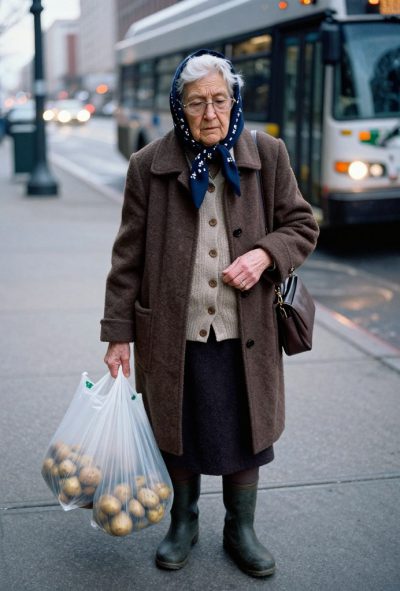
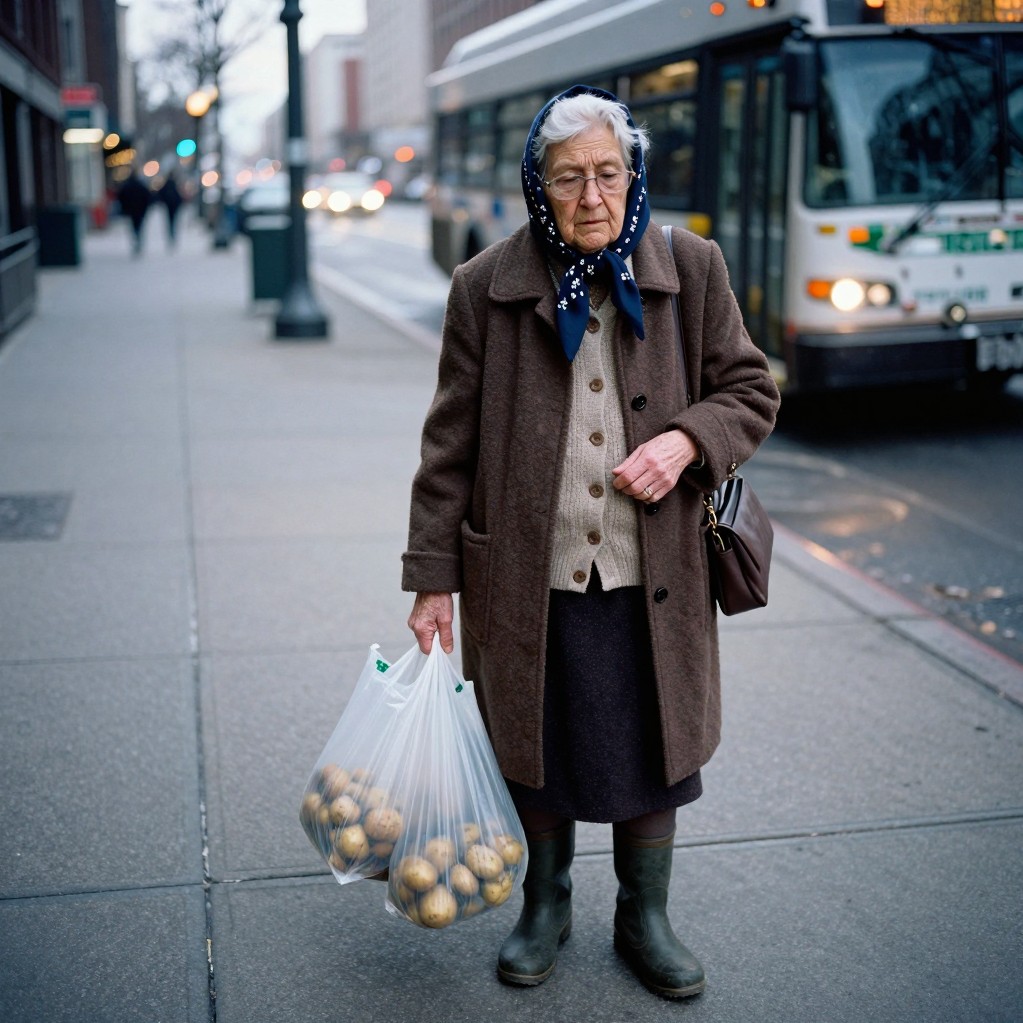
She got on the 65 at Grand and Western with four plastic bags and a purse, and the driver waited for her, and she took eleven seconds to get up the first step.
“Take your time, ma’am.”
“I am taking my time,” she said. “This is me taking my time.”
She had a headscarf tied under her chin, navy blue with little white flowers, and a brown coat that had been good once, and rubber boots over support stockings, and she smelled like lavender and like the inside of a church. She was old the way some women are old — thin wrists, thick middle, everything soft and settled, a face with a lot of lines in it and a mouth that had not smiled in a while but still knew how.
She paid her fare and stood in the aisle looking at the seats like a general surveying a field.
“Ma’am,” I said. “Here.”
“I don’t need a seat.”
“You’ve got four bags.”
“I always got four bags. I been carrying four bags since nineteen seventy.” But she sat down. “Thank you. God bless you.”
The bags went between her feet. One of them had a sack of potatoes in it and the plastic was stretched white at the bottom, and I watched it the whole way because it was going to go and she was not going to catch it.
It went at Central Park.
“Ah —” She grabbed for it and the potatoes went across the floor of the bus, four of them, rolling, one going all the way up to the front where a kid in headphones stopped it with his foot.
“I got it,” I said. “Sit down. I got it.”
“Those are five pounds of potatoes.”
“They’re fine. Look. Nothing’s broke.”
I got them all back in the bag and doubled it up with one of mine and she watched me do it with her hands folded on her purse and her mouth working.
“Central Park,” the driver called.
“That’s me,” she said. “That’s my stop. Twenty-two steps is what’s waiting for me at the other end of this, and I been up and down them twenty-two steps since my Stanley died and I’m going to tell you something, young man, I am sick to death of those steps.”
“I’ll carry the bags up.”
“No.”
“It’s two blocks.”
“No, no, no. You got your own life.” She stood up and got her purse on her arm. “Thank you for the potatoes.”
I took two of the bags off the floor before she could stop me and got off the bus behind her, and she turned around on the sidewalk and looked at me, and her eyes filled up, which she was not expecting and neither was I.
“Oh,” she said. “Oh, don’t. Now look what you did.” She wiped her eye on her glove. “I’m sorry. I’m not a person who cries. My Stanley used to say I was the only woman in Chicago who could bury her own mother and then go make lunch.”
“It’s cold out. Let’s walk.”
Her building was a brick two-flat on a side street with a gangway and a garbage can and a light over the door with a dead bulb. The stairs were narrow and there was a radiator pipe running up the wall that you had to lean around.
“You go first,” she said. “If I fall, I’d rather fall on the bags than on you.”
“Mrs.—”
“Wanda. Wanda Piotrowski. And don’t say ‘careful’ every step, I know the steps. I know these steps better than I know my own face.”
She went up with one hand on the rail and one on the wall and stopped on the landing to breathe, and then she said, “All right,” and we went up the second flight, and at the top she unlocked three locks and put the light on in her kitchen.
It was hot and clean and it smelled like sugar and yeast. There was a table with a plastic cloth and four chairs, and a picture of the Pope, and a man in a dark suit in a gold frame, and a calendar from the funeral home with a different dead person on it every month, and a radio on the sill playing an accordion tune, very low.
“Put them on the counter,” she said. “Not the floor. My knees.”
I put them on the counter. She shrugged out of her coat, draped it over a chair back, and stood in an oatmeal cardigan, and she was smaller without the coat, and her hands were shaking a little.
“Sit down,” she said. “You’re going to have a piece of cake.”
“No, I—”
“You are having a piece of cake,” she said again, “because I made a cake on Tuesday for the ladies at the church and eleven ladies said they were coming and two came, and I have got a cake in that box that is going to go in the garbage on Sunday, and I would rather a stranger ate it than the garbage.”
She cut two pieces and put them on plates with flowers on them and set one in front of me and sat down across from it with her hands in her lap.
It was a poppy seed roll, the real thing, dark and dense, and I had not eaten anything that good in a month.
“Good?” she said.
“It’s incredible.”
“Stanley’s mother’s recipe.” She watched me eat. “You know what I did today? I went to the bank and then I went to the store and then I stood in the aisle at the store for ten minutes because I couldn’t remember if I needed sugar or if I had sugar, and then I came home and I put the sugar in the cupboard next to the sugar.” Her laugh went crooked halfway and she cut it off. “That’s my day. That’s a whole day.”
“Where’s your family?”
“Karen’s in Phoenix. She calls Sundays at four.” She straightened the salt shaker. “She’s a good girl. She’s got a good husband and two boys and a pool, and she says, ‘Mama, come out here,’ and I say, ‘Karen, I’ve got a radiator and a church and a doctor and I’m not going to Arizona to die in a condominium.'”
“And your neighbors?”
“Mrs. Rybak died in March.” She said it plainly. “Downstairs. She was ninety-one and she fell in the bathroom and they didn’t find her for two days. Two days.” She looked at the table. “I was in this apartment. I was right up here. I didn’t hear a thing.”
The accordion on the radio finished and the news came on and she reached over and turned it off.
“So,” she said. “That’s the whole story. My husband’s dead eleven years, my daughter’s in the desert, my neighbor’s dead, and I’ve got twenty-two steps and a cake.” She looked up. “You want coffee? I’ve got coffee. I make it in the pot like a person.”
The coffee came in a cup with a saucer and a spoon and a little dish of sugar cubes and she sat down with her own cup and put both hands around it.
“Tell me something,” she said. “Anything. Talk to me like a human being, not like a nurse.”
So I told her about the week. She listened with her glasses off and her chin raised, and she said “hm” at the right places and once, “Well, that’s men for you,” and by the time I was finished she had finished her coffee and was looking at me over the empty cup with an expression I could not read.
“You know what nobody tells you?” she said. “Nobody tells you that the worst part isn’t the being alone. You get used to the being alone. The worst part is the not being *seen*. I go to the store, I go to the bank, I go to the church, and I am a lady with a scarf and a bag, and nobody looks at my face. Nobody has looked at my face in —” She stopped. “My doctor looks at my face. He’s twenty-nine years old and he looks at my face like I’m a lab report.”
“You’ve got a good face.”
“Don’t.” She held up one finger. “Don’t you do that. Don’t you be kind to me because I’m old and I talked too much.”
“I’m not being kind. I’m eating your cake.”
She laughed then, properly, with her head back, and it changed her whole face — it took twenty years off it and put ten back and made her look like a woman who had been fun once, in a kitchen with an accordion on the radio and a husband who told her she could bury her mother and still make lunch.
“All right,” she said. “All right. You’re all right.”
She got up and took the plates to the sink and stood there with her back to me, and the water ran, and she said, “I’m going to say something and if it’s wrong you can put your coat on and go and I’ll never mention it and we’ll both pretend I was talking about the weather.”
“Okay.”
She turned the water off and turned around and dried her hands on the towel, slowly, one finger at a time.
“I’m seventy-six years old,” she said. “In April I’ll be seventy-seven. And I have not been touched by a man since two thousand and fifteen, and that was my Stanley in the hospital when he was already mostly gone and I held his hand and he didn’t know it was me.” She folded the towel. “I’ve got a body, is what I’m saying. It’s not a nice body. It’s got a scar from the gallbladder and two knees that don’t work and everything’s gone south. But it’s a body and it’s not finished yet, and I am so tired of being a nice old lady in a scarf who nobody looks at.”
The radiator knocked in the wall.
“So,” she said. “That’s what I’m saying. And you can go. I mean it. I’ll give you cake to take with you.”
“Why would I go?”
She blinked.
“I’ve been sitting at your table for an hour,” I said, “and I haven’t thought about the time once.”
“That’s not an answer.”
“It’s the answer I’ve got.”
She held my eye a while, then said, “Well,” and her voice was not quite steady, “then you better come here, because I’m not going to walk all the way across my own kitchen.”
I got up and she came the two steps to meet me and put her hands flat on my chest, and her hands were small and dry and warm and she tipped her face up, glasses off, eyes bright.
“Now listen,” she said. “I’m going to be rusty at this. Eleven years is a long time. And I might cry, and it’s not going to be because you did something wrong, it’s going to be because I’m seventy-six and this is a lot.”
“Then cry.”
“Don’t be nice, I told you.”
“I’m going to be nice,” I said. “You’re going to have to live with it.”
She made a sound that was half a laugh and half something else and put her face against my chest, and I put my arms around her and held her, and she stood there and shook, quietly, for a while.
“Okay,” she said, into my shirt. “Okay. That’s enough of that. I’ve had my cry and now I want to be a woman for an hour.” She pulled back and wiped her face with her sleeve, businesslike. “Bedroom’s through there. And don’t look at the bedroom, it’s got a sewing machine in it and a pile of things I’m going to fix.”
“I won’t look at the bedroom.”
“You’ll look at the bedroom. Everybody looks at the bedroom.” She took my hand and led me through the door. “Sit on the bed. And when I come out, you look at me. Not at the sewing machine. At me.”
The bedroom had a sewing machine and a pile of things she was going to fix and a bed with a crocheted spread on it and a dresser with a doily and a bottle of Jergens and a photo of Stanley in his suit, and she turned the frame face down before she did anything else.
“Not in front of him,” she said. “He was a good man but he’d have something to say.”
Then she stood on the rug and unbuttoned the cardigan and folded it and put it on the sewing machine, and then her blouse, and folded that too, and she did it all without hurrying, the way you fold things when you have folded things for fifty years.
She was seventy-six and her body said so: thin white hair down between her legs, a soft sagging belly with a long pale scar under the ribs, breasts gone flat and low with wide brown nipples, the skin on her arms loose, the bones of her shoulders showing. Her legs were the legs of a woman with two bad knees — a little bowed, a little swollen at the ankle, support stockings rolled down to the calf.
She stood with her arms loose, chin lifted, and let me look, and her face was proud and terrified at the same time.
“Well?” she said.
“Come here.”
“That’s not what I asked.”
“You asked me to look at you. I’m looking.” I put my hands out. “Come here, Wanda.”
She came and stood between my knees and I put my hands on her hips — the skin there was soft and cool and it went into goosebumps — and I kissed her stomach, above the scar, and she said, “Oh,” and her hand came down on the back of my head.
“Nobody’s done that,” she said. “Nobody’s — Stanley, and Stanley’s been dead eleven years, and nobody’s put their mouth there since —” Her breath went out. “All right. All right. That’s enough, I’m going to fall over.”
She got on the bed on her side, with a pillow under her hip, and pulled me down by the shirt, and her mouth was dry at first and then it wasn’t, and she kissed me like a woman making up for eleven years.
“I want to do something,” she said against my mouth.
“Then do it.”
“You don’t know what it is.”
“Then tell me.”
She sat up and looked at me, and then she said, “I want to put my mouth on you,” and she said it plainly, looking right at me, and then she said, “Is that all right? At my age?”
“Wanda.”
“What? It’s a fair question. I’ve got a bridge in my mouth and I don’t want to hurt anybody.”
“I don’t care about your bridge.”
“Everybody cares about the bridge.” She laughed, and then she got serious and sat up properly and said, “Take those off. And don’t help me. If I do it wrong, tell me. I’m not proud, I’m out of practice.”
She got down between my legs on the bed with the crocheted spread bunched up under her knees and she wrapped her fingers around it and studied it the way a woman studies machinery she used to run, then bent her head.
She was careful and slow and she kept looking up to see if it was working, and when I said her name she made a small satisfied sound and stopped being careful.
“Good?” she said, coming off.
“Yes.”
“Don’t lie to me.”
“I’m not lying. Don’t stop.”
“Don’t stop, she says.” She wiped her lips on her wrist, and her eyes were bright and her hair was coming down out of its pins. “Eleven years and a man tells me don’t stop.” She bent her head again. “All right. But I’m going to need to lie down after this, my back is going.”
She lay back on the bed and put her arm over her eyes and breathed.
“Give me a minute,” she said. “The blood’s all gone out of my head. This is what they don’t tell you about getting old — you can still want it, you just can’t do it standing up.”
“We’ll do it lying down.”
“No.” She moved her arm and looked at me. “No, I want to be on top. I’ve been on my back for eleven years, I want to be on top of somebody.” She sat up. “But my knees. If I get down on them I’m not getting up again until Thursday.”
The chair was in the corner with a pile of mending on it — a man’s shirt, a pair of trousers that were going to be too big for anybody now — and she pushed the pile onto the floor and said, “There. I can put my feet on the floor and my hands on the arms and it’s not going to be dignified but it’s going to work.”
She got in the chair and I got her legs over the arms of it, one and then the other, and she said, “Careful, that’s the bad one,” and then, “all right, that’s good, that’s good,” and then I was in her and her head went back against the chair and her mouth came open and she said nothing at all.
She was wet and hot and tight in a way that surprised her as much as it did me.
“Oh,” she said. “Oh, there it is. There it is.” She got her hands on the arms of the chair and lifted herself and came down, and made a noise like she’d been hit. “Don’t you dare be careful with me.”
“I wasn’t going to be.”
“Liar.” She laughed, and then she wasn’t laughing. “Here. Like this. This is how Stanley used to — no. No, not like Stanley. Like this. Like — oh.”
She found her rhythm, and it was not a fast rhythm, slow, unhurried, watching my face the entire time, and her thin hair came down out of the pins and stuck to her neck, and her breasts moved and her stomach moved and she was not a nice old lady in a scarf anymore, she was a woman in a chair with her legs over the arms of it and her chin up and her mouth open.
“I’m going to tell you something,” she said, between breaths. “I’ve thought about this. Not tonight. For years. In this chair. In that bed. In the bath. I’ve thought about a man’s hands on me and I thought, that’s finished, that’s a thing that happened to a different woman.” She came down harder. “And here you are. Here you are in my kitchen and my bedroom and my chair, and I’m —”
She stopped talking and went still and then her whole body pulled tight and the noise she made was close to anger, and then she slumped back in the chair with her legs sliding down off the arms and her hand over her mouth.
“Wanda—”
“Don’t say anything,” she said, from behind her hand. “Don’t say one word.”
I didn’t.
She lay there in the chair with her eyes shut and her chest going, and then she took her hand away from her mouth and it was wet, and she said, “I’m all right. I’m all right. It’s just — eleven years is a long time to be a piece of furniture.”
She reached out and got my hand and pulled me in by it.
“Now you,” she said. “And I want it in my mouth. I want to know I did it. At my age you want to know you did something.”
“Your knees—”
“My knees are fine. My knees are better than they’ve been in a year.” She slid down onto the rug on the pillow and pulled me by the hips. “Come here. And don’t warn me like I’m a child, I’ll take what’s coming.”
She took him in her mouth, hand working, eyes watering, watching me, and when I told her she pulled back just enough and finished it with her hand and her mouth open, and then she knelt up on the rug with her hair everywhere and her face wet and she was laughing.
“Look at that,” she said, wiping her chin with the back of her hand. “Seventy-six years old and I’ve still got it.”
She cried after. She cried in the bed with her head on my chest and her hand flat over my heart, and it wasn’t sad crying and it wasn’t the crying from the kitchen, it was the other kind, the kind that comes when a thing you had given up on turns out to still be there.
“Eleven years,” she kept saying. “Eleven years, and it was all still there, and nobody —” and then she’d stop and start again.
I held her and didn’t say anything and after a while she fell asleep, and I lay there in a strange bed in a hot apartment on a side street with a photograph of a dead man face down on the dresser, and the radiator knocked twice and then it was quiet.
At five she got up and put on a robe and made coffee and eggs, and there was bread that she had made herself and jam that she had made herself, and she stood at the stove with her hair in a braid down her back and her glasses on and said, “You’re going to eat, and then you’re going to take the cake, and then you’re going to tell me what day it is.”
“Thursday.”
“Thursday.” She turned around with the pan in her hand. “Then Thursday you come back. Not because I’m lonely. I mean — I am lonely, I’m not going to lie to you, I’m the loneliest woman on this block and probably on the next one. But that’s not why.” She put the eggs on the plate. “You come back because I’ve got a whole life I stopped living and I’d like to start it up again, and I don’t want to do it by myself in this kitchen.”
“I’ll come Thursday.”
“And you’ll carry the bags.”
“I’ll carry the bags.”
She set the plate in front of me, one hand on the chair back, and gave me the same look she had given me on the bus — a woman checking whether a thing was real.
“Wanda,” I said. “Sit down and eat your eggs.”
“Don’t tell me what to do in my own house,” she said, and sat down, and ate her eggs, and talked for an hour about her mother’s kitchen in Jackowo and a dog she had in 1968 and the way the lake looks in April.
I took the cake home in foil. She stood at the window with her hand flat on the glass while I went down the twenty-two steps and out to the street, and when I looked up she was still there, not waving, just standing, the way old women stand at windows in this city, watching the street for somebody.
On Thursday I was there at four, and she was already at the window.
Related posts:
 My Bus Adventures #18: Soup
 My Bus Adventures #16: Two Ways Home
 My Bus Adventures #10: Close Quarters
 My Bus Adventures #14: The Debt
 My Bus Adventures #12: Unopened
 My Bus Adventures #3: The Signal
 My Bus Adventures #15: Four Eleven
 My Bus Adventures #17: The Ramp
 My Bus Adventures #19: Let Down
 My Bus Adventures #1: The 9:40
 My Bus Adventures #5: Late Pass
 My Bus Adventures #13: The Discipline
