
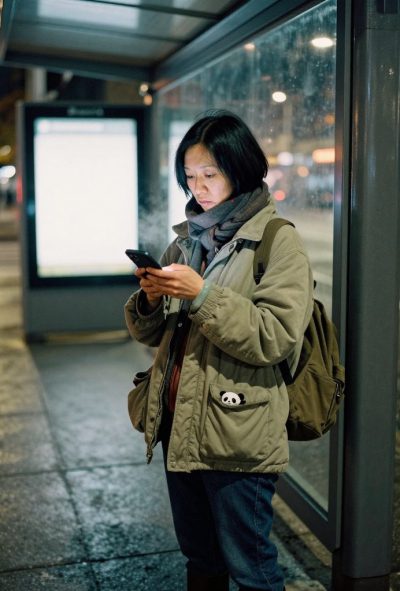
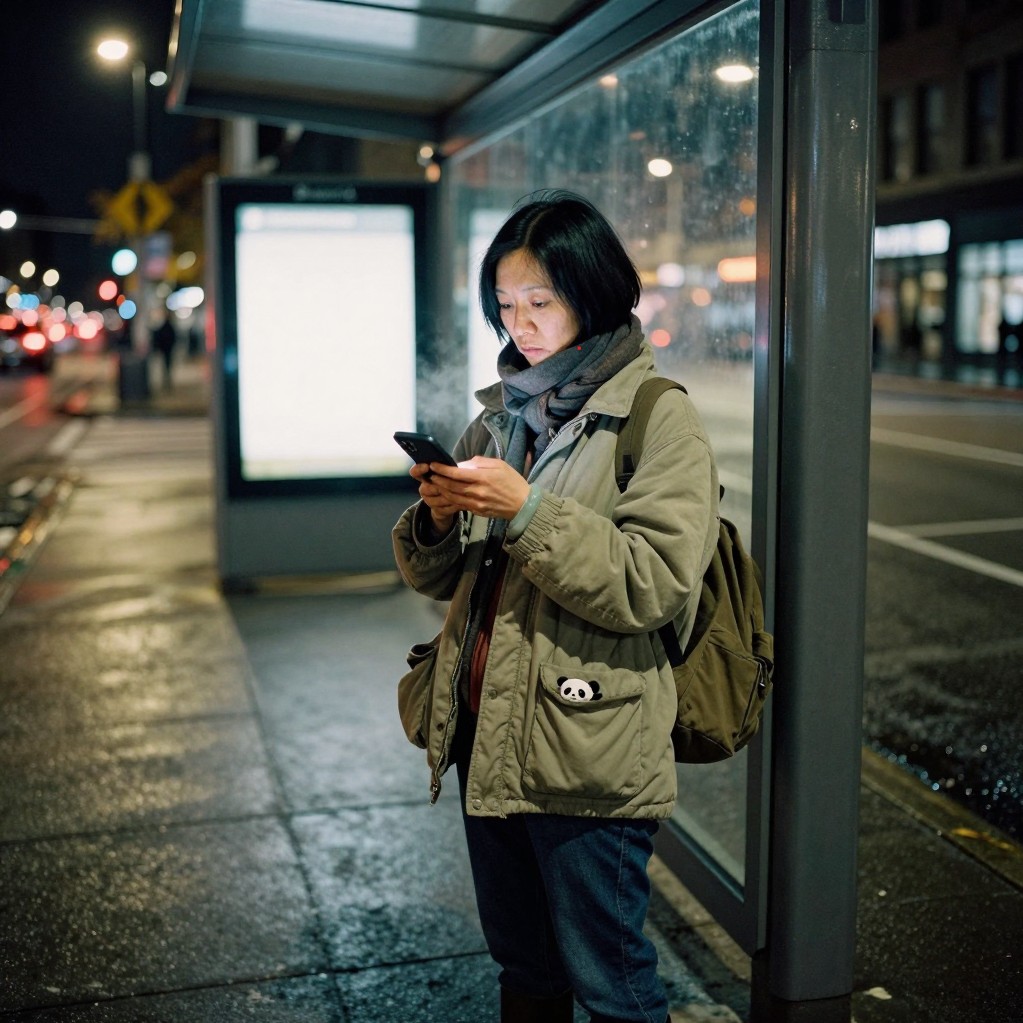
She got on the 151 at Belmont with a backpack on her front and her phone out in front of her like a lantern, and she stood in the aisle checking the seats, then the window, then her phone, then the seats again.
Twenty-six, twenty-seven. Small — five foot two in boots — with black hair cut blunt at the jaw and a canvas jacket two sizes too big and a scarf wound up to her chin and a backpack with a small embroidered panda on it. Chinese. She had the look that people have on their second or third day in a country: tired, over-alert, and reading every sign twice.
She sat down across from me and put her phone on her knee and typed something with both thumbs, and then turned the screen around and held it up at the whole bus.
It said: **”Please. I am going to hostel on Halsted Street. Is this bus going there? Sorry for my English.”**
The driver said something over his shoulder that she didn’t catch.
“Halsted’s the other way,” I said. “You want the 8, or the Red Line.”
She looked at me and then at the phone and then typed again, fast. Turned it around.
**”I do not understand. Please speak slowly or write.”**
I took out my phone and typed, and she leaned over to read it while I did, close enough that I could smell her shampoo — green tea and something like rain.
*You’re on the wrong bus. Halsted is east. This bus goes north.*
She read it, and her face did the thing that faces do when bad news lands in a language you can only half read: first nothing, then the small collapse.
“Ah,” she said. “Wrong.” She pointed at the floor of the bus. “Wrong bus.”
“Yeah.”
“Wrong.” And then she laughed — a real laugh, surprised out of her — and typed again.
**”I have been on four buses tonight. I am very good at buses now. I am good at the wrong buses.”**
I laughed. She watched me laugh and then she smiled, quick and shy, and looked down at her phone and typed one more thing and showed me.
**”My battery is 6%. I am lost. Can you help me? I am not dangerous. I am a teacher.”**
“Teacher,” I said, and pointed at her.
“Teacher,” she said. “Chengdu. Children. Five years.” She held up five fingers. “Very loud.”
I typed: *I’ll get off with you at the next stop and put you on the right bus.*
She read it, then looked up at me and said, very carefully, “Thank you. Thank you very much.” Four separate words, each one carried out and set down.
Her phone died at Fullerton.
She looked at the black screen and then at me and said, very quietly, “Oh no”, and then, “Oh no, oh no,” and started to press the button as if pressing it would bring it back, and her hands were shaking.
“Hey. Hey.” I got my phone out and typed. *It’s okay. I know where the hostel is. I’ll walk you.*
She read it with her face very close to the screen and her lips moving, and then she nodded, and then she did something I didn’t expect: she took her backpack off, unzipped the top pocket, took out a folded piece of paper and put it in my hand.
It was a printout of her hostel booking with the address and a little map, and on the back, in careful pencil, someone had written: *If lost, show this to a police officer.*
I turned it over and showed her the pencil and pointed at her. She nodded.
“Police,” she said. “But —” She made a face and shrugged, embarrassed. “Police is…” She typed on her dead phone out of habit, then gave up and said, “Big. Too big. For a bus.”
“For a bus, yes.”
“You are not police.”
“No.”
She weighed me up, and then she said, “Okay,” and put her backpack on her front and zipped her jacket up to her chin, and stood up when the bus stopped.
It was eleven-thirty and cold and the sidewalk on Halsted was wet and empty and there was a smell of fried food and garbage from the alley.
“Where?” she said.
“Six blocks.”
“Six.” She held up six fingers. “Okay.” And then she took something out of her jacket pocket and held it out to me: a small foil packet, like a wet wipe, with Chinese writing on it. “For hands,” she said. “On the bus. Dirty.”
It was a hand wipe. I took it. She nodded, satisfied, as if we had completed a transaction.
We walked. She kept half a step behind me and to my left, and every so often she would say, “Sorry,” for no reason at all, and once she stopped dead and pointed up at a neon sign of a taco and said, “What is this?”
“Taco.”
“Taco.” She said it back to me three times, committing it. “In Chengdu, we have —” and then she gave up and mimed something with her hands, then pulled out her phone, remembered it was dead, and said, “Oh no,” again, and put it away.
“Spicy?” I said. “Small? Bread?”
“Bread, yes. Spicy, yes.” She thought. “Small. Small, small. On the street. At night.” She brightened. “Many people.”
“Sounds like a taco.”
“It is not a taco,” she said, with enormous dignity. “It is better than taco.”
The hostel was a narrow building with a blue door and a sign and a buzzer, and she got her paper out and pressed the buzzer and nothing happened. She pressed it again. Then she tried the door and it was locked, and she stood there with her hand on it and I watched her work it out.
I typed on my phone and showed her: *Closed. Maybe nobody at the desk after eleven.*
She read it and said, “But I have —” and showed me the paper, and the paper said her booking started *tomorrow*, the twenty-second, and tonight was the twenty-first, and she read her own paper again in the light of the streetlamp and her mouth came open.
“Tomorrow,” she said. “Tomorrow, tomorrow, tomorrow.” She hit her own forehead gently with the heel of her hand. “Stupid.”
“It’s not stupid. It’s a time zone.”
“It is stupid.” She looked at the door. “Where can I go?”
I stood there in the cold with a Chinese schoolteacher who had a dead phone, a backpack with a panda on it, and nowhere to sleep, and I said the thing that you say, and then I had to mean it.
“You can sleep at my place. Couch. I’ll take the couch.”
She read it. She read it twice. And then she typed nothing, because her phone was dead, and she looked up at me and said, very slowly, “Why?”
“Because it’s cold and the door’s locked.”
She looked at me for a long time. Then she said, “Okay,” and then, “But I —” and made a gesture with her hand near her chest that meant nothing and everything, and finally said, “I am not… this is not…” and gave up, and looked at me helplessly.
“Nothing’s going to happen,” I said.
She didn’t understand that. I typed it in the cold with my gloves off, and she read it and nodded and said, “No, no, nothing,” and then she said something in Chinese, quietly, that sounded like she was talking to herself, and followed me to the corner to wait for the 22.
My apartment is one room and a kitchen and a bathroom with a window that doesn’t close, and I watched her take it in from the doorway: the radiator, the books on the floor, the lamp, the couch.
“Small,” she said.
“Small.”
“This is good.” She nodded. “Small is good. Big is —” She made a gesture like a balloon. “Too much.”
She took her boots off at the door and stood them together, neatly, and then she took off the big jacket and folded it, and under it she was smaller still: a grey sweatshirt, jeans, a green jade bracelet on her left wrist that she did not take off.
“You are hungry?” she said.
“I can make something—”
“No.” She put her hand up. “I make.” And she opened her backpack and started taking things out and putting them on my counter: a bag of tea, a small tin, a plastic bag of something dried, a packet of instant noodles, a spoon, a folding cup.
She had brought her own tea across the Pacific Ocean, in a backpack, and she stood in my kitchen and made it in a pot that wasn’t hers.
“Hot water,” she said.
I showed her the kettle. She filled it and stood watching it with her hands clasped behind her back, rocking slightly on her heels, and said, “In China, water is —” and then mimed boiling and then, “People say. Boil. Always.” She looked at me. “You boil?”
“Sometimes.”
She made a face: a small, complete, devastating face. “Sometimes,” she said, and shook her head, and I understood that I had failed an exam I didn’t know I was taking.
The tea was green and pale and it tasted like the smell of her hair. She poured it into the folding cup for me and then into a mug for herself and sat down on my couch with her knees up and her hands around the mug and said, “Ah,” like a person coming home.
“Good?”
“Very good.” She breathed the steam. “This is from my —” and then she stopped and did the thing with her hands again, the thing that meant *the word is not in my mouth*, and then she said, “My mother’s — place. Small place. Mountains. Very —” She pointed up. “High. Green. Wet.”
“The tea grows there.”
“Yes. My —” She tapped her chest, then made a circle with her hands that included her and someone older. “Family. Long time.”
“You brought tea from home to drink in Chicago.”
She looked at me over the mug. “I bring tea everywhere. Hotel tea is bad.” She sipped. “Also. It is for —” She frowned, hunted for the word, gave up, and said, “For when I am sad. Tea from home. So I am not so far.”
“Do you want to charge your phone?”
“Yes. Please.” She got it out and I got the cable and she plugged it in on the floor by the couch and sat watching the little lightning bolt appear like a woman watching a fire start in wet wood.
“Twenty minutes,” I said. “Then it’ll turn on.”
She nodded and drank her tea, and then she said, “You are —” and stopped, and started again. “You are not —” and stopped again, and put the mug down and said, “I am sorry. My English is — in my head, I am very funny. Out of my mouth, I am a child.”
“You’re doing fine.”
“No.” She said it firmly. “But I am trying. That is different.”
She took a shower with the door locked and came out in her own clothes with her hair damp and flat to her head and her face washed and about five years younger, and she stood in the middle of my apartment with her arms crossed and looked at the couch and then at me.
“One thing,” she said.
“Okay.”
She got her phone off the floor, which had come back to life, and typed for a long time — longer than the sentence needed — and then turned it around.
**”Thank you for not being a bad man. In my country my mother told me: never go with a stranger. I am 27 years old and I am doing a very stupid thing tonight and I know it. But my mother is in Chengdu and I am here. So.”**
I read it twice. She watched me read it.
*You’re safe here,* I typed. *Nothing happens that you don’t want.*
She read it and nodded and then she said, “Wait,” and typed again.
**”That is not what I am saying. I am saying I know it is stupid. I am not saying I am sorry.”**
She took the phone back before I could answer and held it against her chest and said, “Okay. Now I am tired. Good night.”
“Good night.”
She lay down on the couch with the blanket and her head on the arm and her phone face down on her stomach, and she said, “The light?” and I turned the light off, and in the dark she said, “Thank you,” and then, after a while, “In Chengdu it is now afternoon. My children are — ” and she yawned enormously, “…very loud.”
I lay in my bed in the dark and listened to her breathing slow down, and it didn’t.
After about ten minutes she said, into the dark, “Are you awake?”
“Yes.”
“Can I ask you a question? A — a culture question.”
“Sure.”
The blanket rustled. She sat up. In the light from the window I could see the shape of her, the panda backpack on the floor, the jade bracelet.
“In America,” she said, “when a woman and a man are in one room, and she says, ‘nothing is going to happen’ —” She stopped. “Is that true? Or is that — polite?”
“It’s true if she means it.”
“And if she does not mean it?”
“Then she says something else.”
She was quiet for a moment. Then she said, “Okay,” and lay back down, and then she said, “I do not know how to say the something else. In English.” A pause. “In Chinese I know. In Chinese I am very good.”
“You could show me.”
The blanket rustled again. Then the phone lit up her face, and she typed with one thumb and her lip between her teeth, and then she turned the screen around and held it out at arm’s length in the dark.
**”I have three days left in this country. I have seen a museum, a lake, and four wrong buses. You are the first person here who has looked at me and not at my map. I would like to kiss you and I would like you to teach me what comes after, because I am curious about everything and I have been curious about this for a long time and I am tired of being careful in a country where nobody can hear me being careful.”**
She lowered the phone. Her face was half lit and her eyes were enormous.
“That is a lot,” she said. “I know it is a lot. I wrote it in Chinese and the phone — the phone is better at English than me.”
I got up and crossed the room and sat down on the floor by the couch, and she sat up with the blanket around her waist and looked at me with her chin low, her eyes raised, wearing the same look as on the bus.
“The phone’s better at English than me too,” I said.
She laughed — one breath of it — and then she said, “Don’t be funny. I am very nervous.”
“Okay.”
“Also, be funny. A little. So I can breathe.”
I put my hand on her ankle through the blanket and she watched it happen and then she let her breath out all at once, and it was the noise of somebody putting down something heavy.
“Okay,” she said. “Okay.”
I kissed her. She was stiff for about two seconds and then she wasn’t, and she made a small surprised sound into my mouth and her hand came up and held my jaw, and her fingers were cold from the room.
“Ah,” she said, when we stopped. “That is a kiss.”
“That’s a kiss.”
“It is different.” She touched her own mouth, thinking about it. “In film it is —” She made a gesture, slow and swoony. “But it is not like that. It is —” She looked for the word. “More real. More — mouth.”
“More mouth.”
“Yes.” She nodded seriously. “More mouth. This is a good phrase. I will use this phrase.”
She kissed me again to check, and then again, and then she got a hand in my hair and stopped being a teacher checking her work.
“Wait,” she said, against my mouth. “Wait, wait.” She sat back and got the phone, and I thought she was going to type something important, and she typed and turned it around and it said:
**”I have not done this. Not never. Once. Two years ago. It was not good. So please do not think I am — experienced. I am not experienced. I am interested.”**
“That’s okay.”
She read my face instead of the words and nodded. “You are not —” She made a face. “You are not disappointed?”
“Xiaoyu.”
She blinked. I’d got her name off the hostel paper.
“Xiaoyu,” she said, testing it in my voice. “Nobody here says it. In the hostel they say ‘hi’ and look at the paper.” She put the phone down on the floor. “Say it again.”
“Xiaoyu.”
“Okay.” She pulled the blanket up to her chin and then, deliberately, let it fall. “Now. Teach me. And be — ” She thought. “Be honest. If I am bad, say. I am not a child. I am a teacher. I know how to be bad at a thing and get better.”
“First thing,” I said. “Stop asking me if you’re bad.”
“…Okay.”
“That’s the first thing.”
“That is a very good first thing.” She laughed, and then she leaned in and kissed me with her hands in my hair and did not stop this time.
She was small and warm and she smelled like my soap now, which did something to me that I was not prepared for. Under the sweatshirt she had a plain cotton bra and small breasts and a soft little belly and a mole under her left collarbone and the jade bracelet sliding up and down her wrist the whole time.
“Cold hands,” she said, when I put them on her ribs.
“Sorry.”
“No. Not sorry. It is —” She shivered. “It is good. It is a — a surprise. All night the surprises have been bad ones.”
I got the bra off and put my mouth on her and she said, “Oh!” — loudly, and then clapped her hand over her own mouth and looked at the wall, at the neighbors, at me.
“Thin walls,” I said.
“Thin walls,” she said, and then she laughed into her hand, and did not take the hand away, and let herself make the sounds into it.
Her jeans came off and her underwear came off and she lay there in the lamplight with one arm over her eyes and her knees together, and then her arm came away and she said, “Look at me. I want to know if you are —” and stopped, and I said, “I’m looking,” and she said, “Okay,” and opened her knees.
She was wet and she was embarrassed about it and she said, “This is — normal?” and I said, “Very normal,” and she said, “Okay. Good. Because in the — ” and gave up on the sentence.
I put my mouth on her and she grabbed the arm of the couch with one hand and my hair with the other and said something in Chinese, twice, and then, in English, “Oh — oh, this is — why did nobody tell me —” and then she stopped talking.
She came quickly, and hard, and then she put both hands over her face and laughed and said, “Sorry. Sorry. Too fast. I am —”
“Xiaoyu. Stop apologising.”
“I am sorry that I am apologising.” She peeked through her fingers. “This is a — a circle. A bad circle.”
“Come here.”
She sat up and crawled into my lap and wound her arms around my neck, her forehead on mine and said, quietly, “Now I want to do something for you. And I do not know how. And I am going to do it badly.”
“Then do it badly.”
She sat back and looked at me. “You are a very strange man.”
“Probably.”
“No.” She touched my face. “Not probably. You are.” And then she slid off my lap and onto her knees on the floor, and looked up at me, and said, “Tell me. Like a teacher. Step one.”
I told her. She listened with her lips pressed together and her eyes on my face, nodding at each thing like a student taking notes, and then she said, “Okay,” and did it, and it was not bad at all.
She was careful in the way that people are careful in a language they’re learning — slowly, checking, watching my face for the correction — and then she stopped checking and got interested, and that was better than careful.
“Good?” she said, coming off, and I said, “Don’t stop,” and she said, “Ah. ‘Don’t stop.’ This is the most useful English,” and bent her head again.
When I told her she pulled back and used her hand, and watched it happen with her mouth open and her eyes going wide, and afterwards she knelt up and looked at her own hand and said, “Huh,” in a voice of genuine scientific interest.
“That’s the face,” I said.
“What face?”
“The one you’re making.”
She looked at me. Then she started to laugh and couldn’t stop, and she had to put her forehead on my knee.
“I am sorry,” she said, into my knee. “I am not laughing at you. I am laughing because I am —” She sat up. “Because I have been in this country for eight days and this is the first thing that has made me laugh like this. Not the lake. Not the museum. This.” She waved a hand at all of it. “A stranger’s floor. At one in the morning.”
She got up and washed her hands and came back and got into the bed with me without being asked, and lay on her back with her arm over her eyes.
“Is this okay?” she said.
“It’s okay.”
“In my — ” She stopped, and then she said, “In Chengdu, I have a small apartment. Sixth floor. No lift.” She moved her arm. “I live alone. My mother calls me every day at six and asks if I have eaten, and I say yes, and she says, ‘What did you eat,’ and I say, ‘Rice,’ and she says, ‘Only rice?’ and this takes ten minutes every day of my life.” She turned her head. “Why am I telling you this?”
“Because it’s one in the morning and you’re not careful here.”
“Yes,” she said. “That is exactly it.” She rolled onto her side to face me. “I am not careful here because nobody can tell my mother.”
She fell asleep before I did, with one hand under her cheek and the jade bracelet on the pillow next to her face.
In the morning she woke up first and I woke up to the sound of my own kettle and a small person in my sweatshirt moving around my kitchen, and she had made tea and cut an apple into pieces and arranged the pieces on a plate in a spiral.
“Sit,” she said. “Eat. Then I have a — a problem.”
“What problem?”
She got the phone and typed, and turned it around.
**”Checkout at the hostel is 11. My flight is in three days. I have a bed tonight but this is my first time in this city and I do not want to see it alone. Is it strange to ask you to come with me? I asked the phone how to say this and the phone said ‘would you accompany me,’ which sounds like a funeral. So I am asking you myself: come with me today.”**
“Not strange.”
“Good.” She sat down on the bed with her tea. “Because I have a list. The phone made the list. There are nine things and four of them are food.”
At the door she put her boots on and her jacket on and the backpack on her front, and she looked around my apartment one more time, at the books and the lamp and the couch with the blanket still on it.
“Thank you,” she said. “For the — for not being a bad man.”
“You said that last night.”
“I know. I am saying it again because today I mean it differently.” She zipped her jacket up to her chin. “Last night I meant, thank you for not hurting me. Today I mean, thank you for the whole night. It is a different thank you.”
She got as far as the hallway and then she turned around and came back and said, “One more thing. In English. No phone.”
“Okay.”
She took a breath, and thought about the sentence, and put it together slowly, word by word, like a woman carrying something across a room.
“I am not lost now,” she said.
And then she took my hand and we clattered down the stairs into the cold, and the 22 was rolling up the street with its lights on.
Related posts:
 My Bus Adventures #19: Let Down
 My Bus Adventures #18: Soup
 My Bus Adventures #20: Two Flights
 My Bus Adventures #21: Second Helping
 My Bus Adventures #4: Straight Lines
 My Bus Adventures #2: Window Seat
 My Bus Adventures #17: The Ramp
 My Bus Adventures #15: Four Eleven
 My Bus Adventures #1: The 9:40
 My Bus Adventures #8: Night Shift
 My Bus Adventures #16: Two Ways Home
 My Bus Adventures #6: Standing Room
