
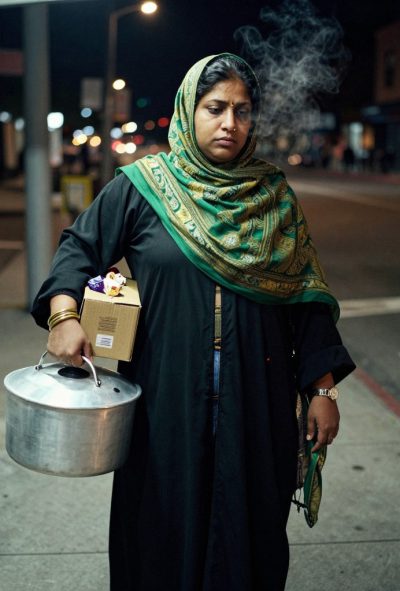
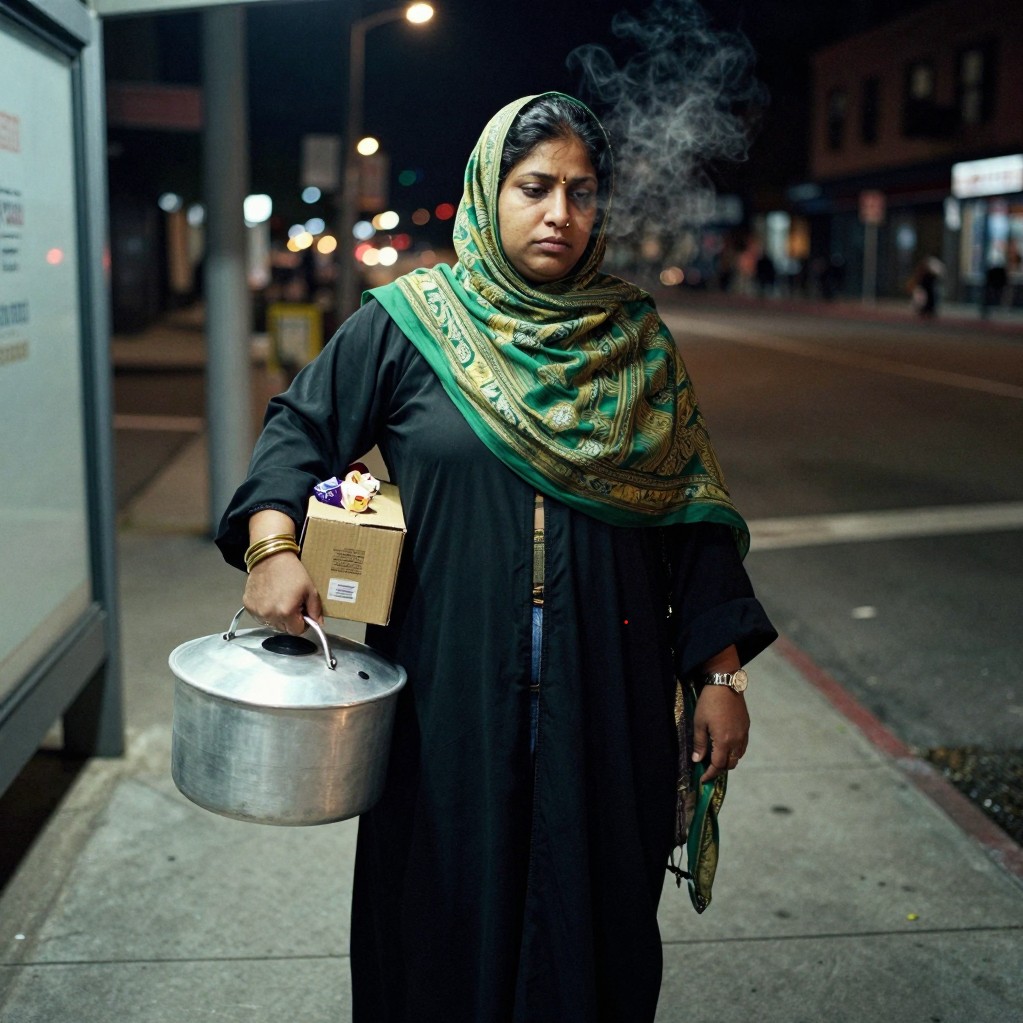
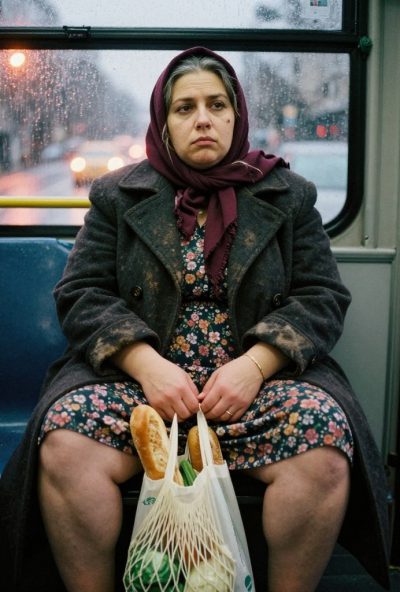
The 155 came down Devon at ten at night full of people with shopping bags, and she got on at Campbell with a pot.
It was one of those big aluminum pots, the kind you make biryani for forty people in, and she had it against her hip with both arms around it, and a cardboard box of sweets balanced on the lid, and a purse hanging off her elbow, and a dupatta that kept sliding off her shoulder, and she was losing the fight on all fronts.
The bus pulled out and she went back two steps and sat down hard in the first seat with the pot in her lap.
“Are you all right?” the driver said.
“Yes. Yes. Sorry.” She had a soft voice, and an accent that had been in this country a long time but had never quite left Lahore.
She was a big woman. Not soft-big — tall and broad, with heavy arms and wide shoulders and a chest and hips that took up more than her seat, and she sat with her knees together and the pot on her lap and her chin down, trying to be smaller, which is a thing big women do all their lives and never once does it work.
Black abaya over jeans, a printed dupatta in green and gold that she had wound twice around her head and then let fall around her neck, gold bangles, a watch with a cracked face, a small gold nose stud. Her face was round and her skin was brown and clear and she had a way of looking up quickly and then looking down again, as if eye contact cost money.
The box slid off the pot at Lawrence and went on the floor.
“I’ve got it.”
“No, no, please—” But I had it, and I put it back on the lid, and she looked at me for about a second and a half and said, “Thank you,” to the pot.
“You want me to hold it? The pot. It’s heavy.”
“It’s fine.”
“It’s sliding.”
“It’s not sliding.” It slid. She caught it with her forearm and shut her eyes. “Okay. It’s sliding.”
I took it. It weighed twenty pounds if it weighed an ounce, and she watched me take it the way you watch somebody pick up your baby.
“Careful, it’s still warm.”
“What is it?”
“Biryani.” She straightened her dupatta. “My cousin’s mehndi was tonight. My aunt made too much. She always makes too much, and then she says, ‘Hina, take it, take it, you’re the only one who eats.'” She stopped. “That’s a joke. In my family that’s a joke.”
“Was it a good mehndi?”
“It was very loud.” A small smile got away from her before she caught it. “There were two hundred people. My aunt hired a DJ and the DJ played the same song four times and my uncle fell asleep in a chair.” She looked at her hands. “I don’t go out much. So. It was a lot.”
“You’re not going home to sleep?”
“I work at six.” She checked the cracked watch. “I’m a pharmacy technician. Night shift. I go home, I change, I go to work.” She said it like a confession. “It’s easier at night. Nobody looks at you at night.”
The bus went past the sari shops and the halal butcher and the restaurant with the neon sign of a goat, and she sat with the box of sweets on her knees and her hands folded on top of it, and she did not say anything else for six blocks, and I could feel her deciding something the whole way.
At Western she said, “You can get off at my stop.”
“What?”
“To carry the pot.” She was looking straight ahead. “It’s four blocks from here and it’s heavy and I’m not going to be able to do it and my mother will see me struggling from the window and then she’ll tell my aunt and then my aunt will call me.” She swallowed. “So. You can carry it, and then you can go. I’m not — I’m not asking you in. I don’t do that.”
“I didn’t think you were.”
“Good.” A pause. “Because I don’t.”
Her building was one of the brick two-flats with a shop on the ground floor that sold phone cards, and there was a light on in the top-floor window with a curtain half drawn, and she looked up at it and made a small sound.
“My mother’s awake. Of course she’s awake.”
We went down the gangway to the basement door and she unlocked it, and the apartment inside was small and warm and smelled like cardamom and clean laundry, and there was a sofa with a crocheted throw and a TV with a prayer channel on it, muted, and a picture of a mosque and a picture of a man in a uniform with a mustache, and a bookcase full of books in Urdu and one shelf of paperback romances with the spines broken.
“Put it on the stove,” she said. “Not the counter. My mother will come down and say the counter is for cutting.”
I put it on the stove. She stood by her own stove with her hands clasped and her head down.
“Thank you,” she said. “You can go now.”
“Okay.”
“You must think I’m strange.”
“I think you carried twenty pounds of biryani across the city on a bus.”
“That’s not —” She laughed and clapped a palm over her lips at once, and her whole face changed when she laughed, it went from a shut door to an open one. “That’s not what I meant.”
“Then what did you mean?”
She looked at the floor. “I meant, you must think I’m strange because I’m thirty-four years old and I can’t talk to a man for ten minutes without telling him about my aunt.”
“I think you’re doing fine.”
“Now you’re being kind.” She said it flatly, not as a compliment. “People are kind to me. Kind is what people are.” She lifted her chin. “Kind is not the same as interested. I know the difference. I’ve had thirty-four years of it.”
“I’m interested,” I said.
She looked at me the way a woman looks at a dog that has just done something clever and unexpected. “No, you’re not.”
“Okay.”
“Don’t say okay like that.”
“You asked me to go, then you told me I wasn’t interested, and now ‘okay’ is the wrong answer.” I picked up my coat off the chair. “I’ll go. It was nice to meet you, Hina.”
“Sit down.”
I sat down.
She stood there with her arms crossed and then she said, “I’m going to make you a plate, because there’s a pot of biryani on my stove and my mother raised me properly,” and she turned around and started doing things with her hands, hard, so she wouldn’t have to look at me.
The kitchen was very small and she was very big in it. She got two plates down and spooned the rice out with the back of the spoon and put a piece of chicken on each one and a spoon of the raita and a piece of the sweet from the box, and she did all of it quickly and neatly and she was blushing the entire time, all the way up her neck and into her ears.
“Here,” she said. “Eat. And don’t say it’s good, say it’s too much salt, my aunt puts too much salt.”
“It’s too much salt.”
“Ha!” She settled opposite me with her own plate, one foot tucked under her and she ate with her fingers, quickly, watching me do the same. “You eat with your hands. Most white men won’t.”
“I’ve eaten before.”
“I can see that.” She tore a piece of chicken. “Where are you from?”
I told her. She nodded and chewed and said, “And you live around here?”
“Not far.”
“Alone?”
“Yes.”
“Hm.” She ate. Then she said, “Don’t read anything into that.”
“I won’t.”
“I’m just asking questions. It’s polite.”
“It’s extremely polite.”
The palm came up over her lips again — not laughing now, hiding. And then she took it away and put it in her lap and said, “I’m sorry. That’s a bad habit. My mother used to slap my hand away from my face. ‘Don’t hide,’ she’d say. ‘You’re not a thief.'” She looked at her plate. “But I am a little bit. I’m hiding all the time.”
Above us the floor creaked, twice, and then a voice came down through the boards, an old woman’s voice, in Urdu, quick and sharp.
Hina answered without looking up. Something short. The voice came again. Hina said, louder, “Ammi, so jao,” and the floor creaked and went quiet.
“She wanted to know who’s down here.”
“What did you tell her?”
“That you’re my friend from work.” She pushed rice around her plate. “She’s going to ask me tomorrow which friend, and I’m going to say the one from the pharmacy, and she’s going to say, ‘Which one from the pharmacy, the tall girl?’ and I’m going to say yes.” She sighed. “I’m thirty-four and I’m lying to my mother about a man at my table, and it’s the most exciting thing that’s happened to me since 2019.”
“You should get out more.”
“I go out.” She said it too fast. “I go to work, I go to my aunt’s, I go to the mosque on Fridays, I go to Patel’s on Saturdays. I go out.”
“That’s not what I meant.”
“I know what you meant.” She set her spoon down. “You meant, why is a woman my age sitting in a basement eating biryani with a stranger at eleven at night. And the answer is, because the stranger carried the pot.” She looked up. “And because when I got on that bus I thought, God, not tonight, not the pot, not again, and then you took it out of my hands.” Her eyes were bright. “And nobody in my whole family has taken anything out of my hands in years. They put things in my hands. That’s all they do.”
The prayer channel flickered. Somewhere in the building a pipe knocked.
“I’m going to say one more thing,” she said. “And then I’m going to clear the plates and you can go, and I’ll see you on the bus sometime, and I won’t be strange about it.”
“Say it.”
“I have never —” She stopped, and started again, and her voice was very low. “In my family I am the big one. The tall one. The one with the good brain and the bad hips. My aunt, God bless her, she says to me at every single wedding, ‘Hina, you’ve gotten bigger,’ like it’s the weather. And there was a boy, once, a long time ago, in Lahore, and he said something to me at a wedding and my cousin told my mother and my mother cried and I have not —” She pressed her lips together. “I’m thirty-four. And no man has ever seen me without my clothes, and I want to say that like it’s a sad thing but it’s not sad, it’s just — it’s a fact, and it’s a fact I’ve been carrying around the city for years like another pot.”
“Then put it down.”
“That’s not how it works.”
“Tonight it is.”
She sat back in her chair. Then she stood and carried the plates over to the basin, and her back was to me, and she said, without turning around, “My mother sleeps with the radio on. She can’t hear anything after eleven.”
“Okay.”
“I’m telling you a fact about my mother, that’s all.”
“Okay.”
“You keep saying okay.'” She turned the water off. “Are you going to sit there all night saying okay, or are you going to come here?”
I came there.
She let me stand in front of her with her hands still in the sink and her head down, and then she turned around and put her wet hands on my chest and looked up, and her face was doing about six things at once.
“I’m not beautiful,” she said.
“Hina.”
“No, listen, I need to say it once so you don’t have to pretend. I’m big, I’m not beautiful, I’m thirty-four, and I’m not going to be one of those women on the television. If this is a thing where you’re being kind, then I’d rather have the plate of biryani and the walk home and nothing else. I would really rather that.”
I put my hands on her waist, where the abaya was tied, and she went still.
“Then it’s not that thing,” I said.
She breathed out, shakily, and said, “Oh,” very quietly, and then she lifted her chin and said, “Take it off me. And don’t be gentle with the pins, my mother’s asleep and I don’t care anymore.”
The pins came out one at a time and she stood very still for it, with her eyes shut, and then the dupatta was off and her hair came down.
It came down and kept coming down. Black, and thick as a rope, and long — past her shoulders, past her waist, down over the big curve of her backside, so heavy it fell straight instead of curling. She had it braided underneath; the braid came apart in my hands and it all spilled out and she made a sound I had not heard from her yet.
“Nobody’s seen it,” she said, into my shoulder. “Not since I was a girl. Not a man. My cousins, my mother. My hairdresser, but she’s sixty.”
I put my hands in it. It was warm from her head and it was heavy and it smelled like coconut oil and like smoke from a kitchen.
“Say something,” she said. “Say something or I’ll die.”
“It’s the most beautiful thing in this apartment.”
“Don’t.” But she was smiling against my shirt. “That’s a very good lie.”
“It’s not a lie. Look at me.”
She looked up. There was wet at the corners of her eyes, her hair all around her face and she looked about twenty years old and about forty at the same time.
“Now the rest,” she said. “And I’m going to say something and you’re going to do it, because I can’t do this with the light off, and I can’t do it with the light on, and I’ve decided to pick one.”
“Pick the light.”
“Turn it off.”
“Hina—”
“Turn it off, and then turn it on again when I’m under the blanket.” She pushed me gently. “I mean it. That’s the deal. That’s how it works for me.”
So I turned the light off and she undressed in the dark — I heard the abaya go over her head, and the zip, and the small clink of the bangles going onto the table — and then she said, “Now,” and I turned the light back on and she was in the bed with the sheet up to her collarbone and her hair spread out over the pillow like ink.
“No looking at my stomach,” she said.
“Okay.”
“I mean it, I’ll know.”
I got on the bed and she watched me with her eyes very wide and her hands holding the sheet. I kissed her and she held on to the sheet the whole time, and then I put my hand on her arm and moved it up under the sheet to her shoulder, and she let me.
“You’re shaking,” I said.
“I’m cold.”
“You’re lying.”
“I’m cold and I’m lying.” She laughed, shakily. “Both. Both are true.”
I got her out from under the sheet slowly, a little at a time, and she let me. Big shoulders, and a soft heavy chest with wide dark nipples, and a belly she immediately tried to cover with her forearm until I took her wrist and moved it away, and thick hips and thighs with pale stretch marks across them like a map, and she lay there and looked at the ceiling with her jaw tight.
“Say it,” she said. “Whatever it is. Say it now so I can stop holding my breath.”
“You’re not what your aunt says you are.”
She turned her head. “What am I?”
“You’re a woman who carries a pot across the city for her cousin and comes home alone.” I put my mouth on her shoulder. “And you’ve got the best hair I’ve ever had my hands in.”
She made a noise like a sob and a laugh at once and then she pulled me down by the ears and kissed me hard, and her hands were not shy anymore.
She was wet before I got near her, and shy about that too, and she said, “Don’t — I’m sorry—” and I said, “For what?” and she said, “I don’t know. For everything. For this. I don’t know how to do this.”
“Then lie back.”
“I don’t want to lie back.” She got a hand on my chest and pushed me over onto my back, which surprised us both. “There. I’ve been lying back my whole life.” She sat up and her hair came over her shoulder and she looked down at me, and there was a moment when the shyness went out of her face entirely and something else came up behind it. “Now you tell me what to do.”
“Come here and sit on me.”
“On—” She looked. “All the way?”
“All the way.”
“In my family—” She stopped herself, and snorted, and covered her lips with her fingers, then pulled them away on purpose. “I was going to say, in my family we don’t do this. But nobody in my family is here.” She got up on her knees, and she was a lot of woman up there with the light on and her hair falling and her thighs wide, and she said, “Help me. I’ll do it wrong.”
She got down on me slowly with one hand braced on my chest and her hair hanging down around us both, and when she was all the way down she stopped and said, “Oh,” and did not move for a while.
“All right?”
“Don’t talk. I’m counting.” She breathed. “One. Two. Three. Okay. Okay, I’m all right.”
She started to move, and she was clumsy at first and then she wasn’t, and the whole bed complained, and she put both hands on my chest and her head went back and her hair swung.
“Nobody told me,” she said, between breaths. “Nobody told me it was like this. My cousins, they tell you nothing. They tell you, be a good girl, be patient, some man will come. And then some man comes and he takes the pot out of your hands on the bus and—” She came down hard and lost the end of the sentence.
Her bangles were on the table and her watch was on the table and there was nothing on her at all now and she was not trying to be smaller. Her thighs worked and her stomach moved and she watched me watch her, and once she said, “You’re looking at me,” not as a complaint.
“You’re worth looking at.”
“Stop it.”
“I’m not stopping.”
She leaned down over me and kissed me with her hair falling on both sides of my face, and then she sat up and said, “I can’t — my hips, I can’t do this much longer,” and I said, “Turn around,” and she said, “Turn around how?” and I said, “On your hands and knees,” and her face did something complicated.
“Like that?”
“Like that.”
“My mother is right upstairs.”
“Your mother’s radio is on.”
“That’s true.” She got off me and got on her hands and knees on the bed and looked back at me with her hair all over one shoulder. “If the bed breaks, we’re both going to have to move to another state.”
The bed did not break but it made a case for itself. She was wide and warm and her back broad and smooth, her shoulders shaking with the effort of holding herself up, and I got a hand in her hair — the whole rope of it, at the back of her neck — and she said, “Yes,” in a register I had not heard from her before.
“Harder,” she said. “I mean it. Don’t be careful. Everybody’s been careful with me my whole life, they think I’ll break, I’m not going to break.”
So I wasn’t careful.
She went down onto her elbows and then flat onto her cheek with her mouth open and one hand up above her head, gripping the edge of the mattress, and she was cursing in Urdu and then in English and then the words ran out, and her whole body locked and she made a long low sound into the mattress and went still.
I stopped. She reached back and grabbed my hip.
“Don’t you dare,” she said, muffled. “Don’t you dare stop now, I’ve been waiting eleven years for somebody to not stop.”
“It’s been eleven years?”
“Not the —” She laughed into the sheet. “I don’t know how many years. It feels like eleven. Keep going and don’t ask me questions.”
I kept going and she took it, and after a while she pushed back and turned over and pulled me down by the shoulders and said, “Now I want to do something and you’re going to let me,” and slid down the bed.
She had never done it. That was obvious in about four seconds, and she was mortified, and she said, “I’m sorry, I’m sorry, tell me—” and I said, “Hina. Slow down. Nobody’s timing you,” and she said, “Everybody’s timing me,” and then she stopped apologising and got to work, and she was a fast learner, and she had her hair in one hand to keep it out of the way.
She came up once and said, “Am I doing it wrong?” and I said, “No,” and she said, “You’re lying,” and went back down.
When I told her, she didn’t pull away. She stayed, and her hand kept going, and afterwards she rocked back onto her heels, palm pressed to her lips, and dropped it and started to laugh, and then she was crying, and then she was doing both.
“Come here,” I said.
“I’m a mess.”
“Come here.”
She lay down on my chest and her hair went everywhere and she said, “I’m going to be so embarrassed tomorrow.”
“Probably.”
“Don’t be nice about it. Let me be embarrassed.” She wiped her face on my shoulder. “I’ve been embarrassed my whole life about the wrong things. Tonight I did something and I’m not even sorry. That’s new.”
At three the floor above us creaked and a voice came down through the boards, and Hina went rigid.
“Ammi?”
The voice said something long and complaining.
“It’s the TV!” Hina called up, in English, loudly. “Go back to sleep!”
A pause. The voice said something short.
“Four o’clock,” Hina said. “She says she wants to know why I’m watching TV at four o’clock.” She buried her face in the pillow and her shoulders shook. “Go to sleep, Ammi. Please. I’ll make parathas in the morning.”
The floor creaked and went quiet.
She lay there and shook with laughter for a while and then she got up, pulled on a robe, and made tea, and stood at the stove with her hair braided again, loosely, and the tea steaming, and she brought two cups to the bed and got in beside me.
“Friday,” she said.
“What’s Friday?”
“My mother goes to my brother’s on Friday. All day. She takes the bus at ten and she comes back at eight and she calls me twice from Skokie to tell me what Bilal’s wife said.” She blew on her tea. “So. Friday. Ten o’clock. And you don’t have to carry anything, there’s nothing to carry, I’m telling you a fact about my Friday.”
“I’ll be here at ten.”
“Bring nothing. My aunt’s pot is still on the stove, there’s food for a week.” She drank her tea and looked at the wall, and then she said, quietly, “In my family, when a man comes to the house, the whole street knows by noon. My mother will find out. My aunt will find out. There’ll be a phone call.”
“Okay.”
“You’re not scared?”
“I’m a little scared of your aunt.”
She laughed, one hand flying up to her lips, and then — deliberately, watching me watch her — she let it drop and let me see her laugh, all of it, with her hair down and the tea going cold and the six o’clock shift coming whether she liked it or not.
“Good,” she said. “You should be.”
Related posts:
 My Bus Adventures #19: Let Down
 My Bus Adventures #15: Four Eleven
 My Bus Adventures #20: Two Flights
 My Bus Adventures #9: The Back Row
 My Bus Adventures #12: Unopened
 My Bus Adventures #8: Night Shift
 My Bus Adventures #2: Window Seat
 My Bus Adventures #16: Two Ways Home
 My Bus Adventures #14: The Debt
 My Bus Adventures #18: Soup
 My Bus Adventures #11: Deep Clean
 My Bus Adventures #3: The Signal
